Written by Urvashi Srivastav · Last reviewed against public vendor sources: July 2026
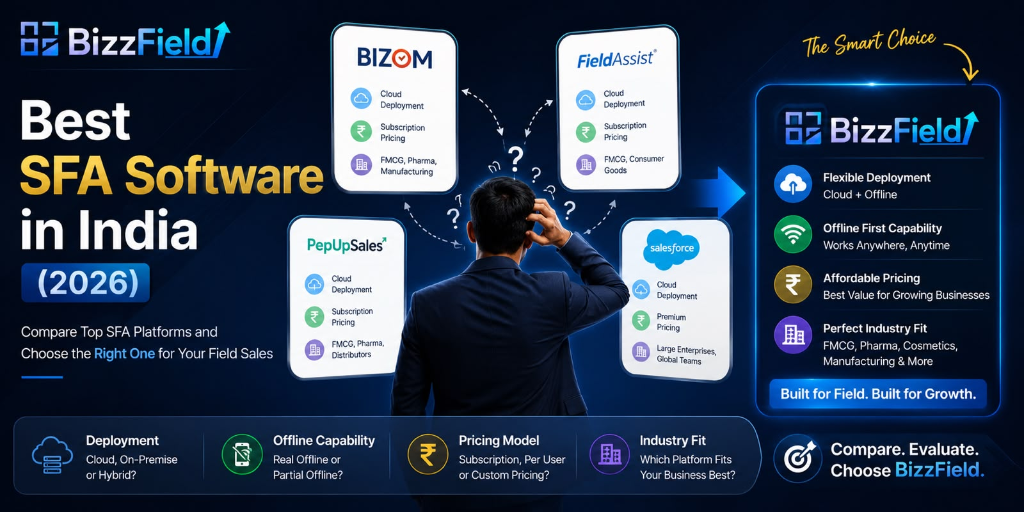
BizzField, Bizom, FieldAssist, PepUpSales and Salesforce compared on deployment, offline capability, pricing model and industry fit.
What a purpose-built platform in this category is expected to do:
- Purpose-built for Indian field sales
- Works offline in low connectivity
- Real-time visibility & insights
- Beat planning, DMS, RCPA & more
The short version
You have sat through four demos this month, and you still cannot tell whether Bizom and FieldAssist are different products or the same feature list in different fonts. Here is what actually separates them.
- There is no single “best” SFA — the right pick depends on industry, team size, connectivity, and your existing DMS/ERP stack.
- Four of the five are purpose-built SFA + DMS platforms for Indian field sales. Salesforce Sales Cloud is a general CRM with SFA-adjacent features layered in, not a field-ops-native product.
- None of the four SFA+DMS platforms publish per-user pricing as of July 2026 — budget for a vendor call to get a quote.
- Rural mobile teledensity (58.16%) is roughly half of urban (125.30%), per TRAI — which is why offline capability, not an “offline mode” checkbox, matters across Tier 2/3 India.
- India’s SFA market is growing at a projected 9.1% CAGR through 2030 (Grand View Research) — an actively expanding category, not a commoditized one.
- BizzField positions on a same-day rollout for 10–200-rep teams. That is BizzField’s own stated positioning, not an independently audited benchmark.
More on cost: what SFA software typically costs in India →
The 2026 shortlist
A starting point, not the whole picture — the sections below explain why the category difference matters more than any single feature row.
Swipe sideways to see every platform.
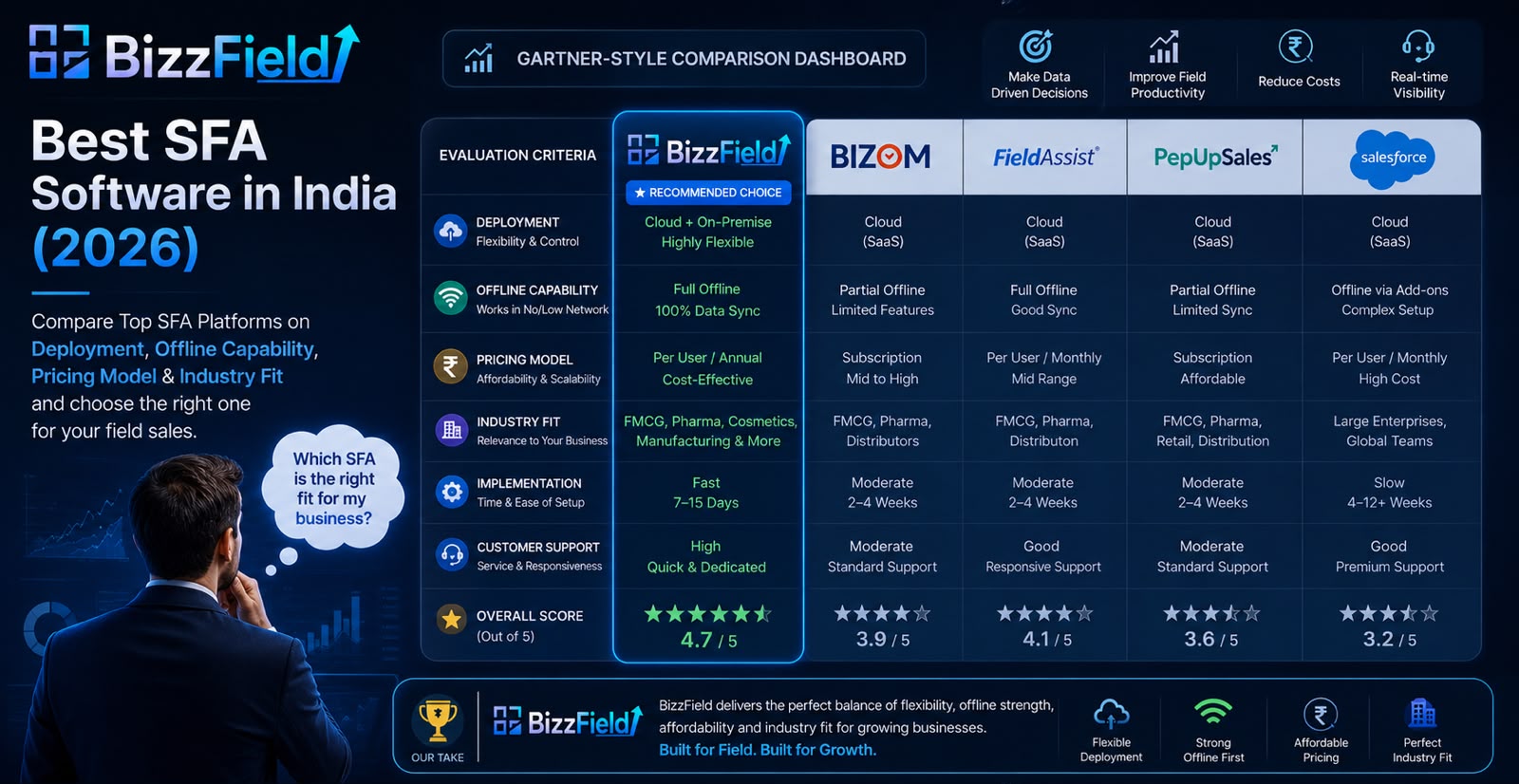
| Platform | Category | Best fit | Deployment | Pricing model |
|---|---|---|---|---|
| BizzField | SFA + DMS, purpose-built | 10–200 reps, FMCG/Pharma/Cosmetics | Same-day (vendor-stated) | Per-user, quote-based |
| Bizom | SFA + DMS, retail intelligence | Large FMCG/CPG field forces | Weeks (custom config) | Per-user, custom quote |
| FieldAssist | SFA + DMS, FMCG-focused | Mid-to-large FMCG, retail execution | Weeks | Per-user, custom quote |
| PepUpSales | SFA + DMS | SMB/mid-market, distribution-heavy | Days to weeks | Per-user, custom quote |
| Salesforce Sales Cloud | Enterprise CRM (not field-ops-native) | Enterprises already on Salesforce | Months (partner typical) | Published USD tiers |
Which category are you actually shopping in?
This is the step most comparison articles skip, and the one that saves you a wasted demo cycle. The Indian SFA market splits into three genuinely different products wearing the same label.
Enterprise CRM platforms. Salesforce, Zoho CRM and Microsoft Dynamics were built for sales pipelines and opportunity management first, field execution second. They can be configured for beat plans and visit tracking, but you are bending a CRM into an SFA shape — usually with an implementation partner, a multi-month rollout, and ongoing customization cost.
Point-tracking apps. GPS and attendance, and little else. Fast to deploy and cheap to start, but most teams outgrow them in 3–6 months once they need beat planning, order booking, or a distributor-side view.
Purpose-built SFA + DMS. BizzField, Bizom, FieldAssist and PepUpSales are built around how Indian distribution actually runs — beat plans, geofenced visits, order-to-distributor sync, secondary sales visibility — as native functionality, not a bolt-on. This is where most of the real competition lives.
Short answer: which one do you actually need?
If field execution — beat plans, geofenced visits, distributor order sync — is your primary need, a purpose-built SFA+DMS platform will get you live faster and cost less to maintain than bending a CRM into that shape. If you are already standardized on a CRM ecosystem and field execution is secondary, the CRM route can still make sense despite the longer setup. If your need is genuinely just attendance and GPS, a point-tracking app is fine — until beat planning or distributor visibility become a requirement, which most teams hit within two quarters.
Not sure which fits? See our SFA buying guide for the questions to ask before any demo.
The five platforms, one at a time
Each profile carries the same four facts up front — category, best fit, deployment and pricing model — so you can compare like for like.
BizzField
- Category: SFA + DMS, purpose-built
- Best fit: 10–200 reps, FMCG/Pharma/Cosmetics
- Deployment: Same-day (vendor-stated)
- Pricing: Per-user, quote-based
A purpose-built SFA + DMS platform for 10–200-rep FMCG, Pharma and Cosmetics teams that want to be live in days, not months. Where it is not the right fit: teams north of a few hundred reps with dedicated IT resourcing for deep custom workflows may want to also evaluate Bizom or FieldAssist’s enterprise configurations.
Built for the 10–200 rep range specifically — FMCG, Pharma, Cosmetics and distribution-heavy teams who need selfie+GPS attendance, auto-generated beat plans, live order sync via Distribution Management, and an AI layer (BizzGuru) that flags coverage gaps and at-risk outlets. Works offline, syncing when signal returns.
BizzField states a same-day rollout on its own site. Independent, third-party-verified rollout benchmarks are not published, so treat that as a vendor claim to confirm in your own demo.
Bizom
- Category: SFA + DMS, retail intelligence
- Best fit: Large FMCG/CPG field forces
- Deployment: Weeks (custom config)
- Pricing: Per-user, custom quote
One of India’s most established SFA platforms for large FMCG field teams, particularly strong in retail execution analytics.
Run by Mobisy Technologies. Strong in retail-execution analytics — planogram compliance, shelf-share tracking — and serves a wide industry spread including alcobev, telecom, and pharma alongside FMCG. Pricing is not published; expect a custom quote and a longer, more configuration-heavy rollout than a purpose-built SMB platform, which tracks with its enterprise/large-CPG customer base.
FieldAssist
- Category: SFA + DMS, FMCG-focused
- Best fit: Mid-to-large FMCG, retail execution
- Deployment: Weeks
- Pricing: Per-user, custom quote
A VC-backed, FMCG-focused SFA brand particularly strong in retail execution for large consumer brands.
One of the more recognized Indian SFA brand names. Like Bizom, pricing is quote-based and implementation is proportionate to enterprise scale — built for large field forces with the internal resourcing to run a longer configuration cycle.
PepUpSales
- Category: SFA + DMS
- Best fit: SMB/mid-market, distribution-heavy
- Deployment: Days to weeks
- Pricing: Per-user, custom quote
An SMB/mid-market SFA + DMS platform positioned on ease of use and adoption speed.
Positions itself toward SMB and mid-market distribution teams, with a stated focus on ease of use and adoption speed over deep enterprise customization. Closer in target segment to BizzField than Bizom or FieldAssist are, which makes the two worth comparing directly if you are a growing brand rather than an established national one.
Salesforce Sales Cloud
- Category: Enterprise CRM (not field-ops-native)
- Best fit: Enterprises already on Salesforce
- Deployment: Months (partner typical)
- Pricing: Published USD tiers
A general-purpose CRM with SFA-adjacent features layered in — not a field-sales-native product.
Publishes per-user pricing tiers (in USD, which matters for INR-budgeted Indian teams). The case for Salesforce is strongest when your organization is already standardized on the Salesforce ecosystem for other functions and wants one platform, not when field execution — beat plans, geofenced visits, distributor sync — is the primary need.
- Read the full BizzField vs Bizom comparison
- Read the full BizzField vs FieldAssist comparison
- Read the full BizzField vs PepUpSales comparison
- Full BizzField vs Salesforce comparison — coming soon
Feature matrix
Eight capabilities that actually differ between these platforms — not the table-stakes list every vendor deck repeats.
| Feature | BizzField | Bizom | FieldAssist | PepUpSales | Salesforce |
|---|---|---|---|---|---|
| Selfie + GPS attendance | Yes | Yes | Yes | Yes | Not native |
| Auto-generated beat plans | Yes | Yes | Yes | Yes | Not native |
| Built-in DMS (distributor sync) | Yes | Yes | Yes | Yes | Not native |
| Offline-first (works with zero signal) | Yes | Partial* | Partial* | Partial* | Not native |
| Native AI agent (coverage/churn alerts) | Yes (BizzGuru) | Analytics-led | Analytics-led | Not publicly stated | Add-on (Einstein) |
| Public pricing | Quote-based | Quote-based | Quote-based | Quote-based | Published (USD tiers) |
| Typical deployment | Same-day (vendor-stated) | Weeks | Weeks | Days–weeks | Months |
| Built for | SMB–mid-market | Large FMCG/CPG | Large FMCG | SMB–mid-market | Enterprise, cross-function |
*Offline capability is claimed by most platforms in this category; the meaningful difference is what functions work offline versus sync-only. Verify against your own Tier-2/3 coverage areas during a demo rather than the feature list alone.
Rural versus urban wireless teledensity in India (February 2025), per TRAI data reported by the Press Information Bureau. A beat plan or order that cannot be captured without signal does not get captured at all across large parts of rural India — which is the case for offline-first architecture, not an offline “mode.”
India’s SFA software market grew from USD 428.5M in 2023 toward a projected USD 786.5M by 2030 (Grand View Research). Fortune Business Insights reports field force automation improves sales productivity and reduces administrative workload. Category-level third-party observations — not claims about any vendor here.
Which one should you actually shortlist?
- Growing FMCG, Pharma or Cosmetics brand. 10–200 reps, want to be live this month — BizzField or PepUpSales
- National or multinational CPG brand. Established IT team, months to configure — Bizom or FieldAssist
- Already running Salesforce company-wide. Want one platform for everything — Salesforce Sales Cloud
- Team under 20 reps. Tracking-only need for now — A point-tracking tool — for now
Under 20 reps? A tracking tool may be enough short-term — but revisit this list once you need beat plans or distributor visibility, which most teams do within two quarters.
Pricing and offline capability
The two questions everyone asks.
How much does SFA software cost in India?
Four of the five — BizzField, Bizom, FieldAssist and PepUpSales — use custom, quote-based pricing rather than a published rate card. Salesforce is the exception, with per-user tiers in USD. Your cost depends on team size and which modules (DMS, AI layer, ERP integration) you need. Ask every vendor for an all-in 12-month cost, not the headline per-user rate.
Which SFA software works offline?
Of the five, BizzField is the only one that states full offline-first functionality — check-in, order booking and form submission all work with zero signal, syncing when connectivity returns. Bizom, FieldAssist and PepUpSales each claim some offline mode; the meaningful difference is which actions work offline versus which just show cached data. Confirm that distinction directly with each vendor.
10 questions to ask before you sign
Whichever platform you shortlist, ask every vendor these. The answers matter more than the feature list.
- Deployment: What is the realistic go-live date for a team our size, not the best-case number in the deck?
- Offline capability: Which specific actions (check-in, order booking, form submission) work with zero signal, and which just show cached data?
- Support: Is support included in the license, or a paid add-on? What is the response-time commitment during a field outage?
- Pricing: What is the all-in cost per user for 12 months, including onboarding and per-module add-ons — not just the headline rate?
- Distributor sync: Does distributor/DMS integration ship as a native module, or is it a custom build billed separately?
- Customization: What can we configure ourselves (forms, beat rules, reports), and what requires a vendor ticket?
- Reporting: Can a regional manager get the reports they need on a phone, or does reporting require a laptop and a separate login?
- ERP integration: Is the ERP sync two-way and near-real-time, or a periodic export/import?
- Mobile app: Can we test the rep-facing app ourselves, on our own devices, before committing — not just watch a demo?
- Scalability: What breaks, or gets slower, as we go from our current team size to 2–3x that size?
See our full buying guide → for the longer version of this checklist.
Common mistakes when buying SFA software
- Buying CRM instead of SFA: A CRM can be configured to look like an SFA platform in a demo. The gap shows up three months in, when beat planning and geofenced visits still need a customization ticket.
- Ignoring offline capability: Every vendor says “offline mode.” What matters is which specific actions work with zero signal — ask before you sign, not after your first outage.
- Comparing only on price: The cheapest per-user rate can hide a longer implementation timeline, a thinner support tier, or DMS as a paid add-on rather than a native module.
- Ignoring implementation effort: A platform that is cheap to license but takes three months and an internal project team to configure is not the cheaper option once you count the time.
- No distributor integration plan: If your DMS and SFA do not talk to each other natively, someone on your team becomes the manual bridge between them — indefinitely.
- Not testing with actual reps: A platform that looks clean in a sales demo can still be confusing on a low-end Android phone with patchy signal — the real device and conditions.
- No reporting validation: Confirm a regional manager can get the report they need, on the device they will actually use, before go-live — not after the first monthly review.
- Choosing too many features: Prioritize depth on beat planning, attendance, order booking and distributor sync over breadth on features you may never turn on.
About this page
Written by Urvashi Srivastav and reviewed by our Product & Customer Success team, who work daily with live rollouts across the 10–200-rep segment this page covers.
We are BizzField — one of the platforms listed here. Based on public information as of July 2026 from vendor websites, G2 & Capterra.
How we built this comparison
We are BizzField, and we are one of the five platforms featured on this page. Like any vendor-authored comparison, this guide is intended to help you understand the market, but we encourage you to verify important details independently. Every competitor claim is based on publicly available information from the vendor’s official website, public pricing pages, or public G2 and Capterra listings, reviewed as of July 2026. Where a company does not publish pricing, we state “custom quote” rather than estimating.
Product features, pricing, deployment timelines and availability change over time. While we make reasonable efforts to keep this accurate, verify the latest information directly with each vendor before making purchasing decisions. If you notice anything inaccurate or outdated, let us know and we will review it.
Editorial, fact-check and testing policy
Editorial policy: We write comparison content as a vendor with a stake in the category — see the disclosure at the top of this page. Every competitor claim is sourced from that vendor’s own public materials, we mark anything we cannot independently verify, and we correct errors when readers flag them.
Fact-check policy: Every competitor claim is sourced from that vendor’s own website, pricing page, or public G2/Capterra listing, dated as of the month noted. We do not use unverified competitor statistics.
Product testing methodology: Deployment timelines, offline behavior and feature claims for BizzField are based on our own product and customer rollout data. Competitor claims are based on public vendor materials, not hands-on testing — labeled accordingly rather than presented with the same confidence as our first-party data.
Last reviewed: July 2026. Pricing, deployment claims and competitor details go stale fastest and are checked first at every review. Learn more about BizzField →
Sources & further reading
- BizzField homepage — product claims and rollout time cited above.
- How to Choose the Right SFA Software in India — the category framework this page builds on.
- What Is a Distributor Management System (DMS) in 2026?
- What Is Beat Planning in FMCG Sales?
- How Much Does SFA Software Cost in India? 2026 Guide
Trademark notice
BizzField, Bizom, FieldAssist, Salesforce, PepUpSales, Zoho CRM, Microsoft Dynamics and other product or company names mentioned on this page are trademarks or registered trademarks of their respective owners. They are used solely for identification, comparison and informational purposes. Their inclusion does not imply endorsement, sponsorship or affiliation with BizzField.
See it on your own data
Comparison pages only get you so far. The real test is whether your team uses it on a Tuesday morning with three outlets offline and a distributor asking where an order went.
Book a 15-minute walkthrough of BizzField on your own beats, outlets and reps — and judge it against the four platforms above yourself. A walkthrough on your own data — no slide deck.
Deeper reading: What is a Distributor Management System (DMS)? · What is beat planning in FMCG sales?
Ready to narrow it down?
Book a demo — or read the head-to-head breakdowns: BizzField vs Bizom and BizzField vs FieldAssist.
Frequently asked questions
SFA (Sales Force Automation) manages field execution — rep attendance, visits, and order capture. DMS (Distributor Management System) manages what happens after the order: distributor stock, secondary sales, and channel visibility. Most Indian teams eventually need both, which is why platforms like BizzField, Bizom, and FieldAssist bundle them rather than selling them separately.
Salesforce is a strong CRM, but it is not built natively for field execution — beat planning, geofenced visits, and distributor order sync require customization rather than out-of-box functionality. It fits best for teams already standardized on Salesforce elsewhere.
Most platforms in this category — including BizzField, Bizom, FieldAssist, and PepUpSales — use custom, quote-based pricing rather than published rates, so “cheapest” depends on team size and modules needed. Ask every vendor for an all-in 12-month cost, not just the per-user headline rate.
It depends on category. Purpose-built SFA+DMS platforms sized for SMB/mid-market teams (like BizzField, by its own stated rollout time) typically deploy fastest. Enterprise-configured platforms and CRM-based approaches (Salesforce) commonly take weeks to months depending on customization scope.
Not if your SFA platform includes distributor management natively — check whether “DMS” is a real module or just an order-export feature.
It depends on team size. For 10–200-rep teams that want a faster rollout and lower configuration overhead than Bizom’s enterprise-first model, BizzField and PepUpSales are the closer fit. For large, multi-region field forces already used to a longer implementation cycle, Bizom’s depth may still be worth the trade-off. See our full BizzField vs Bizom comparison for a module-by-module breakdown.
Neither is universally “better” — they are built for different scales. FieldAssist is FMCG-focused and configured for large field forces with dedicated IT resourcing; BizzField is built for the 10–200-rep range across FMCG, Pharma, and Cosmetics with a faster, lower-touch rollout. The right pick depends on your team size and how much configuration time you can spend before go-live.
BizzField uses per-user, quote-based pricing — like Bizom, FieldAssist, and PepUpSales, it does not publish a rate card. Book a demo to get a quote against your team size and modules.
BizzField offers a live, guided demo on your own data (BizzField describes this as roughly 15 minutes). The public site does not state a self-serve free trial as of July 2026, so confirm current trial availability directly with the sales team when you book a demo.
Beat planning is the practice of assigning each field rep a fixed, repeating route of outlets to visit on specific days — the “beat.” A good SFA platform auto-generates these routes from outlet location and visit-frequency rules, rather than leaving reps to plan their own day.
Geo attendance (also called selfie+GPS attendance) verifies where a rep checks in and out from, usually with a location-stamped selfie at the first outlet of the day. It replaces manual attendance registers and gives a manager a location-verified record of whether the team is actually in the field, not just marked present.
Geo fencing draws a virtual radius around an outlet’s registered location. A rep’s visit only counts as valid if their check-in falls inside that radius, which stops “drive-by” or desk check-ins from being logged as completed visits. It is the mechanism that makes beat-plan compliance data trustworthy rather than just self-reported.
RCPA is a pharma-specific field activity where reps audit chemist and pharmacist outlets for stock availability, competitor presence, and prescription trends, then log it against the outlet. It is one of the reasons pharma field teams need SFA software with configurable audit forms rather than a generic visit-logging tool.
Yes, if the platform is genuinely offline-first — meaning reps can check in, log visits, and book orders with zero signal, with data queued locally and synced automatically once connectivity returns. Not every platform that lists “offline mode” works this way; confirm which behavior a vendor means during the demo, especially if your team covers Tier 2/3 towns.
Most purpose-built SFA+DMS platforms offer ERP integration so orders captured in the field sync into finance and inventory systems without manual re-entry. Ask specifically whether it is a native two-way sync or a periodic export/import, since that affects how current your inventory and finance data actually are.
Yes — pharma field teams have specific needs beyond standard FMCG SFA, including RCPA, doctor/chemist call reporting, and stricter audit trails for compliance. Confirm a platform supports configurable audit forms and doctor-call workflows natively rather than as a custom add-on.
CRM (Customer Relationship Management) is built around sales pipelines, opportunities, and account relationships — oriented toward closing deals. Distributor management (DMS) is oriented toward what happens after the order: distributor stock, secondary sales, and channel-wide visibility. A field sales team usually needs both.
Yes — van sales (where a rep sells and delivers stock directly from a vehicle) needs a few things beyond standard SFA: real-time stock tracking per van, on-the-spot order/invoice capture, and load-out/load-in reconciliation. Confirm this is a real, named capability during the demo rather than assuming standard order-booking covers it.
WRITTEN BY
Urvashi Srivastav
VP, Business Management & Client Relationships
VP at BizzField, working across business management and client relationships — building strong partnerships, streamlining operations and driving business growth.
Connect on LinkedIn