
Written by Urvashi Srivastav · Last verified against both vendors’ websites: August 2026
Most teams don’t go looking for a FieldAssist alternative because something broke.
They go looking because something changed. The field team went from 25 reps to 70. A new vertical came in with a beat structure the current setup wasn’t built for. Or the renewal quote landed on the CFO’s desk and someone asked the uncomfortable question: what are we actually paying for here?
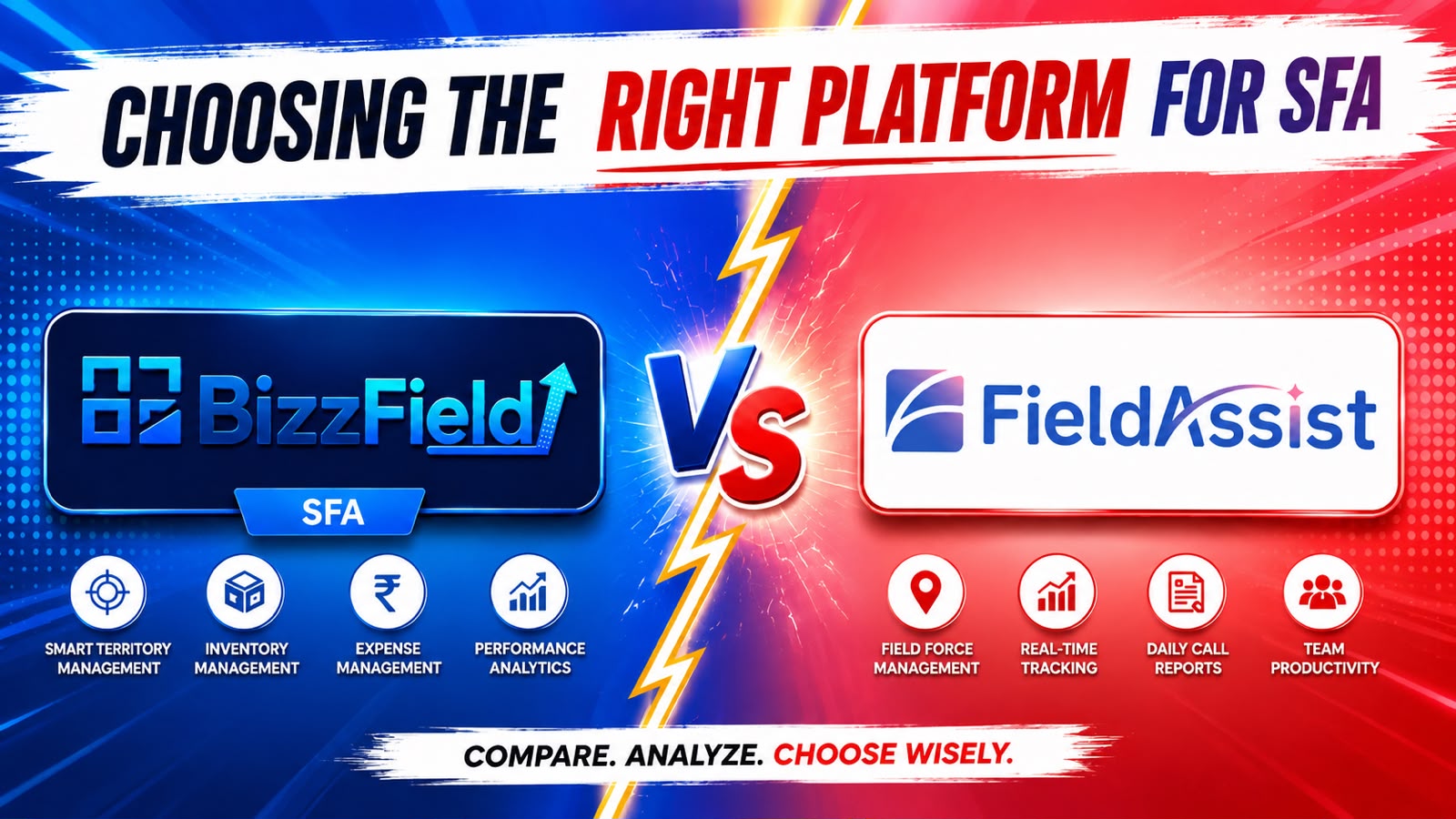
If that’s roughly where you are, this is a straight comparison of BizzField and FieldAssist.
One disclosure before we start: we build BizzField. You should read this the way you’d read any vendor’s comparison page — with your guard up. What we can do is make that guard unnecessary, by being specific about where FieldAssist is genuinely the stronger option. You’ll find those things out on the demo call anyway. Better you hear them here.
The short answer
FieldAssist is the larger platform. It publishes 190K+ users, 8.9mn+ outlets and operations across 32+ countries on its own website, along with a wide add-on portfolio — van sales automation, retail image recognition (IRIS), modern trade merchandising (ModMart) and rural distribution. BizzField is a newer, India-focused SFA + DMS platform built for growing FMCG, pharma, cosmetics, agriculture, electronics, textile and building-material teams that want one system, a fast rollout, and pricing scaled to a smaller field force.
If you’re running a multi-country operation with 500+ reps and need image-recognition-based shelf audits, FieldAssist is the safer shortlist entry. If you’re 10–200 reps in India, digitising for the first time or replacing something that’s become heavier than your team, BizzField is worth a look.
Everything below is drawn from bizzfield.com and fieldassist.com as published at the time of writing. Neither vendor’s self-reported statistics have been independently audited — including ours.
Why teams start looking for a FieldAssist alternative
In our conversations with buyers switching or shortlisting, the same five triggers come up again and again.
The team size and the platform stopped matching. Software architected for a 500-rep, multi-country FMCG operation carries structure a 40-rep regional distributor doesn’t need — more configuration, more admin roles, more implementation. That’s not a flaw in the software. It’s a mismatch.
The renewal forced a real TCO conversation. Neither BizzField nor FieldAssist publishes pricing, so we’re not going to pretend to know what you’re paying. But renewals are when finance starts counting modules nobody logs into.
Module sprawl. Broad portfolios are an advantage until you’re licensing merchandising, loyalty and incentive modules for a business that mainly needs beat plans, secondary sales visibility and a distributor portal that works.
Vertical fit. Agri-input, electricals and building-material dealer networks have scheme logic and beat rhythms that don’t behave like biscuits and shampoo. Coverage depth in your vertical matters more than the length of a vendor’s industry list.
First-time digitisation. A lot of searches for “FieldAssist alternative” aren’t from FieldAssist customers at all. They’re from teams moving off WhatsApp and Excel, who found FieldAssist first and now want a second name to compare it against. That’s just good procurement.
BizzField vs FieldAssist at a glance
| Capability | BizzField | FieldAssist |
|---|---|---|
| Headquarters | Kanpur, Uttar Pradesh | Gurugram, Haryana |
| Core platform | SFA + DMS, natively combined | SFA + DMS, natively combined |
| Offline order booking | Offline-first with auto-sync | Offline with auto-sync |
| GPS + selfie attendance | Yes | Yes |
| Beat planning | Auto-generated routes | Marketed as AI-driven |
| Distributor management (DMS) | Yes | Yes |
| Primary / secondary / tertiary tracking | Yes | Yes |
| Scheme & trade promotion management | Yes | Yes |
| Named AI layer | BizzGuru AI — coaching, forecasting, churn alerts, morning brief | FAi Suite, Pulse AI, NOVA (agentic), IRIS (image recognition) |
| Van sales automation | Not published as a named module | Dedicated product |
| Retail image recognition | Not published | IRIS |
| Rural distribution module | Not published | Rural Automation |
| Geographic footprint | India-focused | 32+ countries (vendor-stated) |
| Published scale | 10+ FMCG teams live (vendor-stated) | 8.9mn+ outlets, 190K+ users, 75K+ distributors (vendor-stated) |
| Industries with dedicated pages | FMCG, pharma, cosmetics, agriculture, electronics, textile & apparel, building materials | FMCG, consumer durables, cosmetics, footwear, apparel, building material, pharma & OTC, stationery, auto parts |
| Pricing | Quote-based | Three tiers (Starter, Business, Enterprise AI), all quote-based |
| Stated rollout time | 24-hour rollout (vendor-stated) | Not published |
Where a cell says not published, it means the vendor doesn’t state it on its public site. It does not mean the capability is missing. Ask both vendors directly.
Where the two platforms are basically the same
This is the part most comparison pages skip, and it’s the part that saves you the most time.
Core sales force automation is, in 2026, a solved problem. Both platforms do GPS and selfie-verified attendance, geofenced check-ins, auto-generated beat plans, digital order booking against a live catalogue, offline capture with sync-on-reconnect, distributor dashboards, scheme engines, expense claims, DCR automation and manager dashboards. Both have a named AI layer. Both have mobile apps their reps use daily in Tier 2 and Tier 3 markets.
If a vendor — us included — tries to sell you GPS attendance as a differentiator, be skeptical. It’s table stakes.
So don’t burn your evaluation on a feature-by-feature checklist where 80% of the rows will say “yes” on both sides. Spend it on the four things that actually diverge.
Where BizzField and FieldAssist actually differ
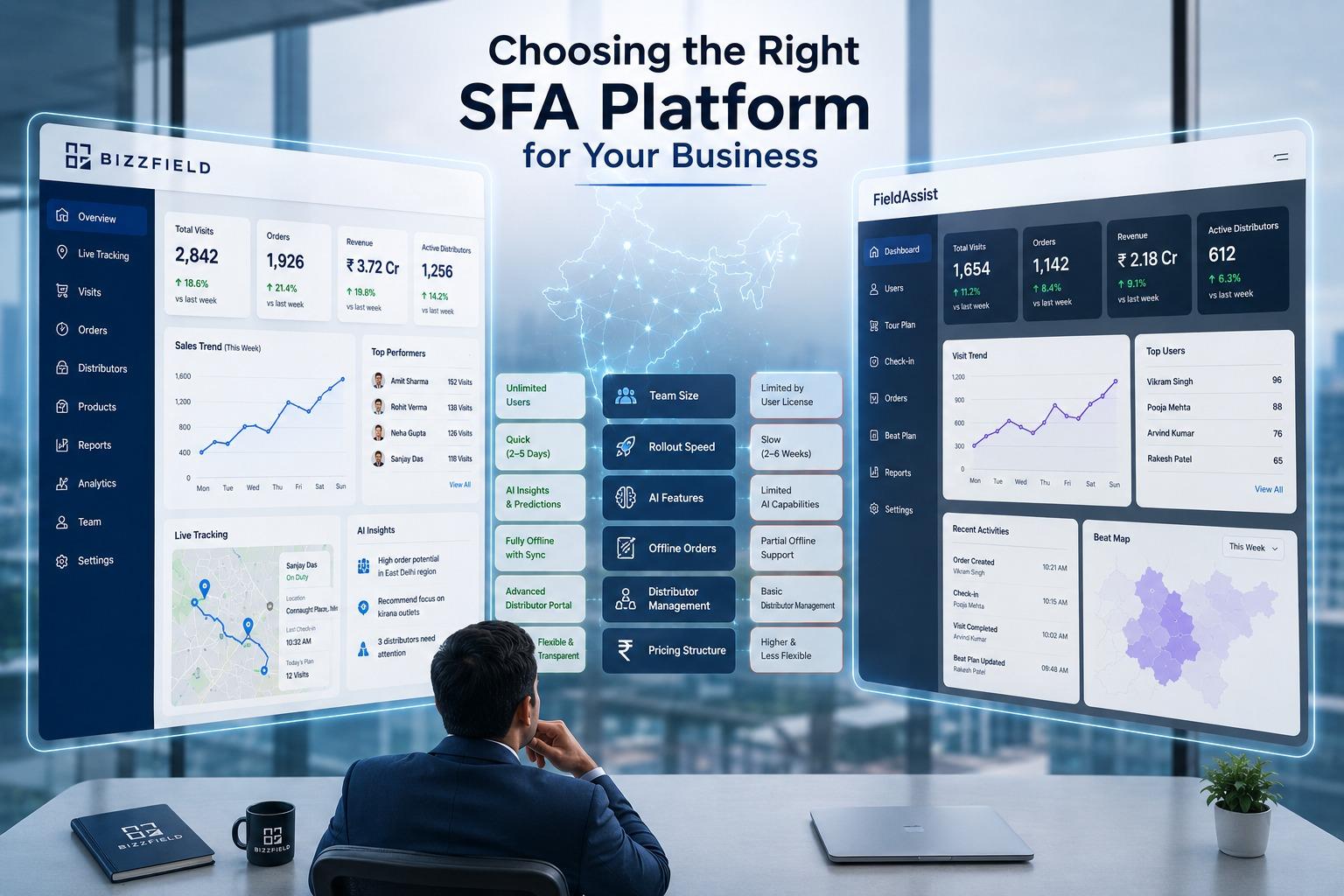
1. Scale and geography
FieldAssist publishes operations in 32+ countries and maintains dedicated pages for Africa and Indonesia. Its case studies reference large multinational brands. BizzField is built and sold for the Indian market, and our published FMCG customer base is 10+ teams.
That difference cuts both ways. If your five-year plan includes Southeast Asia or East Africa, a vendor that has already done those rollouts removes real risk. If you’re India-only and likely to stay that way, multi-country architecture is capability you’ll pay to carry and never use.
2. Module breadth
FieldAssist’s portfolio extends well past core SFA and DMS: van sales automation, ModMart for modern trade merchandising, IRIS for image-recognition shelf audits, a retailer EB2B ordering app, loyalty management, incentive management, an integration platform (FAIS) and rural automation.
BizzField’s approach is narrower on purpose — one platform covering attendance, beat planning, order booking, DMS, merchandise management, inventory, schemes, expenses and the BizzGuru AI layer, without a separately-branded product for each.
If planogram compliance scored by image recognition is a must-have — which it genuinely is for some modern-trade-heavy FMCG businesses — FieldAssist has a named product for it and we don’t publish one. That’s a real gap, and you should weigh it as one.
3. Who the product is designed around
FieldAssist’s tiering (Starter, Business, Enterprise AI) and its enterprise case studies point at large, structured sales organisations with internal IT capacity and procurement processes to match.
BizzField’s positioning is explicitly the other way — growing FMCG, pharma, cosmetics and distribution teams, marketed against what we describe as “enterprise complexity” and against ₹3–5L/year enterprise contracts in the broader market. That’s our comparative claim about the category, not a statement about FieldAssist’s pricing, which isn’t public.
Practically, this shows up in how much internal effort a rollout takes and how much of the platform you have to configure before it’s useful to a rep on day one.
4. Rollout speed and who you end up talking to
BizzField states a 24-hour rollout on its site. FieldAssist doesn’t publish implementation timelines. Neither vendor publishes support SLAs, which is a genuine transparency gap on both sides — and one you should close in writing before signing anything.
The softer version of this difference: with a smaller vendor you’re likelier to reach someone who can change something. With a larger one you’re likelier to reach a structured support process that doesn’t depend on any individual. Both are legitimate preferences. Know which one you have.
So which one should you pick?
Pick FieldAssist if:
- You operate in multiple countries, or expect to within two years
- Image-recognition shelf audits or planogram compliance scoring is non-negotiable
- Van sales / direct store delivery is a core route-to-market
- You have a rural distribution network needing dedicated workflows
- Procurement requires a long list of comparable enterprise references
Consider BizzField if:
- You’re India-focused with roughly 10–200 field reps
- You want SFA and DMS in one system rather than assembled from modules
- You’re in FMCG, pharma, cosmetics, agriculture, electronics, textile or building materials
- Speed to go-live matters more than breadth of optional modules
- You’re digitising for the first time and need something reps adopt without long training
And the honest caveat: FieldAssist’s published customer base is far larger than ours. If a deep reference list is a procurement requirement, that’s a gap we can’t argue away today. Ask us for references in your specific vertical and judge from those.
Is there a cheaper FieldAssist alternative for SMBs?
Nobody can answer this honestly from public information, including us. Neither vendor lists prices. FieldAssist’s three tiers all end at “Request Pricing”; BizzField’s pricing is quote-based too.
What you can do is force both quotes into the same shape before comparing them:
- Licensing — per user, flat, or tiered? What triggers a tier upgrade, and what does it cost when it does?
- Modules — is DMS included, or priced separately from SFA? Which AI features sit behind which tier?
- Implementation — is onboarding, data migration and configuration included or billed?
- Training — are rep and manager training bundled, and what does a refresh cost in year two?
- Customisation — what does a custom scheme rule or report cost after go-live?
- Support — what’s included by default, and what does priority support cost?
- Growth — model the total at your current rep count and at 2x. The gap between vendors often inverts.
A three-year TCO on the same rep count is the only comparison that means anything. A per-user headline price isn’t. For market context before you ask, see our guide to SFA software pricing in India.
What switching from FieldAssist actually involves
The software migration is the easy part. The data is where projects slip.
Outlet master cleanup is the real work. Every SFA system accumulates duplicate outlets, dead retailers, wrong GPS pins and stale credit terms. Migration surfaces all of it at once. Budget more time here than anywhere else — and treat it as a one-time cleanup you’d benefit from regardless of which platform wins.
Sales history needs a decision, not just an export. Decide upfront how many months of order and scheme history you actually need live in the new system versus archived. Pulling three years of transactions you’ll never query slows everything down.
Distributors have to be re-onboarded. They’re using a portal or app today. Every one of them needs credentials, a walkthrough and a reason to care. This is the step most likely to cause an order gap in week one.
Reps need retraining regardless of how intuitive the app is. Both vendors describe their apps as easy. Both are still a change to a daily habit. Plan for a fortnight of dip.
Run one full cycle in parallel. Old and new systems together for one complete beat cycle, then cut over. It costs a few weeks of duplicate effort and it’s cheaper than a month of missing secondary sales data.
Stagger by region. One state or one distributor cluster first. Fix what breaks. Then expand.
Ask both the outgoing and incoming vendor — in writing — what migration support is included. “We’ll help you migrate” is not a scope.
Questions to ask on both demo calls
Take the same list to both vendors. The comparison only works if the questions are identical.
- Show me a beat plan built from our outlet list, not a demo dataset.
- Put the app in airplane mode, book three orders, then reconnect. Show me the sync.
- How is a slab-based scheme with a free-goods component configured — and can we do it ourselves?
- Show me the report a regional sales manager opens first thing on Monday.
- What exactly does primary vs secondary vs tertiary tracking look like when a distributor doesn’t share data on time?
- What’s the ERP integration path — native connector, API, or middleware — and who builds it?
- What is the implementation scope, in weeks, for our rep count and outlet count?
- Who supports us after go-live, what’s the response time, and is that in the contract?
- What are the top three reasons customers of our size have churned?
- Can we speak to two references in our industry, at our scale?
- What does our cost look like at double the current field team?
- What happens to our data if we leave — format, timeline, cost?
Question 9 is the one that separates vendors. Anyone who says “none” isn’t being straight with you.
See it against your own data
The fastest way to end a comparison is to stop reading comparisons.
Bring your outlet list, one real beat plan and your messiest scheme rule. We’ll run BizzField against them in about 15 minutes — and if the fit isn’t there, we’ll tell you.
Still shortlisting?
Book a demo — or read the full Best SFA Software in India comparison if you’re still building your list. Already looking at Bizom? We have a BizzField vs Bizom comparison too.
Frequently asked questions
There isn’t a single best one — it depends on team size, industry and geography. BizzField is worth evaluating if you’re an India-focused FMCG, pharma, cosmetics, agri or distribution business wanting SFA and DMS combined. Bizom and PepUpSales are other India-based options commonly shortlisted alongside.
For core SFA and DMS use cases in India, yes — both cover attendance, beat planning, order booking, offline capture, distributor management and scheme handling. For van sales automation, retail image recognition and multi-country deployments, FieldAssist publishes dedicated capability that BizzField currently does not.
Yes. BizzField is built offline-first: reps capture attendance, visits and orders without connectivity, and data syncs automatically when the network returns. This matters most in Tier 2 and Tier 3 beats where coverage drops mid-route.
No. FieldAssist lists three tiers — Starter, Business and Enterprise AI — but all three require a quote request. No price points are published. BizzField’s pricing is also quote-based. Request written quotations from both, scoped to the same rep count and module list.
FieldAssist’s website states 32+ countries, with dedicated pages for Africa and Indonesia. This is a vendor-published figure, current at the time of writing.
That’s the segment it’s built for. BizzField positions itself against enterprise complexity and targets growing field teams rather than large multinational deployments. Whether it fits your business depends on your vertical and module requirements — confirm on a demo using your own data.
Export outlet master and order history, clean duplicate and dead outlets, re-onboard distributors to the new portal, retrain reps, run both systems in parallel for one full beat cycle, then cut over region by region. Get the migration scope in writing from both vendors first.
Yes. BizzField’s Distribution Management System covers order intake through delivery, purchase orders, distributor dashboards, claims and scheme management, and primary, secondary and tertiary sales visibility.
Both target FMCG as a core vertical. FieldAssist has the deeper enterprise FMCG reference list and dedicated modern-trade merchandising. BizzField is oriented toward growing FMCG teams wanting faster rollout and a single combined platform. The deciding factor is usually scale, not features.
Three-year total cost at your actual rep count, offline reliability tested on your own routes, scheme configuration flexibility, distributor workflow depth, reporting your managers will actually open, implementation scope in weeks, and contractual support response times.
WRITTEN BY
Urvashi Srivastav
VP, Business Management & Client Relationships
VP at BizzField, working across business management and client relationships — building strong partnerships, streamlining operations and driving business growth.
Connect on LinkedIn