

It's the 20th of the month. An Area Sales Manager has eleven reps, four distributors who each describe stock differently, and a team sitting at 82% of target. Which beats are dragging it down? Nobody can say for sure. Last week's visit reports are split between WhatsApp and two Excel sheets that don't agree with each other.
By the month-end review, the cause will be obvious. By then there's nothing left to do about it.
That gap between something going wrong in the field and a manager finding out is where AI SFA software earns its place. It's also where a lot of vendors overpromise. This post covers what AI does in Indian field sales today, what still deserves suspicion, and what to check before you buy anything.
In short: AI SFA software reads the visits, orders and distributor data your team already records, then points managers to what needs attention: an outlet that has stopped reordering, a SKU a retailer is due to restock, a rep slipping against target in week two. Forecasting, order suggestions, performance alerts and plain-language questions on your own data work today. A system that runs a sales team on its own does not, and we wouldn't trust one that claims to.
Why monthly reporting loses to the market
Most teams still plan beats once a month, work from outlet lists nobody has audited in a year, and learn about secondary sales when a distributor sends a statement. Reps and distributors sort things out over phone calls. Nothing breaks loudly. Decisions just get made on last week's picture, or last month's.
Meanwhile the market keeps moving. NielsenIQ's Q2 2026 snapshot for April to June has FMCG volumes down 2% year on year. Rural volumes fell 5% while urban stayed flat, and e-commerce reached 7% of FMCG sales nationally. Coverage of the same report adds that traditional trade volumes fell 6%, which matters a great deal if your business runs on kirana stores.
In a market like that, a beat plan drawn up in April and left alone until July is probably wrong by July.
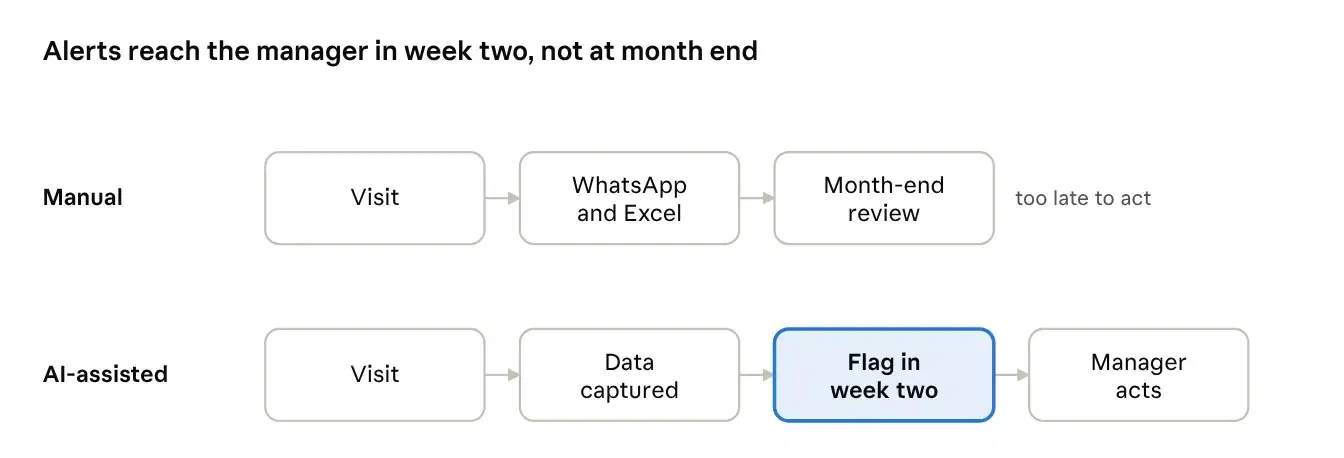
Five ways AI is changing field sales
1. Demand forecasting at SKU level
Forecasting is the oldest AI use case in distribution, and the one with the most evidence behind it. A model looks at past sales, seasonality, how often each retailer reorders and how stock is moving, then estimates what an outlet or distributor will need next.
Picture a biscuit brand heading into Diwali. A Lucknow distributor always stocks up in October. This year there's a new 50 g pack and a scheme running in only some districts. A spreadsheet repeats last year's number. A model reading SKU-level secondary sales can show the new pack selling faster in two districts while the distributor sits on more of the old pack than demand justifies. (That's an illustration, not a customer case.)
The model proposes a number. A manager checks it against schemes, launches and festivals before anything is ordered.
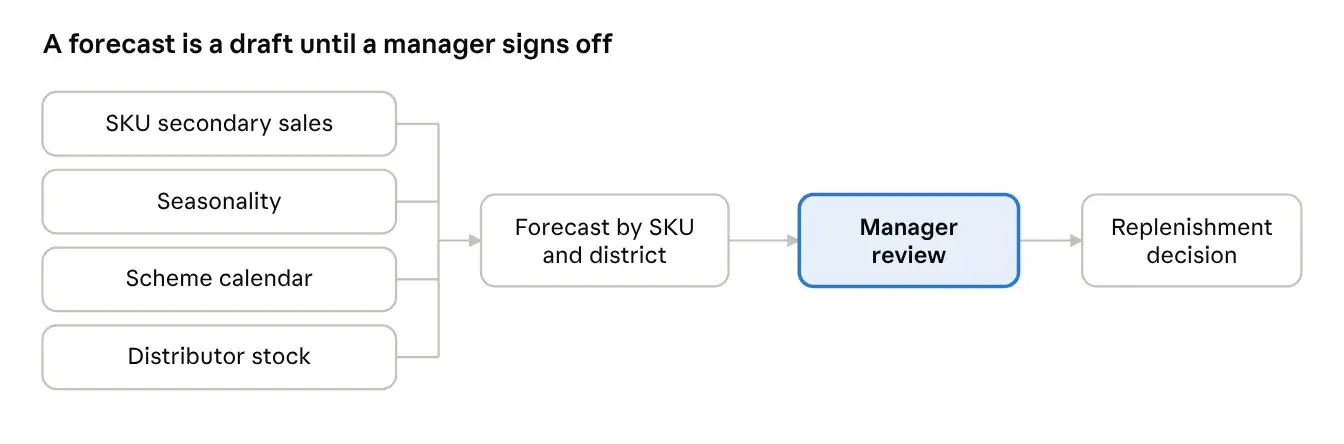
McKinsey estimates that AI-driven forecasting can cut supply chain forecast errors by 20 to 50 percent and reduce lost sales from product unavailability by up to 65 percent. Take that as a best case. The article dates from 2022 and covers supply chains in general, not Indian FMCG.
BizzField's SKU Performance AI Agent brings SKU-level demand forecasting and availability alerts into the SFA.
2. Sales assistants and copilots
Three terms get tangled, so here's the plain version. A chatbot answers set questions from a script. A sales assistant, often called a copilot, reads your live sales data and answers open questions like “which beats are below target this week?” An autonomous agent goes further and acts by itself, rescheduling visits or placing orders without being asked.
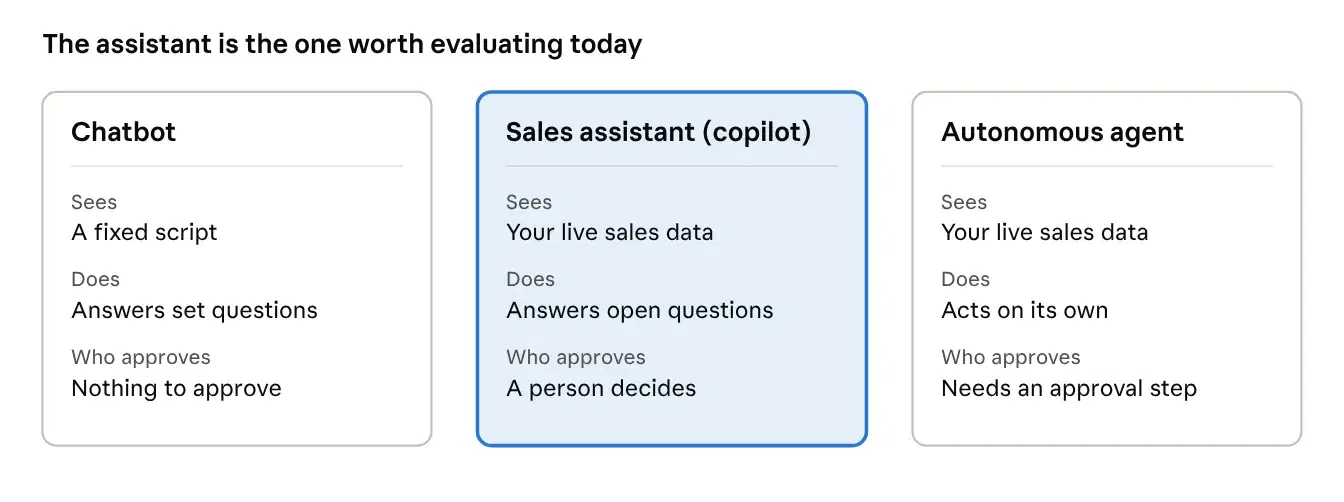
The assistant is the one worth evaluating today. A rep gets context before a visit: the last order, pending dues, SKUs the outlet doesn't stock yet. A manager asks a question and gets an answer instead of building a pivot table on Sunday night.
Autonomous agents are a different story. If an action touches money or stock, we think a person should approve it, full stop. BizzField's SFA AI Agent is built as an assistant that answers plain-language questions on live field data.
3. Beat and route planning
Give AI territory data, visit history, outlet potential and working-hour limits, and it can suggest which outlets to cover and in what order. It can also rework the day when a visit falls through.
What it can't know is that a retailer only buys on Thursdays, or that a market shuts for a local festival, unless somebody has recorded it. So treat the route as a strong first draft and let the ASM edit it. There's more on how this works in our route management software.
4. Coaching based on what actually happened
Managers usually spot these patterns late: an outlet whose orders have dropped three visits running, a territory with plenty of visits and poor conversion, a rep whose activity has turned patchy.
The alert itself is the small part. What matters is the conversation that follows. Instead of “your numbers look low,” the ASM walks in with five specific outlets and the visits that went wrong. Anurag Gupta of Ashok Nutririch, a BizzField customer, says “our review meetings now start from real numbers.” BizzField's Performance Agent is built for this kind of insight.
5. Order suggestions and distributor visibility
From ordering history, AI can suggest what an outlet is probably due to reorder, or flag a distributor running thin on a fast-moving SKU. A distributor-level monitor like the DMS AI Agent watches stock, secondary sales trends and payment ageing in one place.
Still, a suggested quantity is only a starting point. Someone has to check it against actual stock, running schemes and the retailer's credit limit. A suggestion that ignores an overdue payment makes the rep look careless.
Where AI helps in FMCG and distribution
The benefits below depend on data quality and adoption. None of them is automatic.
| Business challenge | AI application | Potential benefit |
|---|---|---|
| Demand swings by SKU and district | SKU-level demand forecasting | Earlier replenishment signals, fewer surprise stockouts or overstock |
| Retailers ordering out of habit | Reorder and must-sell SKU suggestions | Better order conversations, wider SKU range per call |
| Distributor stock gaps | Inventory alerts and replenishment hints | Gaps spotted before outlets run dry |
| Rep productivity | Visit prioritisation and pre-visit summaries | Less admin and guesswork |
| Outlet coverage | Beat gap and missed-outlet detection | A clear view of who isn't being served |
| Manager decisions | Daily briefs, target-risk alerts, plain-language queries | Faster, evidence-based reviews |
What's real and what's still hype
Not every AI feature in a brochure is equally mature. Here's a rough working split.
| Practical today | Needs careful evaluation |
|---|---|
| AI-assisted reporting and sales summaries | Fully autonomous sales management |
| Finding slipping outlets, SKUs and territories | Perfect demand predictions |
| Demand pattern identification | Sales teams that run themselves |
| Suggested order recommendations | AI replacing experienced sales managers |
| Decision-support alerts for managers | Decisions taken with no human review |
Some of the right-hand column will mature, and none of it is impossible. But if a vendor says it works today, ask to see it running on your data, not a demo dataset.
The difference between the columns is mostly about foundations. If reps skip check-ins, outlet records are duplicated or distributor stock gets updated once a week, the output turns shaky fast. ERP and DMS integration matter just as much, along with clear rules on who can see and approve what.
Indian enterprises are running into this at scale. EY and CII's survey of over 200 Indian enterprises, published in November 2025, found 47% running multiple GenAI use cases live. In the accompanying press release, CII's Director General notes that data readiness, governance and measurement are still open problems. In field sales, we'd translate that into duplicate outlets, late stock updates and alerts that nobody owns.
What to look for in AI SFA software
AI should sit on a working SFA. It can't stand in for one. If attendance, visits and orders aren't captured reliably, no AI layer will rescue you. Once the basics hold, check these nine things:
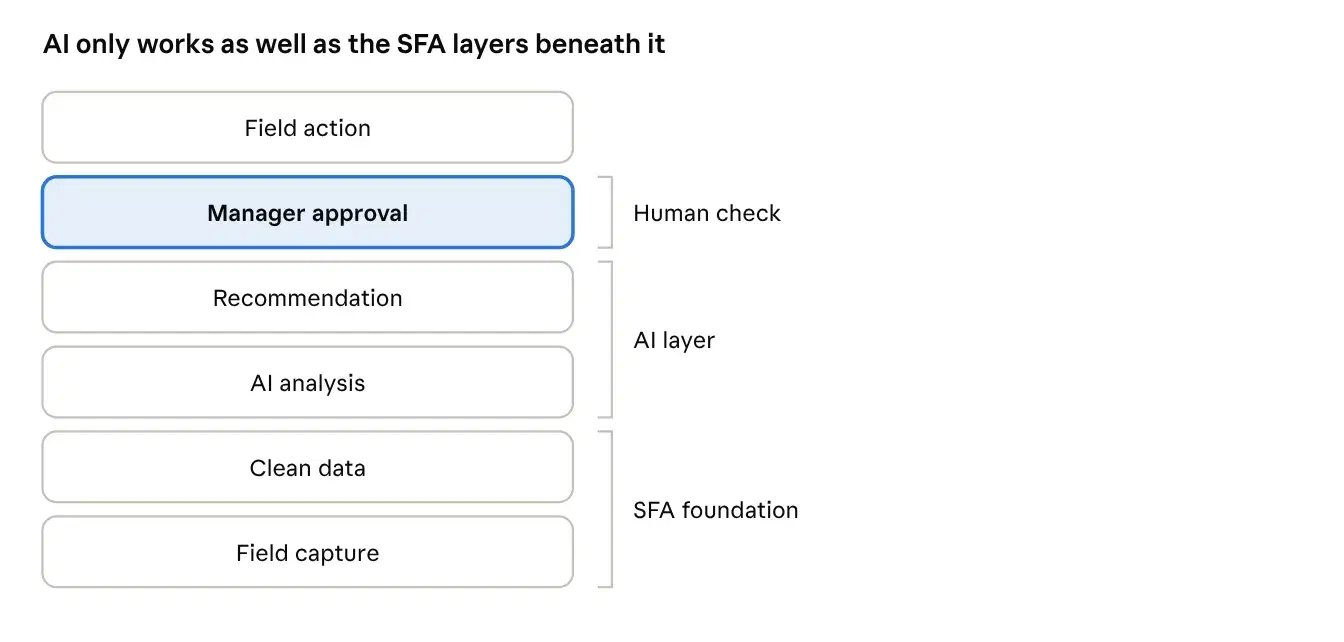
- SFA foundation: visits, orders, secondary sales and expenses captured consistently.
- Assistant capability: can it answer questions on your data, or does it only show dashboards?
- Data quality: clean outlet and SKU masters, and distributor stock that's current.
- Visibility: one view across field activity and distributor sales.
- Integration: how stock and billing data flow in from your ERP, Tally or DMS. See BizzField's integrations.
- Mobile and offline: reps on weak-network beats still need to work. Here's how an offline field sales app handles it.
- Security: role-based access, so each level sees only its own data.
- Scale: does it hold up at 20 reps and at 2,000?
- Review controls: can a manager see why something was recommended, and approve it?
If you're starting from zero, our advice is to pick one use case, probably at-risk outlet alerts, and prove it on a few beats before expanding. Small pilots are easier to judge, and easier to fix.
How BizzField approaches AI-assisted field sales
BizzField builds sales force automation software for FMCG, pharma, consumer durables, agri and building materials teams. It covers attendance with GPS and selfie verification, visits, orders, routes, expenses and secondary sales, and it works offline. The AI layer sits on that same data.
That layer is BizzGuru AI. It analyses daily field activity to flag underperforming beats and at-risk outlets, tracks rep productivity, beat adherence and order value trends to show who may need coaching, and recommends SKUs an outlet under-buys based on its purchase history. Four AI agents sit alongside it, covering SFA questions and next actions, rep performance, SKU availability and demand, and distributor stock and payments.
The SFA AI Agent works within the permissions a customer sets. Whichever vendor you choose, ask for that guarantee in writing.
Want to see how this looks on your own beats and distributors? Book a 15-minute demo, or see BizzGuru AI on the SFA page.
Final thoughts
AI pays off in field sales when four things are already true: the field data is reliable, people follow the process, the SFA captures all of it, and someone is accountable for acting on what the system flags. Without those, an AI layer just produces more reports nobody trusts. With them, a manager gets the Sunday evening back and a slipping outlet gets noticed in week two instead of week four.
If you're comparing vendors, start with your own data and your own beats, and ask each one to show their AI working on your numbers. We're glad to do that for BizzField. Book a 15-minute demo or read more about the BizzField SFA platform.
Frequently asked questions
AI forecasts demand, suggests what an outlet should reorder, flags reps and territories falling behind target, prioritises visits and answers managers' questions on sales data in plain language. Most of it is decision support. The system recommends, and a manager or rep decides.
It's sales force automation with an AI layer on top. The SFA captures attendance, visits, orders and secondary sales. The AI analyses that data to spot patterns, forecast demand and suggest next actions. It works only as well as the field data underneath it.
It gives a rep context before and during a visit: the outlet's last orders, pending dues, SKUs not yet stocked and applicable schemes. It can also summarise the day and cut manual reporting. The rep still decides what to pitch. The assistant saves the time spent hunting for information.
Often, yes, especially at SKU, outlet and distributor level, where patterns are hard to spot by hand. McKinsey's 2022 analysis estimates AI can cut supply chain forecast errors by 20 to 50 percent, though results vary with data quality. Forecasts still need human input on schemes, launches, festivals and policy changes like GST.
It can. AI can monitor distributor stock, flag retailers whose orders are slowing, point out overdue payments and suggest replenishment priorities. It can't fix poor stock data or weak distributor discipline, so accurate inventory and billing feeds from distributors come first.
In practice the terms overlap. Both answer questions and make suggestions from your sales data while a person stays in control. "Copilot" usually stresses working alongside the user in daily tools, while "assistant" is the broader label. Vendors use both loosely, so check what the product actually does.
Check data quality first: outlet and SKU masters, visit records and distributor stock. Then look at ERP integration, offline performance in weak-network areas, access controls, and whether managers can review and approve recommendations. Start with one use case, such as at-risk outlet alerts, before expanding.
WRITTEN BY
Shivam Gupta
Brand Manager
Brand Manager with 8+ years of experience in building brands, developing growth strategies, and creating impactful marketing campaigns that drive business success.
Connect on LinkedIn