Written by Urvashi Srivastav · Last reviewed against public vendor sources: July 2026
An objective look at how the two platforms compare on modules, pricing model, offline capability and company-size fit — using only what each vendor publishes.
- BizzField— SFA + DMS for SMB & mid-market field teams
- Bizom — Retail intelligence / route-to-market suite for CPG
We are BizzField — one of the two platforms compared here. Every Bizom detail below comes from bizom.com and other public sources, reviewed July 2026. Verify current features and pricing with each vendor before deciding. See our editorial policy.
What is the difference between BizzField and Bizom?
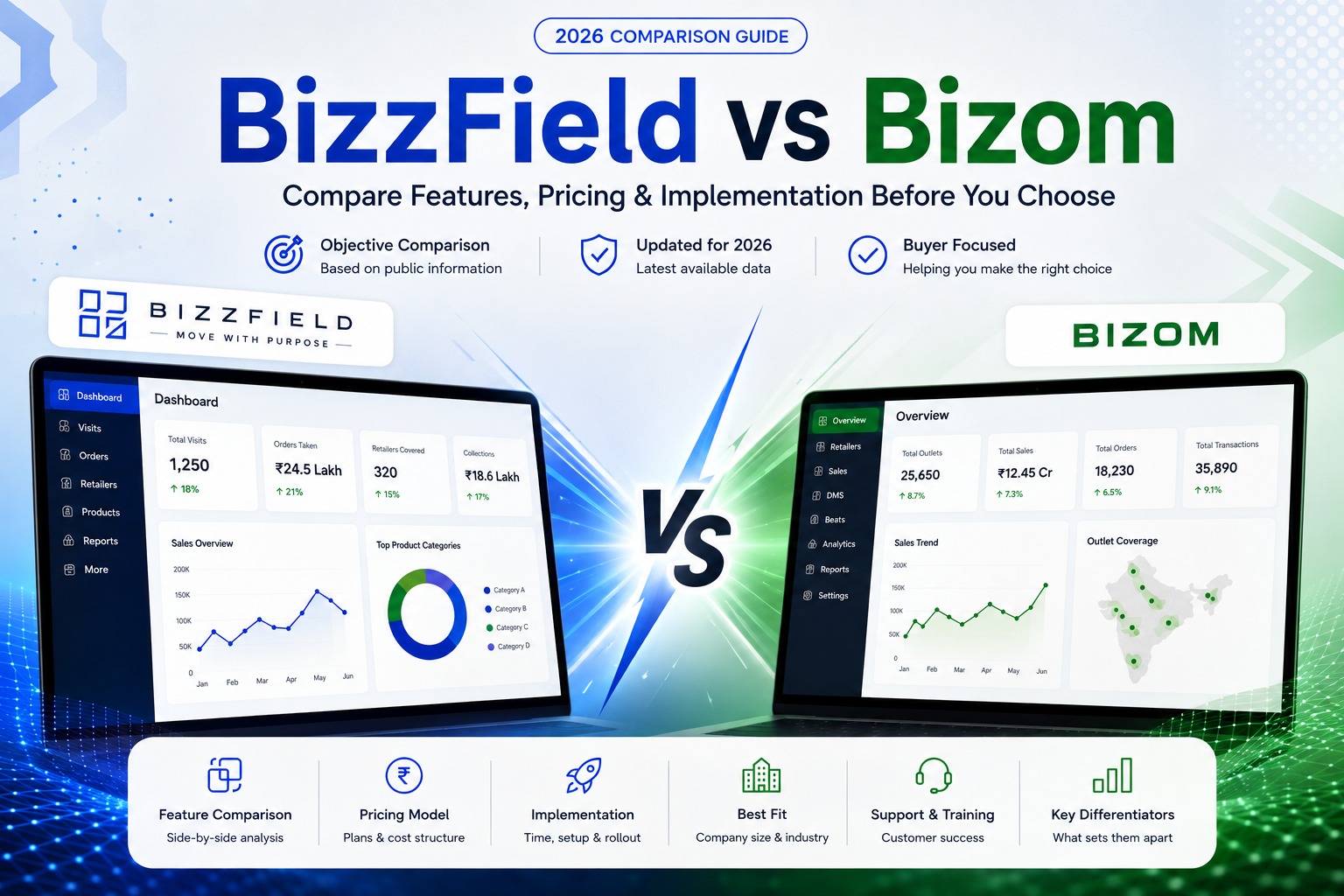
BizzField and Bizom both offer sales force automation, order management, distributor management and field tracking. The main publicly visible differences are in target company size and pricing transparency: BizzField publishes a self-serve demo path aimed at SMB and mid-market FMCG, pharma and distribution teams, while Bizom’s public materials emphasise its footprint with larger CPG brands and a tiered “Basic / Growth / Power” plan structure — with pricing itself request-only for both vendors.
This page compares BizzField’s Sales Force Automation platform and Bizom, two SFA platforms used by consumer goods, pharma and distribution businesses in India and other emerging markets. It is written for buyers who are already evaluating Bizom and want an objective view before booking a demo.
If you are searching for an alternative to Bizom, comparing Bizom competitors in the Indian SFA market, or weighing Bizom vs one specific platform, you are doing what most buyers in this category do. Buyers usually start comparing Bizom alternatives for a few recurring reasons: budget fit for a smaller team, how long implementation takes, how easy the app is for field reps with limited digital literacy, and whether the platform is priced and packaged for their company size. This page walks through those factors using only information publicly available from each vendor’s own website, without speculating about pricing, client counts, or features that are not publicly documented.
How to evaluate SFA software, in short
Look at (1) which modules you actually need — order management, distributor management, beat planning, attendance and reporting are the core five; (2) how the vendor prices and packages those modules; (3) how long a typical rollout takes for a team your size; (4) whether the app works offline in low-connectivity markets; and (5) what support and training come with the plan.
Comparing the wider market rather than just these two? See our best SFA software in India comparison →
Quick answers
Short, direct answers to the questions buyers most often type into a search engine.
- What is the best Bizom alternative? There is no single verified “best” Bizom alternative — the right choice depends on company size, budget, and needed modules. BizzField is one option built for SMB and mid-market FMCG, pharma, and distribution teams, offering SFA, DMS, and offline support. Compare features and request demos from multiple vendors before deciding.
- What is the difference between BizzField and Bizom? Publicly, BizzField focuses on SFA and DMS for SMB/mid-market FMCG, pharma, and distribution businesses with industry-specific configurations and offline mode. Bizom offers a broader retail-intelligence/route-to-market suite with modules like trade promotion optimization, van sales, and B2B commerce, often referenced with larger CPG brand relationships. Exact feature depth should be verified with each vendor.
- How much do BizzField and Bizom cost? Neither BizzField nor Bizom publishes pricing publicly, so no verified cost comparison is currently possible. Bizom lists three named tiers (Basic, Growth, Power) that require a quote request; BizzField directs buyers to a demo. Contact both vendors directly for current pricing and compare total cost of ownership, not just license fees.
- Is BizzField better than Bizom? Based on public positioning, BizzField markets itself toward SMBs, manufacturers, and distributors, while Bizom’s materials more often reference larger CPG brand relationships alongside SMB-relevant tiers. “Better” depends on your outlet count, budget, and required modules — request a demo from each vendor using your own data before deciding.
- Can I migrate from Bizom to BizzField? Migration between SFA platforms is generally possible but depends on each system’s data export/import capabilities. Neither vendor publicly documents a dedicated Bizom-to-BizzField migration process. Businesses considering a switch should confirm data migration, distributor re-onboarding, and training support directly with BizzField before committing to a transition timeline.
How do BizzField and Bizom compare at a glance?
This table reflects publicly available information at the time of writing and should be independently verified on each vendor’s official website. Swipe sideways to see the full table.
| Capability | BizzField | Bizom | Source | Why it matters |
|---|---|---|---|---|
| Core focus | Sales Force Automation for SMB/mid-market field sales teams | Retail Intelligence / Route-to-Market (RTM) platform combining SFA, DMS and retail execution | Based on each vendor’s own website positioning | — |
| Best for | SMB & mid-market FMCG, pharma, cosmetics, distribution | Larger CPG brands and enterprise route-to-market teams | — | Match the vendor’s focus to your company’s size. |
| Target company size | SMBs, manufacturers, distributors (per bizzfield.com) | Vendor materials reference “CPG brands” broadly, including large enterprise accounts | Not publicly specified in exact employee/revenue bands for either vendor | — |
| Industry focus | Dedicated pages for pharma, FMCG, cosmetics, agriculture, electronics, textiles & building materials | CPG brands broadly | — | Industry fit means fewer workarounds at setup. |
| Pricing model | Not publicly listed; demo-based quote | Tiered plans (Basic, Growth, Power), pricing on request | Depends on plan for both vendors | Shapes total cost against your budget and team size. |
| Order management | Available (per bizzfield.com) | Available (per bizom.com) | Publicly confirmed on both vendor sites | Reps capture orders instantly, cutting manual entry. |
| Beat / route planning | Available (per bizzfield.com) | Available via Beat Optimisation module (per bizom.com) | Publicly confirmed on both vendor sites | Helps reps cover more outlets in less time. |
| GPS / attendance tracking | Available — geofenced check-in, selfie/face-verified attendance | Available — Attendance & Leave Management module | Publicly confirmed on both vendor sites | Confirms visits happened as planned. |
| Distributor Management (DMS) | Available (per bizzfield.com) | Available — Web & Mobile DMS, Bizom Connect | Publicly confirmed on both vendor sites | — |
| Offline mode | Stated as “works offline” (per bizzfield.com) | Not publicly detailed on the pages reviewed | Please verify with Bizom directly | Keeps reps working without signal in the field. |
| AI-based insights | “BizzGuru AI” — sales coaching, demand forecasting, churn detection | “RI Copilot” and “RI Agent” for retail intelligence | Both vendors market AI features; specific outputs not independently verified | Surfaces sales gaps and coaching opportunities faster. |
| Implementation timeline | Marketing claim of rapid rollout referenced on bizzfield.com | Not publicly specified | Verify with the vendor — timelines vary by project scope | — |
| Published customer count | Not independently verifiable; site displays logos without a stated total | “750+ CPG brands” on one page; “600+ CPG leaders” on another | Figures differ across the vendor’s own pages; verify current number | — |
| Demo availability | Demo available | Not publicly stated | — | Test the platform with your own data before buying. |
| Free trial | Not publicly specified | Not publicly specified | Contact each vendor | — |
Why do businesses look for Bizom alternatives?
Buyers typically compare SFA vendors — including Bizom — on budget fit, implementation speed, ease of use for field staff, quality of support, industry-specific fit, mobile usability and how much customization is available. This is a standard evaluation process for any software category, not a sign that a specific vendor is deficient in these areas.
Budget fit. Smaller distributors and single-region FMCG companies often look for pricing that scales down to their team size, rather than enterprise-oriented packages.
Implementation timeline. Businesses with an upcoming sales season or distributor onboarding deadline want to know how quickly a platform can go live.
Ease of use. Field reps in tier-2/tier-3 markets may have limited smartphone experience, so a simple, low-friction app matters.
Support responsiveness. Companies without a large in-house IT team need vendor support that resolves issues quickly.
Industry fit. Pharma, cosmetics, building materials and FMCG each have different workflows — doctor call reporting versus van sales, for instance.
Mobile usability and offline access. Field sales in India and other emerging markets frequently happens in low-connectivity areas, so offline-first design is a common criterion.
Customization. Businesses with unique order formats, scheme structures or reporting needs want to know how flexible the platform is.
None of these factors imply that Bizom lacks any of them — they are simply the standard criteria buyers use when comparing any two SFA vendors, and are worth checking against both companies’ current documentation.
What is BizzField?
BizzField is a Sales Force Automation platform, based in Kanpur, India, aimed at field sales teams in FMCG, pharma, cosmetics and distribution businesses. It covers attendance tracking, beat planning, order management, distributor management, retailer management, expense management and AI-based sales insights through a feature it calls “BizzGuru AI”.
What does BizzField include?
- Live tracking. GPS-based rep tracking with geofenced, selfie-verified check-ins.
- Beat planning. Auto-generated daily routes for field reps.
- Attendance. Face-match and geofence-based attendance with an offline-first design, so data syncs once connectivity is restored.
- Order management and scheme engine. Reps capture orders against a live product catalog with active schemes, which sync to distributor systems.
- Distributor sync / DMS. Orders are pushed to distributor systems, per the vendor’s description of its Distribution Management module.
- Expense management. Expense capture with receipts as part of the daily call report (DCR).
- BizzGuru AI. Described on the site as an AI layer covering sales coaching, demand forecasting, early-churn detection, a morning briefing and beat optimisation.
- Industry configurations.Dedicated pages for Pharma, FMCG, Cosmetics, Agriculture, Electronics, Textile & Apparel and Building Materials.
Explore the modules in depth: geofencing, route management, tertiary sales tracking, scheme & offer management and the reporting suite.
Who is BizzField built for?
Ideal customer. Per BizzField’s public positioning: small and mid-sized manufacturers, distributors, and FMCG, pharma and cosmetics companies that want a field sales and distribution management platform without enterprise-level complexity. Industry-specific builds also exist for agriculture, electronics, textiles and building materials.
Feature availability, pricing and rollout timelines should be confirmed directly with BizzField, as marketing pages can change and may not reflect every plan tier.
What is Bizom?
Bizom, operated by Mobisy Technologies Pvt. Ltd., is a Route-to-Market (RTM) and retail intelligence platform for consumer packaged goods companies. According to bizom.com, it combines Sales Force Automation, a Distributor Management System and retail execution/merchandising tools, along with AI-driven analytics modules such as “RI Copilot” and “RI Agent”.
What does Bizom include?
Summarising from Bizom’s own site, its platform is organised into three broad categories:
- Digitalisation. Sales Force Automation (attendance and leave management, order management, asset management, van sales automation, user claims management), plus a Distributor Management System with web and mobile access (“Bizom Connect”).
- Optimisation. Auto Replenishment System, Beat Optimisation, Trade Promotion Management, Smart Merchandising, Outlet Deduplication, Gamification and a Tertiary Sales App, along with AI features named “RI Copilot” and “RI Agent”.
- Expansion. B2B commerce tools, B2B “Buy Now, Pay Later”, ONDC seller registration and a WhatsApp ordering bot.
How is Bizom priced?
Bizom’s pricing page lists three named tiers — Basic, Growth and Power — each bundling a different combination of modules, but the site does not publish specific prices; buyers must submit a form to request a quote.
How many customers does Bizom have?
A note on Bizom’s published customer numbers. Publicly stated customer figures vary across Bizom’s own pages: one page cites “750+ CPG brands”, while another references “600+ CPG leaders” across “32+ countries”. Because these numbers differ by source page and may reflect different points in time, verify the current figure directly with Bizom rather than relying on either number.
This overview is based solely on publicly available content from bizom.com at the time of writing. Please verify current features, pricing and terms directly with Bizom, as marketing pages are updated periodically.
Which features does each platform actually offer?
Both platforms publicly document order management, beat planning, GPS tracking, attendance, distributor management and analytics. Differences that could not be independently verified from public sources — such as exact pricing, implementation duration and some support-tier details — are marked “Not publicly specified” rather than estimated.
Sales Force Automation
| Capability | BizzField | Bizom | Notes |
|---|---|---|---|
| Order management | Order capture against a live catalog with active schemes | Order management within the SFA suite | Publicly confirmed on both vendor sites |
| Beat planning | Auto-generated daily routes for field reps | Beat Optimisation module | Publicly confirmed on both vendor sites |
| Attendance | Face-match and geofence-based, offline-first | Attendance & Leave Management module | Publicly confirmed on both vendor sites |
| GPS tracking | Live rep tracking with geofenced check-ins | Geofencing referenced in module list | Publicly confirmed on both vendor sites |
| DCR (Daily Call Report) | Expense capture with receipts as part of the DCR | Not named as a standalone module on bizom.com | Publicly unclear for Bizom — verify with vendor |
| Expense management | Included as part of the DCR workflow | Referenced as “User Claims Management” | Confirmed on both sites, under different naming |
Distribution Management
| Capability | BizzField | Bizom | Notes |
|---|---|---|---|
| Retailer management | Available as part of the platform | Retailer App | Publicly confirmed on both vendor sites |
| Distributor management | Orders sync to distributor systems | Web & Mobile DMS, “Bizom Connect” | Publicly confirmed on both vendor sites |
Analytics & AI
| Capability | BizzField | Bizom | Notes |
|---|---|---|---|
| Reports | Included in AI-based insights via BizzGuru | Proprietary analytics engine referenced in listings | Depth of analytics not independently verified |
| AI assistant | BizzGuru AI — sales coaching, morning briefing | RI Copilot and RI Agent | Both vendors market AI features; specific outputs not independently verified |
| Sales forecasting | Demand forecasting, part of BizzGuru AI | Not explicitly named on bizom.com | Publicly unclear for Bizom — verify with vendor |
Advanced Features
| Capability | BizzField | Bizom | Notes |
|---|---|---|---|
| Mobile app | iOS / Android referenced | iOS / Android referenced | Publicly confirmed on both vendor sites |
| Offline mode | Stated as “works offline” | Not publicly detailed on pages reviewed | Publicly unclear for Bizom — verify with vendor |
| Van Sales | Not listed as a named module | Available (Van Sales Automation) | Publicly unclear for BizzField — verify with vendor |
| Trade Promotion Management | Not listed as a named module | Available | Publicly unclear for BizzField — verify with vendor |
| B2B / WhatsApp Ordering | Not listed as a named module | Available (WhatsApp Ordering Bot, B2B Commerce) | Publicly unclear for BizzField — verify with vendor |
Commercial & Support
| Capability | BizzField | Bizom | Notes |
|---|---|---|---|
| Scalability | Not itemized with specific user/outlet limits | “Users: 100” and “Users: 100+” referenced for Basic/Growth | Depends on plan for Bizom; not publicly specified for BizzField |
| Support | Not itemized by tier on the public site | “L1-L2 Support” referenced for Basic and Growth tiers | Depends on plan for Bizom; not publicly specified for BizzField |
| Pricing Transparency | Quote-based; no published price list | Quote-based across all three tiers; no published price list | Not publicly specified for either vendor |
59.89% vs 143.10%
Rural versus urban wireless teledensity in India at the end of March 2026, per the Telecom Regulatory Authority of India. Rural coverage is still well under half of urban, which is why offline capability is a purchase criterion rather than a checkbox for any team selling beyond the metros. BizzField states that check-in, order booking and form submission all work with zero signal.
Every row reflects only what each vendor states on its own public website at the time of writing. Where a feature was not explicitly named or described, it is marked “Not publicly specified” or “Publicly unclear” rather than assumed absent.
Which software fits which business?
The right fit depends on company size, the complexity of your distribution network, and whether you need a broader retail-intelligence suite or a more focused SFA/DMS toolset. Neither platform is universally “better” — the scenarios below are meant to help you narrow your shortlist, not replace a demo and a proof-of-concept with your own data.
When BizzField may be the better fit
- You are an SMB, single-region distributor, or mid-sized FMCG/pharma/cosmetics company evaluating your first SFA platform.
- You want industry-specific configurations already built for categories like pharma, cosmetics or building materials.
- Offline functionality for reps in low-connectivity areas is a priority.
- You want an AI-assisted layer focused on day-to-day sales coaching and gap detection rather than a full retail-intelligence suite.
- You prefer a demo-first, lighter-weight evaluation process before committing.
When Bizom may be the better fit
- You are a larger CPG brand operating across multiple states or countries and need a full route-to-market suite, not just SFA.
- You require built-in modules for trade promotion management, van sales, auto-replenishment, or B2B/ONDC/WhatsApp commerce alongside SFA.
- You want tiered plans (Basic, Growth, Power) that can bundle DMS, claims and retail execution together.
- You are comfortable with a request-a-quote pricing process and a longer enterprise sales cycle.
In both cases, the most reliable way to confirm fit is a live demo using your own data — your outlet count, distributor structure and product catalog — rather than relying on marketing pages alone.
The most reliable next step is to shortlist based on module fit and industry alignment, then request a live demo from each vendor using your own outlet, distributor and product data before making a final decision.
How much do BizzField and Bizom cost?
Neither BizzField nor Bizom publishes exact prices on its website. Bizom names three tiers (Basic, Growth, Power) but requires a form submission for a quote; BizzField’s public pages point to a live demo rather than a published price list. Request pricing directly from both vendors and evaluate total cost of ownership, not just the headline license fee.
Neither platform publishes rates: Bizom pricing appears only as three named tiers with no figures attached, and BizzField quotes against your actual team size and module mix rather than a fixed rate card. Because cost varies by user count, modules and contract length, this page does not estimate either vendor’s pricing. When comparing quotes, consider these total cost of ownership factors beyond the base license:
What should you ask about total cost of ownership?
| TCO factor | What to ask each vendor |
|---|---|
| Implementation | Is there a one-time setup or onboarding fee? What is included? |
| Training | Is field-rep and manager training included, or billed separately? |
| Customization | Are custom fields, workflows or integrations part of the base plan or an add-on? |
| Support | What support tier (e.g. L1/L2) is included at your plan level, and what are the response-time commitments? |
| Licensing | Is pricing per user, per outlet, or a flat platform fee? Does it scale with distributor or SKU count? |
| Contract term | Is there a minimum commitment period, and what are the renewal terms? |
Pricing information for both vendors was not publicly available at the time of writing. Treat any third-party pricing estimates, including those on review sites, as unverified until confirmed directly with the vendor. For general market context, see our guide to SFA software pricing in India →
What is involved in switching from Bizom?
Switching SFA platforms involves migrating historical data, retraining field reps and managers, re-onboarding distributors onto the new order flow, and planning a cutover period. Ask both vendors directly how they support each step, since these processes are not fully documented on either public website.
US$ 289bn → 643bn
India’s FMCG market was worth Rs. 25 lakh crore (US$ 289.1 billion) in 2025 and is projected to reach nearly US$ 642.87 billion by 2030 — a 17.3% CAGR, per IBEF, the India Brand Equity Foundation. Field teams are being asked to cover more outlets against that growth, so the cost of a slow or stalled rollout compounds — plan the migration around a season, not around a quarter-end.
- Data migration. Outlet lists, distributor records, historical order data and rep hierarchies typically need to be exported and mapped into the new system. Confirm what data can be exported from your current platform and what import support the new vendor offers.
- Training users. Field reps and managers will need onboarding on new workflows, even if the new app is simpler. Ask about training format and how long teams of similar size typically take to become proficient.
- Historical reports. Decide whether you need historical performance data available inside the new platform, or whether it will be archived separately for reference.
- Distributor onboarding. If the new platform includes a DMS, your distributors will need to be set up and trained on the new order-receiving process.
- Implementation planning. Set a realistic go-live timeline that accounts for a pilot phase with a subset of reps, rather than switching your entire field team on day one.
- Support during transition. Confirm what support level is available during the first 30–90 days after go-live, when most adoption issues surface.
Implementation timelines and migration support vary by project scope. Please verify with the vendor directly for a plan specific to your team size and data volume.
Which one should you choose?
Short answer: There is no universally “better” choice between BizzField and Bizom. The right platform depends on your company size, budget, industry, implementation timeline, and which specific modules — SFA-only versus a full retail-intelligence/RTM suite — you actually need.
Module and industry fit: Based on publicly available information, BizzField’s positioning leans toward SMB and mid-market FMCG, pharma, cosmetics and distribution businesses looking for a focused SFA and DMS platform with industry-specific configurations and offline support. Bizom’s public materials describe a broader retail-intelligence platform with modules for trade promotion optimisation, van sales, B2B commerce and enterprise-tier CPG relationships.
Cost and timeline: Neither company publishes pricing, so cost comparison requires directly requesting quotes from both. Implementation timelines, exact feature depth and support-tier details were also not fully published by either vendor at the time of writing and should be confirmed directly.
The reliable next step: Shortlist based on module fit and industry alignment, then request a live demo from each vendor using your own outlet, distributor and product data before making a final decision.
About this page
Written by Urvashi Srivastav and reviewed by our Product & Customer Success team.
How we built this comparison
We are BizzField, and we are one of the two platforms compared on this page. Like any vendor-authored comparison, this guide is intended to help you understand the market, but we encourage you to verify important details independently.
Every Bizom claim on this page is based solely on publicly available content from bizom.com and other public sources at the time of writing. Where a feature was not explicitly named or described, it is marked “Not publicly specified” or “Publicly unclear” rather than assumed absent. We do not estimate either vendor’s pricing.
Product features, pricing, deployment timelines and availability change over time. If you notice anything inaccurate or outdated, let us know and we will review it. Last reviewed: July 2026.
Trademark notice
Bizom is a trademark of Mobisy Technologies Pvt. Ltd. BizzField, Bizom and other product or company names mentioned on this page are trademarks or registered trademarks of their respective owners. They are used solely for identification, comparison and informational purposes. Their inclusion does not imply endorsement, sponsorship or affiliation with BizzField.
Related reading
- Best SFA Software in India (2026) — five platforms compared
- How to Choose the Right SFA Software in India
- How Much Does SFA Software Cost in India?
- BizzField Sales Force Automation · Distribution Management
See how BizzField would work for your team
Book a 15-minute walkthrough on your own outlets, beats and distributors — and judge the comparison above for yourself.
- Book a live demo using your own outlets, distributors and product catalog.
- Talk to a product expert about which modules — order management, DMS, attendance, AI insights — fit your current workflow.
- Request pricing tailored to your team size and industry.
No pressure, no scripted pitch — just a working session on the dashboard your team would actually use.
Still shortlisting?
Book a demo — or read the full Best SFA Software in India comparison if you’re still building your list. Already looking at FieldAssist? We have a BizzField vs FieldAssist comparison too.
Frequently asked questions
There is no single “best” alternative — it depends on your company size, budget, and required modules. BizzField is one option positioned for SMB and mid-market FMCG, pharma, and distribution businesses. Buyers should compare specific feature sets and get a demo before deciding. Claims of “best” or “#1” should always be checked against verified evidence, not marketing copy.
According to BizzField’s own website, its positioning targets SMBs, manufacturers, and distributors. Whether it fits your specific company depends on your outlet count, distributor structure, and budget — confirm these details directly with BizzField.
BizzField’s website lists a Distribution Management module and states that orders sync to distributor systems. For exact capabilities (e.g., multi-distributor hierarchies, claims processing), verify with the vendor.
Data migration between SFA platforms is generally possible but depends on the export/import capabilities of both systems. Neither vendor’s public website details a specific migration process for switching from a competitor, so this should be confirmed directly with the vendor you choose.
Implementation timelines are not publicly specified in detail by either vendor. BizzField’s marketing references a fast rollout, but exact duration depends on your outlet count, integrations, and data complexity. Please verify with the vendor for a project-specific timeline.
BizzField’s website states that the platform “works offline,” with attendance and visit data syncing once connectivity is restored. This is useful for field teams operating in low-connectivity areas. Confirm the exact scope of offline functionality (e.g., which modules work offline) with the vendor.
Both vendors’ public sites reference FMCG, pharma, cosmetics, and general consumer goods distribution. BizzField additionally lists dedicated pages for agriculture, electronics, textiles, and building materials. Bizom’s public materials focus more broadly on CPG brands. The right fit depends on your specific workflow needs (e.g., doctor-call reporting for pharma).
SFA platforms like BizzField are generally designed to replace manual spreadsheet-based tracking with automated attendance, order capture, and reporting. Whether it fully replaces your current spreadsheet process depends on your existing workflow — a demo using your own data is the best way to confirm.
Compare vendors on: (1) which modules you actually need, (2) pricing model and total cost of ownership, (3) implementation timeline, (4) offline/mobile usability, (5) industry-specific fit, and (6) support quality. Avoid relying solely on vendor marketing claims — request references and a live demo with your own data.
BizzField lists a dedicated FMCG SFA page and includes FMCG-relevant features such as order management, scheme/offer management, and distributor sync. Bizom also serves FMCG/CPG brands broadly, per its own site. Suitability depends on your company’s specific scale and requirements — verify with each vendor.
WRITTEN BY
Urvashi Srivastav
VP, Business Management & Client Relationships
VP at BizzField, working across business management and client relationships — building strong partnerships, streamlining operations and driving business growth.
Connect on LinkedIn