
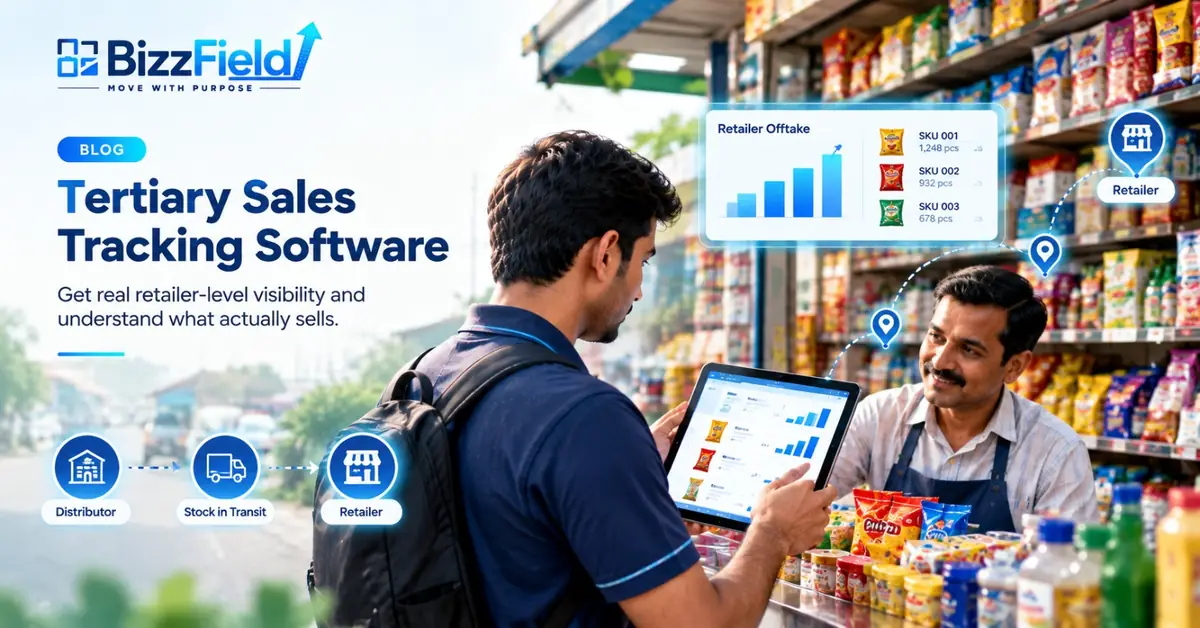
Secondary sales are on target for the quarter and distributors are billing on time, yet the sales manager still can't say which SKUs are moving off retailers' shelves. A new 200 ml hand wash may have been invoiced into outlets across the territory and be sitting unsold in most of them. Tertiary sales tracking software is meant for that blind spot. It records what retailers sell on, so your distribution management software reports and how secondary sales are recorded can be read against actual offtake.
What is tertiary sales tracking software?
Tertiary sales tracking software records and consolidates what retailers sell to end consumers, by outlet and SKU, so an FMCG company can compare distributor billing with reported or estimated retailer offtake. Where retailer billing or POS data isn't available, offtake is usually estimated from field-captured stock and purchase records.
The tertiary sales meaning comes down to the last link in the chain: retailer to shopper. It is also the link a manufacturer sees least, since most small general-trade outlets have no digital billing to share and larger retailers share data selectively. For the first link, see how primary sales and the distributor order cycle work.
How do tertiary sales differ from primary and secondary sales?
Primary sales are the company's sales to its distributor. Secondary sales are the distributor's sales to retailers. Tertiary sales are the retailer's sales to end consumers.
| Aspect | Primary | Secondary | Tertiary |
|---|---|---|---|
| Seller → buyer | Company → distributor | Distributor → retailer | Retailer → consumer |
| Usual record | Company invoice | Distributor invoice | Retailer billing, stock counts, or field-captured data |
| What it shows | Stock pushed into the channel | Stock pushed to outlets | Stock pulled off the shelf |
| What it misses | What the distributor does next | What the retailer does next | Often incomplete or unavailable |
Secondary sales show stock supplied to retailers, not what shoppers bought. Secondary figures can climb while offtake stalls: a retailer may stock up ahead of a scheme, sit on a slow SKU, or reorder only the fast-moving pack. Low retailer stock doesn't prove consumer sales either, since returns, stock adjustments, damaged goods and recording errors all move the numbers. Verified data comes from retailer invoices or POS records. Estimated offtake is calculated from stock counts and purchases. Reports should keep the two apart.
An illustrative example
This example is hypothetical and not real data. A distributor invoices a general store with 24 units of 200 ml hand wash and 24 units of a 100 g tea pack in the first week of the month. The secondary record shows 48 units sold, with both SKUs looking equal. By week four, the retailer has sold 22 tea packs and 4 bottles of hand wash. A retailer-level view shows tea moving and hand wash not.
A second example: one rep visit
Also hypothetical. A rep visits the same store at the start and end of the month. Opening stock is 2 bottles of hand wash and 3 tea packs, the store bought 24 of each in between, and closing stock is 22 bottles and 5 packs. Estimated offtake is opening stock plus purchases, minus closing stock: hand wash 2 + 24 − 22 = 4 bottles, tea 3 + 24 − 5 = 22 packs.
That is an estimate from stock counts, not verified consumer billing, and a return or stock adjustment would throw it off. It still points to a decision: tea needs the next order, while hand wash has 22 bottles left, so another order can wait. Before changing the scheme or shelf placement, check whether other outlets show the same pattern.
How does retailer offtake tracking work?
The method depends on what data exists at the outlet, and most FMCG companies end up using a mix.
How tertiary sales data can be captured
- Retailer or distributor data, where available. Some modern trade chains and larger retailers share sales or stock reports. Not every business has access to retailer billing or POS data, so don't assume it.
- Field-team reporting. Reps record retailer stock and purchases at each visit, and offtake is estimated as above.
- Third-party or panel data. Useful for market-level checks, rarely granular enough for outlet decisions.
How the data is consolidated
Each record should tie to an outlet, SKU, date, rep and distributor, and the masters must match. “Tea 100g” and “TEA-100” would otherwise split one SKU's movement into two lines. Once consolidated, estimates can sit beside secondary billing, and the gap between the two is the number worth reading.
Which reports and indicators should FMCG managers evaluate?
- SKU-wise movement by outlet, beat and territory
- Billed-versus-sold gap: secondary billing against estimated retailer offtake
- Retailer stock cover, in days
- Outlet-level trends, such as lapsing or fast-growing outlets
- Reporting frequency: per visit, weekly or monthly
- Data completeness: the share of visits that captured stock
Completeness matters most. A SKU-wise sales report built on a third of visits can mislead, because an outlet with no stock entry looks like an outlet with no sales.
What makes retailer-level data hard to collect?
Retailers are often reluctant to share sales figures, and many have nothing digital to share. Reps treat stock entry as extra work, so entries get rushed or skipped. SKU naming differs between distributors. A retailer seen fortnightly gives fortnightly data. And stock-based offtake carries an error margin that decision-makers should know about.
How should you evaluate tertiary sales tracking software?
Follow the data from collection to report:
- Who enters retailer stock or sales data, and how long does it take per outlet?
- Does it work offline on weak-network beats?
- How are entries verified, for example by GPS check-ins or photos?
- Can retailer or distributor data files be imported where they exist?
- Can secondary and tertiary figures be compared by SKU and outlet, and how often is the data refreshed?
Where does BizzField fit?
BizzField's official site describes a Sales Force Automation platform with distribution management in the same system. Its FMCG sales force automation pages describe:
- Beat planning and GPS-verified outlet check-ins
- Retailer and outlet management
- Digital order booking from the outlet, with live scheme visibility
- Distributor stock and secondary sales rolled up to a manager dashboard
- Offline working for low-connectivity markets
In practice, a rep follows a beat plan, checks in at the outlet with GPS verification, and books the order in the app with live scheme visibility. The order updates distributor stock and secondary reporting in the same platform, and the manager dashboard shows beat adherence beside secondary sales. Verified visits and consistent order records give any retailer-level report something to stand on: you know a visit happened, at which outlet, and what was ordered.
That supports tertiary visibility, but it isn't verified retailer-to-consumer sales capture. Retailer stock capture at a visit, SKU-wise offtake calculation, secondary-versus-retailer comparison in one report, and POS or retailer data import should be confirmed in a demo, not assumed.
What to assess before you choose
Start with the data you can realistically get. If retailer billing exists, you need an import path. If it doesn't, you need a field process reps will actually follow. Then test the tool on your weakest beats. In a demo, ask to see a retailer visit where stock is captured, the report comparing billed and estimated sold quantities by SKU, and a beat with no network, using your own SKUs and outlets.
Frequently asked questions
Sales made by retailers to end consumers. They follow primary (company to distributor) and secondary (distributor to retailer) sales and show what actually leaves the shelf.
Secondary sales are recorded when the distributor invoices a retailer, so they show stock pushed into outlets. Tertiary sales show what the retailer sells on, which can differ sharply by SKU and outlet.
By combining available retailer or distributor data with field-captured stock counts. Reps record stock at each visit, and offtake is estimated from opening stock, purchases and closing stock.
At minimum: outlet ID, SKU, date, opening and closing stock, and purchases since the last visit. Distributor and rep identifiers, plus secondary billing for comparison, make it far more useful.
Yes, but the output is estimated offtake, not verified sales. That suits general trade if reports label it as an estimate and allow for returns and stock adjustments.
How retailer data is captured and verified, offline performance, SKU and outlet master handling, side-by-side secondary and tertiary reporting, import options and refresh frequency.
Through its SFA and distribution management capabilities: beat planning, GPS-verified visits, retailer management, order booking, distributor stock and secondary sales reporting. Whether it captures retailer-level offtake for your workflow should be confirmed in a demo.
WRITTEN BY
Shivam Gupta
Brand Manager
Brand Manager with 8+ years of experience in building brands, developing growth strategies, and creating impactful marketing campaigns that drive business success.
Connect on LinkedIn