
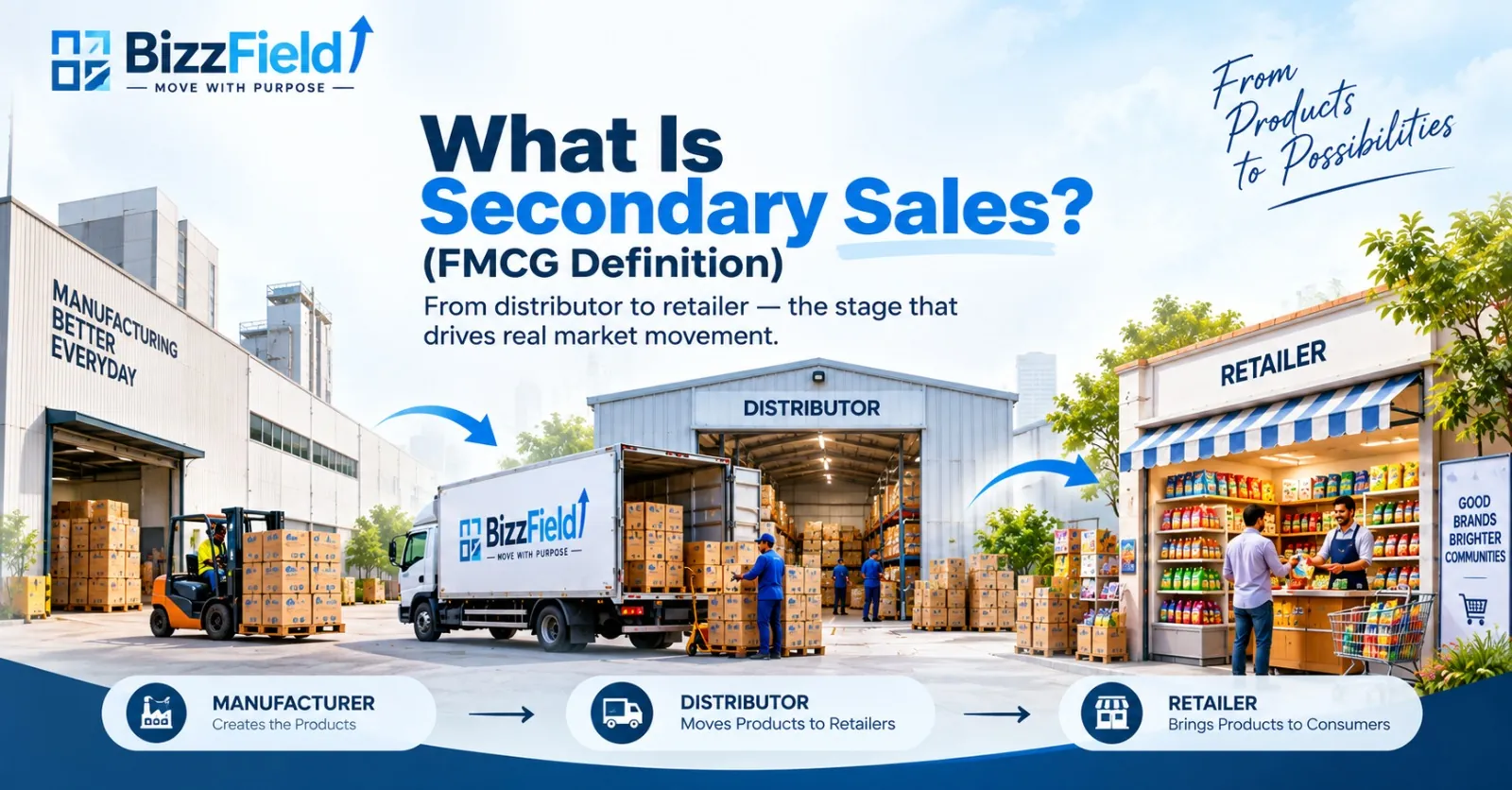
A distributor receives 500 cases from a manufacturer. On paper, that looks like 500 cases sold. In reality, it just means 500 cases changed hands. But that shipment alone doesn't tell you how much stock has actually reached retailers, or whether consumers are buying it.
That gap is what secondary sales is about.
In FMCG, secondary sales is the sale of goods from a distributor (or stockist) to a retailer. It's the second handoff in the chain that runs from manufacturer to distributor to retailer to consumer, and it's the point where stock stops being a warehouse number and starts becoming market activity.
What Secondary Sales Actually Means
The FMCG supply chain has three handoffs, and each one gets its own label:
- Primary sales — manufacturer sells to distributor or stockist
- Secondary sales — distributor sells to retailer
- Tertiary sales — retailer sells to consumer
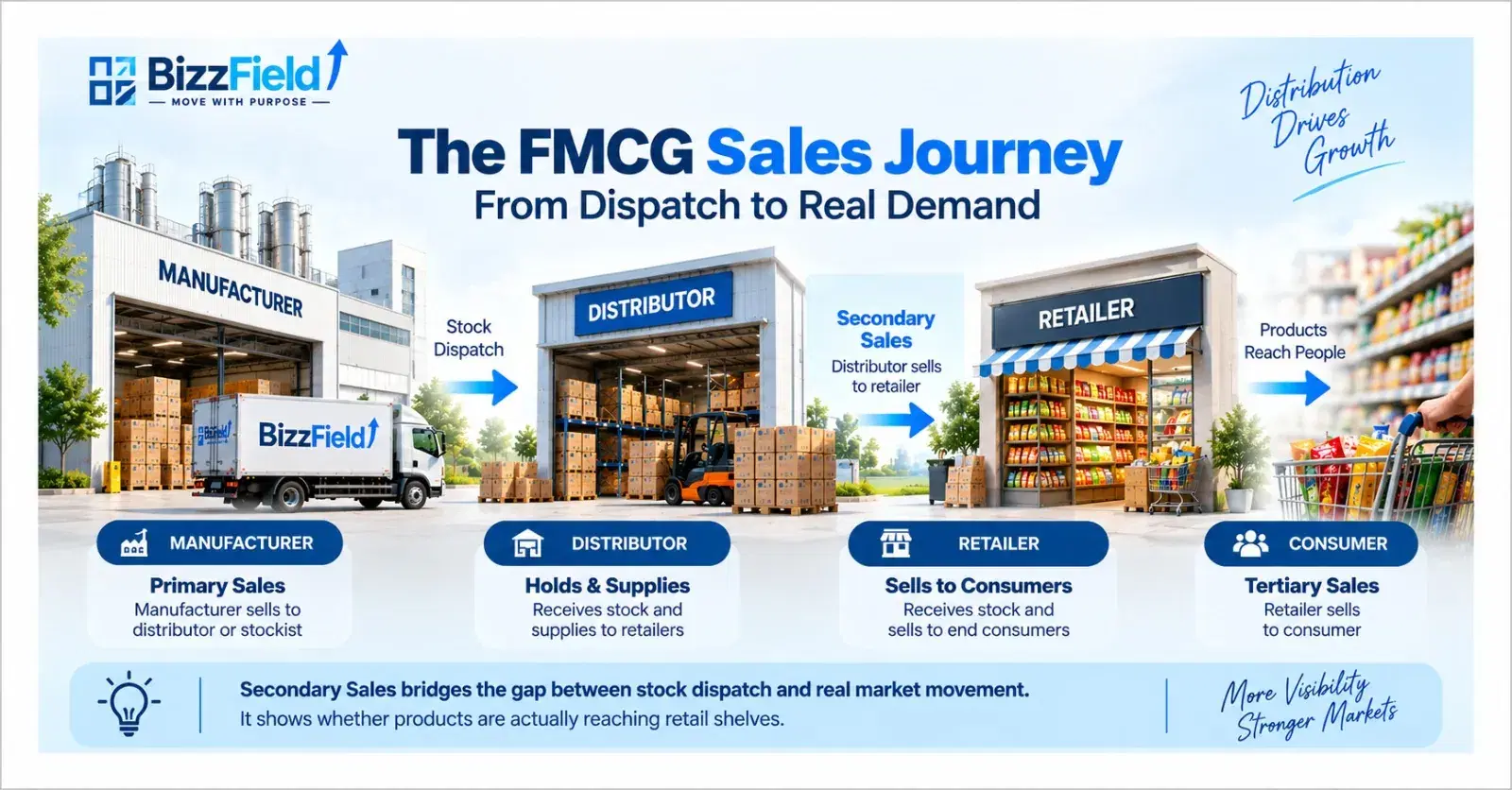
Secondary sales sits in the middle, and it often tells you more about real market movement than the other two. Primary sales tells you what a manufacturer shipped out. Tertiary sales tells you what a consumer actually bought. Secondary sales tells you whether the distributor is getting that stock out into the retail network at all.
For many regional sales teams, secondary sales is one of the most useful indicators of whether products are actually moving through the market. It offers a much clearer view of whether products are reaching retail outlets than primary dispatch data alone.
Secondary Sales in the FMCG Distribution Chain
FMCG companies rarely sell directly to retailers. They go through networks of distributors, each covering a set of towns, neighbourhoods, or retail beats. A single brand might work with dozens of distributors across a state, each responsible for supplying outlets in their patch.
This is precisely where primary sales numbers can mislead. A company can look at total dispatch and assume the product is performing well, when in truth a portion of it is still sitting in distributor godowns without moving into the retail market. Secondary sales is what separates “we shipped it” from “it's actually moving.”
How the Handoff Actually Works
Take a beverage brand launching a new drink. The manufacturer ships 500 cases to a distributor covering a particular district — that's the primary sale, recorded the moment the stock leaves the factory.
Over the next few weeks, the distributor's sales team visits retailers across the district, taking orders and delivering stock. By month-end, they've supplied 350 cases across various outlets — small grocery stores, a couple of local supermarkets, a handful of general stores. That's the secondary sale.
The remaining 150 cases haven't gone anywhere. They're still sitting with the distributor, without moving into the retail market. And that unsold balance is exactly the kind of thing primary sales figures don't show you, because primary numbers are recorded the moment the stock leaves the factory, regardless of what happens to it next.
Later, when shoppers buy the individual bottles or packs from those retailers, that's the tertiary sale — the transaction closest to real demand.
Primary Sales vs Secondary Sales
| Aspect | Primary Sales | Secondary Sales |
|---|---|---|
| Sales flow | Manufacturer to distributor | Distributor to retailer |
| Seller | Manufacturer | Distributor/stockist |
| Buyer | Distributor/stockist | Retailer or outlet |
| Stage | First stage of distribution | Second stage of distribution |
| Main purpose | Supplying inventory to distributors | Moving inventory to retail outlets |
| Channel partner involved | Distributor | Retailer |
| Typical focus | Dispatch volume, order fulfilment | Market movement, retail coverage |
| Example | Manufacturer ships 500 cases to a distributor | Distributor supplies 350 cases across retail outlets |
Why FMCG Companies Care About This Number
Dispatching stock and selling through the market are two different things, but primary sales figures tend to blur that line. A company can report strong monthly dispatch while individual distributors are quietly sitting on inventory they haven't been able to move.
Secondary sales data corrects for that. It shows which distributors are actually pushing product, which territories are underperforming despite healthy dispatch, and where retail coverage has gaps — outlets that should be stocking the product but aren't getting visited or restocked.
For sales and category teams, it's often the number that actually shapes decisions: where to send promotional support, which distributor relationships need attention, and which markets are genuinely responding versus just receiving stock.
Secondary Sales vs Tertiary Sales
These two get mixed up often enough that it's worth spelling out clearly.
Secondary sales refers to the movement from distributor to retailer. Tertiary sales refers to the movement from retailer to consumer — the actual purchase by the person who's going to use the product.
A retailer can stock up heavily, which shows up as strong secondary sales, while that same stock sits unsold on the shelf for weeks. Strong secondary sales figures don't automatically mean the product is selling to consumers. Reading the two together gives a more accurate picture than looking at either one in isolation. For the full three-way comparison, including how primary sales fits into the same chain, see primary, secondary and tertiary sales explained.
Tracking Secondary Sales the Traditional Way
For a long time, secondary sales tracking has meant sales officers collecting reports from distributors — sometimes handwritten, sometimes in Excel sheets that get updated inconsistently. Field staff note down retailer orders during market visits, and someone back at the office compiles it all, usually days or weeks later.
Some companies try to shortcut this by comparing primary dispatch against distributor stock counts, estimating secondary sales as the difference. It works as a rough gauge, but it's only as accurate as the last stock count, and those don't happen often enough to catch problems early.
Where DMS Software Fits In
A Distribution Management System (DMS) changes where the data comes from. Instead of reconstructing secondary sales after the fact from paper reports, it captures the data at the source — when a field rep logs a retailer order, or when a distributor records an outbound delivery.
That shift matters more than it sounds. Sales and distribution teams stop waiting for weekly reconciliation and get more timely visibility into how much stock is actually reaching outlets, which distributors are meeting their retail coverage expectations, and where coverage is thinning out. It also narrows the gap between what's happening on the ground and what management is looking at on a dashboard — a gap that, in many FMCG companies, is otherwise measured in days. For a closer look at what that lag costs, see why secondary sales visibility is usually late and how a DMS fixes it.
Getting Visibility Into Secondary Sales With BizzField
Once you see the difference between what leaves the factory and what actually reaches a retailer, it's clear why so many FMCG businesses want better visibility into that middle stage.
BizzField is built around that exact workflow. It connects field sales teams, distributors, and retailer-level order data in one system, so businesses aren't relying on end-of-month reports to know what's moving through their channel. A sales officer logging a retailer order on the ground shows up on the management side without the usual lag.
For companies running multiple distributors across different territories, that kind of connected visibility makes it easier to spot which markets are actually performing, which distributors might need closer support, and where outlet coverage is falling behind — based on what's genuinely happening in the market, not just what left the warehouse.
If your team is still piecing together distributor-wise secondary sales, retailer orders, and territory performance from spreadsheets and delayed reports, explore how BizzField DMS can help bring that information into one connected workflow.
Frequently asked questions
It's the sale of goods from a distributor or stockist to a retailer — the second stage of the FMCG distribution chain, coming after primary sales (manufacturer to distributor).
Primary sales refers to the transaction between manufacturer and distributor. Secondary sales refers to the transaction between distributor and retailer. One reflects dispatch, the other reflects actual retail-level movement.
Secondary sales refers to the movement of stock from distributor to retailer. Tertiary sales refers to the final purchase by the consumer. Secondary sales shows distribution reach; tertiary sales shows real demand.
Because primary sales can look healthy even when stock is sitting unsold with distributors. Secondary sales data exposes that gap and points to underperforming markets or coverage issues before they become bigger problems.
Mostly through distributor reports, field sales visits, or by comparing primary dispatch against distributor stock levels. All three work, but with varying degrees of delay and accuracy.
Yes. A Distribution Management System captures secondary sales data directly from field activity and distributor records, which gives businesses more timely visibility than manual reporting allows.
WRITTEN BY
Urvashi Srivastav
VP, Business Management & Client Relationships
VP at BizzField, working across business management and client relationships — building strong partnerships, streamlining operations and driving business growth.
Connect on LinkedIn