

DCR stands for Daily Call Report in pharma. It is a daily record of a Medical Representative's field calls and related activity, including doctors, chemists, or hospitals visited, call outcomes, and details such as samples given. The exact DCR format can vary by organisation.
What Is a Daily Call Report in Pharma?
A Daily Call Report is the MR's account of what happened on a given day in the field — typically doctor visits, and where relevant, chemist or hospital visits carried out as part of that day's beat plan.
The core idea is simple: an MR plans a set of calls for the day, makes those calls, and then documents what happened — who was met, what was discussed or detailed, and what came out of the interaction. This documentation is the DCR.
Formats vary by organisation. Some companies use a simple register or Excel sheet with a handful of fields; others use more detailed formats for compliance or reporting purposes. There is no single universal DCR format — the fields and level of detail depend on how a particular company structures its field reporting.
What stays constant is the underlying function: a DCR gives a manager visibility into what an MR did during the day, without being present in the field. It turns scattered field activity into a record someone else can review, question, or act on.
What Information Does a Pharma DCR Contain?
A DCR may include a mix of the following, though exact fields depend on the organisation:
- Date of the field activity
- MR/representative name
- Territory or area covered that day
- Doctor or healthcare professional visited
- Chemist or hospital visit, where applicable
- Call or visit outcome — a brief note on how the interaction went
- Products detailed, where product detailing is part of the call
- Samples distributed, where applicable
- Follow-up notes or actions for the next visit
Typical fields can include order-related information too, such as Product Order Booking (POB) status, depending on the organisation's reporting structure. Not every field is mandatory in every format — a smaller company might track only doctor name, visit outcome, and samples, while a larger one may require more granular detail for compliance reasons.
This is also why DCR formats differ so much between companies: the underlying activity (visiting doctors and chemists) is similar across pharma field sales, but what gets recorded, and how much detail is required, is an internal decision each organisation makes.
Example of a DCR Entry
- Doctor: Dr Sharma, Cardiologist
- Activity: Product detailing
- Samples: 2 provided
- Follow-up: Discuss response during the next visit
This is an illustrative example; actual DCR fields and formats vary by organisation.
Why Do Medical Representatives Use DCRs?
The DCR exists to serve a few practical, everyday purposes for both the MR and their manager.
Creating a daily record. Field work happens away from the office, so without a DCR, there is no written trail of what an MR did on a given day.
Giving managers visibility.An Area or Regional Sales Manager can't be present for every doctor visit. The DCR is how they find out what happened — which doctors were covered, what was discussed, and what needs follow-up.
Supporting follow-up.Pharma sales rarely closes in a single visit. Notes from today's DCR often inform what an MR should raise or check on the next visit to the same doctor.
Maintaining structured records. Over weeks and months, DCRs build a history of coverage — which doctors are visited regularly, and which are being missed.
Reducing dependence on scattered reporting.Without a defined DCR process, field activity tends to live in an MR's memory or scattered notes and messages, which are hard for a manager to consolidate or rely on.
None of this means DCRs guarantee accuracy or eliminate manual effort by themselves — that depends on how consistently a team fills them in and how the format is designed.
DCR vs Other Pharma Field-Sales Terms
MRs encounter several related terms alongside DCR. Here's how they differ:
| Term | Meaning | How It Relates to Field Activity |
|---|---|---|
| DCR | Daily Call Report | Daily record of an MR's calls/visits and outcomes |
| PJP | Permanent Journey Plan | The planned schedule of doctors/chemists an MR is meant to visit, which the DCR later reports against |
| RCPA | Retail Chemist Prescription Audit | A method of tracking competitor product movement or prescriptions at the chemist counter |
| POB | Product Order Booking | Order information captured during a doctor or chemist interaction, depending on the organisation's reporting process |
| SFA | Sales Force Automation | Software category used to plan, capture, and manage field-sales activity, including DCR filing |
These terms often work together: a PJP sets the plan, the MR executes calls against it, and the DCR is where that day's activity — including any POB or RCPA data collected — gets recorded. Each term has its own depth, and this page keeps that explanation brief since the focus here is specifically on DCR.
How Does DCR Fit Into Pharma SFA?
At a basic level, DCR reporting follows a simple workflow:
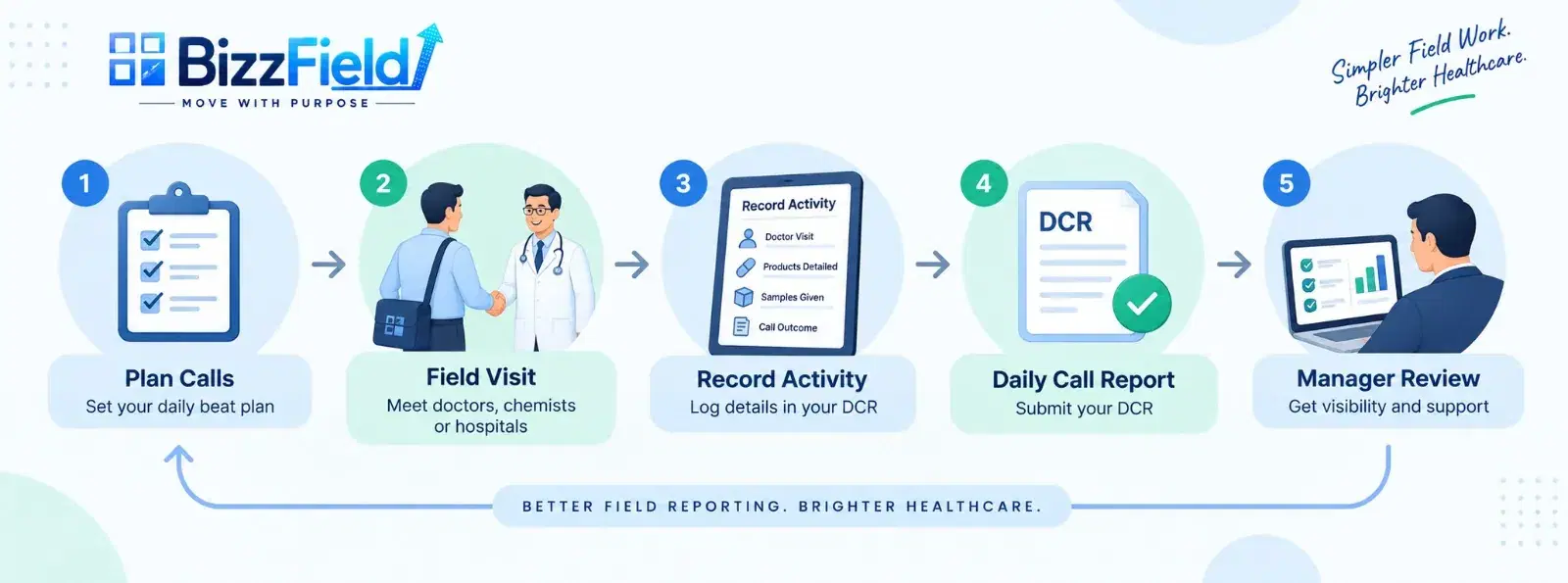
An MR plans which doctors or chemists to visit, makes those calls, and then records what happened. That record — the DCR — gives a manager or sales head visibility into the day's work.
Pharma SFA software digitises this workflow where the platform supports those functions, turning a paper or Excel-based process into a mobile-based one. Instead of reconstructing the day's calls from memory in the evening, a pharma SFA software platform like BizzField lets DCR filing happen from the field itself, alongside GPS-verified doctor and chemist visits and sample tracking, depending on how the implementation is configured.
The relationship, in short: DCR is the reporting concept, and Pharma SFA is one way organisations choose to digitise that reporting.
DCR Reporting: Manual vs Digital
| Manual DCR | Digital DCR |
|---|---|
| Paper, register, or Excel entry | Mobile/digital capture |
| Delayed consolidation by the manager | Structured submission from the field |
| Higher dependence on manual, end-of-day entry | Data captured through a defined workflow |
Digital DCR systems can provide faster access to structured field information, depending on implementation. This isn't a universal outcome — it depends on how well the system is set up and how consistently the field team uses it. Readers who want a closer look at how DCR software works, including automation, POB, and RCPA in more depth, can refer to BizzField's dedicated guide on DCR software for pharma.
Frequently asked questions
DCR stands for Daily Call Report in pharma. It's the daily record a Medical Representative files, covering the doctors and chemists visited and the outcome of each call. The exact format can vary from one pharma company to another.
In pharma sales, DCR refers to the document or digital entry an MR submits at the end of each working day, summarising that day's field activity — who was visited, what was discussed, and any follow-up notes for future calls.
An MR typically records the date, doctor or chemist visited, territory, call outcome, and sometimes products detailed or samples distributed. Depending on the organisation, POB status or follow-up actions may also be included in the same report.
A DCR gives sales managers visibility into field activity they can't directly observe. It supports follow-up on doctor relationships, helps track coverage over time, and creates a structured record instead of relying on scattered, informal updates.
DCR is a reporting concept, while Pharma SFA is software that can digitise it. Many Pharma SFA platforms, including BizzField, include DCR filing as one of their core features, alongside other field-reporting functions like visit tracking.
WRITTEN BY
Urvashi Srivastav
VP, Business Management & Client Relationships
VP at BizzField, working across business management and client relationships — building strong partnerships, streamlining operations and driving business growth.
Connect on LinkedIn