Pharma sales teams generate a huge amount of field activity every day — from doctor visits and chemist interactions to order bookings and prescription audits. When this information is collected through Excel sheets, WhatsApp messages, or paper forms, sales managers often end up with delayed updates, reporting errors and limited visibility into what's actually happening in the field.
This is where DCR software for pharma becomes valuable.
DCR, POB and RCPA are three core components of pharmaceutical field sales operations. Together, they help companies understand where their field teams are working, what business they are generating, and how products are performing in the market. Modern Pharma SFA software brings these processes into a single digital workflow, allowing Medical Representatives to record field activity through a mobile app while managers get real-time visibility into performance.
This guide explains what DCR, POB and RCPA mean, how they connect, the challenges of manual reporting, and what to look for when evaluating DCR automation software.
What Is DCR in Pharma?
DCR stands for Daily Call Report. It is a record of the activities completed by a Medical Representative during a working day, giving managers visibility into field interactions and helping organizations track whether planned activities are actually being carried out.
A typical DCR can include:
- Doctor visits
- Chemist visits
- Hospital visits
- Meeting outcomes
- Samples distributed
- Follow-up actions
- Visit remarks and observations
Example
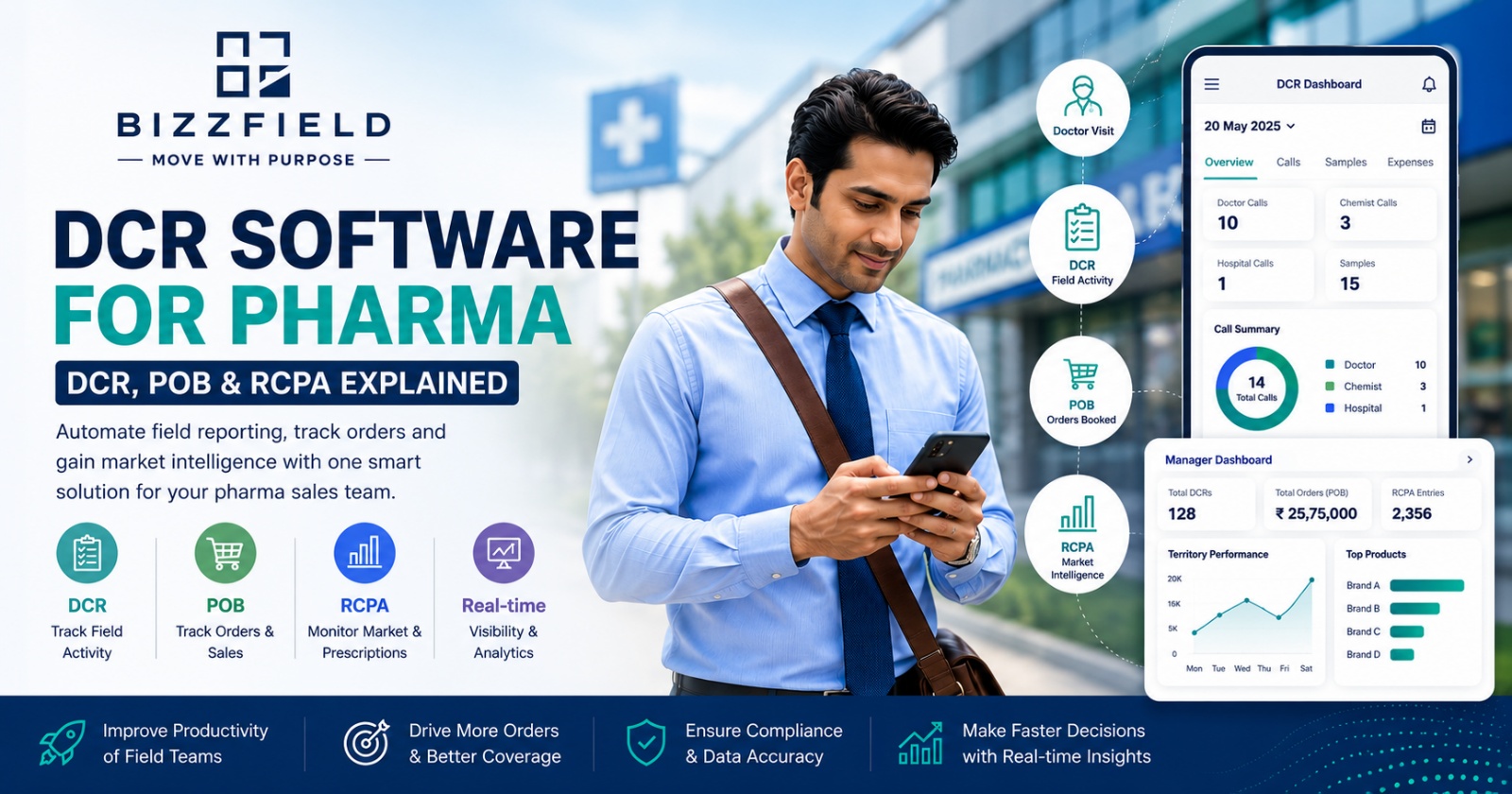
A Medical Representative visits 10 doctors, 3 chemists and 1 hospital in a single day. Each of these interactions — who was met, what was discussed, samples left behind, and any follow-up required — is logged through the DCR. Instead of waiting for a physical report or spreadsheet at the end of the day, a digital DCR system captures this information as it happens.
Problems with Manual DCR Reporting
Traditional DCR reporting creates several recurring challenges:
- Delayed report submissions
- Inaccurate or incomplete information
- Duplicate entries
- Limited manager visibility
- Compliance-related risks
- Time-consuming manual consolidation
For organizations managing large field teams across multiple territories, these problems become harder to manage as the team scales.
What Is DCR Software for Pharma?
DCR software for pharma is a digital reporting system that allows Medical Representatives to record and submit field activities through a mobile application — instead of maintaining separate Excel files, paper registers or WhatsApp updates.
Common capabilities of digital DCR reporting systems include:
- Visit tracking — logging doctor, chemist and hospital visits as they happen
- Doctor call reporting — capturing outcomes and next steps per visit
- Geo-location tracking — recording where a visit took place
- Sample management — tracking samples issued during doctor visits
- Expense tracking — logging field expenses tied to daily activity
- Real-time reporting — making submitted reports visible to managers instantly
- Manager approvals — allowing supervisors to review and approve DCRs
- Field-force monitoring — tracking activity and coverage across territories
- Performance dashboards — consolidating field data into a single view
The biggest advantage of automated MR reporting is that information becomes available in a structured, centralized format. For managers, this means faster access to field data. For Medical Representatives, it means less time spent preparing manual reports.
What Is POB in Pharma?
POB stands for Primary Order Booking. It represents orders collected by Medical Representatives from stockists, distributors or retailers — and it's an important metric because it connects field activity to commercial outcomes.
POB helps pharma organizations evaluate:
- Revenue contribution
- Field sales performance
- Territory effectiveness
- Demand generation
- Product movement
Example
An MR books a ₹1,50,000 order from a distributor. This order contributes to the territory's POB and is tracked as part of overall sales performance for that period.
When POB data is connected with field activity data, managers get a clearer picture of how field execution translates into actual sales.
What Is RCPA in Pharma?
RCPA stands for Retail Chemist Prescription Audit. It is used by pharma sales teams to understand prescription patterns, competitor movement and product performance at the retail level.
RCPA can capture:
- Product name
- Brand
- Competitor brand
- Quantity sold
- Prescribing doctor
Why RCPA Matters
RCPA data helps pharma companies:
- Track competitor movement
- Identify market trends
- Improve targeting
- Understand product performance
- Strengthen prescription-generation strategies
When captured digitally, this information is easier to analyze across products, territories, doctors and regions — rather than being scattered across individual MR notes.
How DCR, POB and RCPA Work Together
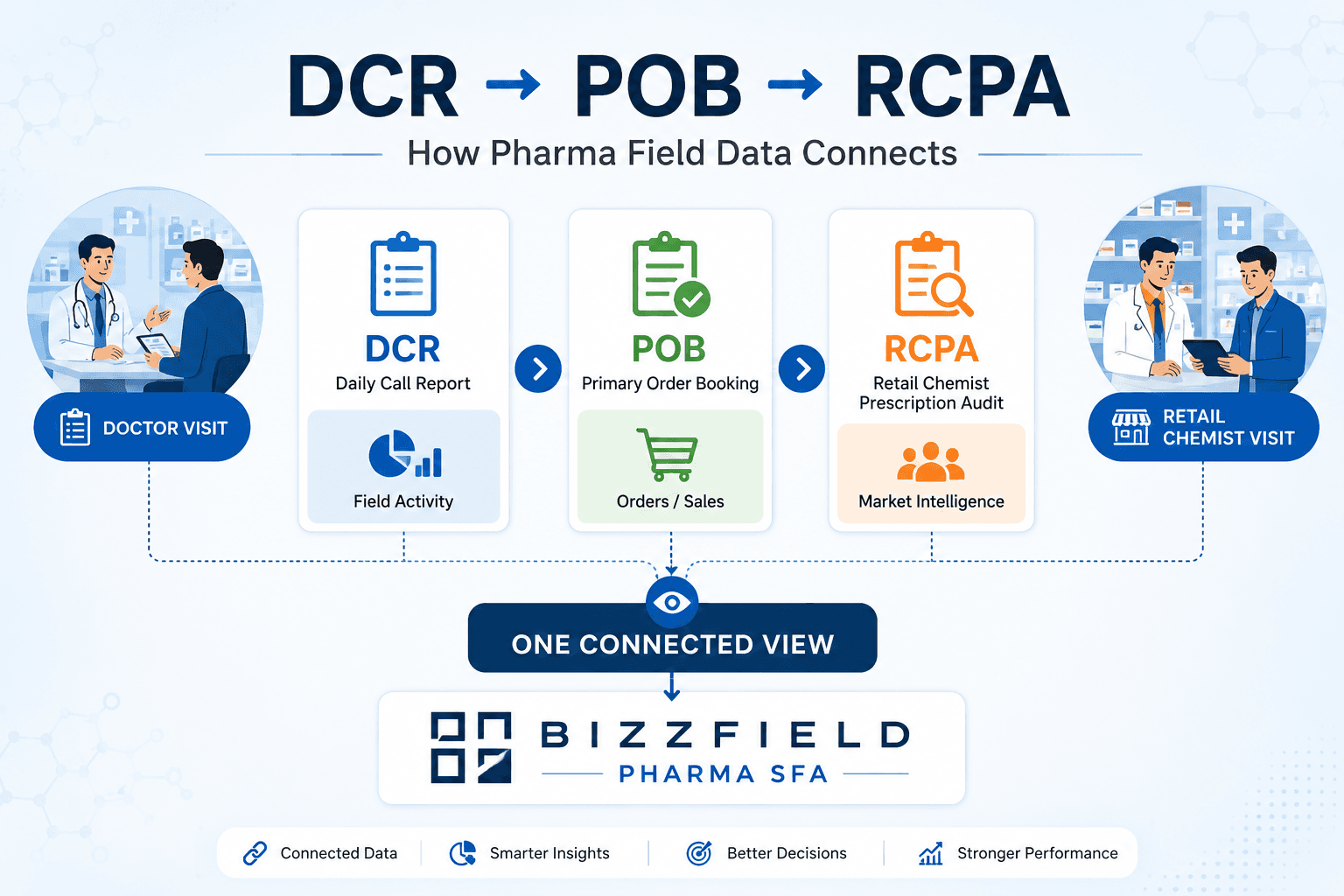
DCR, POB and RCPA each provide a different piece of the same field-sales picture:
- DCR — tracks field activity
- POB — tracks orders generated
- RCPA — tracks market response and competitive intelligence
Looking at just one of these metrics rarely tells the full story. For example, an MR may be completing a high number of doctor visits according to DCR data — but POB may show limited order generation, while RCPA reveals strong competitor movement in the same territory. Seen together, these three datasets explain not just what is happening in the field, but why.
Without integration, organizations are more likely to end up with:
- Data silos, where field, sales and market intelligence sit in different systems
- Reporting delays, from manual reconciliation across sources
- Poor decision-making, based on incomplete or outdated information
Challenges of Manual DCR, POB and RCPA Reporting
Manual Excel Reporting
Excel is useful for basic record-keeping, but managing large field teams through spreadsheets tends to create:
- Duplicate entries
- Human errors
- Data inconsistencies
- Version-control problems
- Delayed, manually consolidated reporting
WhatsApp Reporting
WhatsApp is convenient for quick updates, but it doesn't offer a structured reporting environment:
- Unstructured, inconsistent information
- Difficult tracking across MRs and territories
- No meaningful analytics
- Scattered data that's hard to retrieve historically
Paper-Based Reporting
Paper registers create the greatest visibility and compliance risk:
- No real-time visibility for managers
- Records that are easy to lose, damage or misplace
- Significant administrative effort to collect and consolidate
Benefits of Automated DCR Software for Pharma Companies
Real-Time Visibility
Managers can monitor field activity as it happens, without waiting for end-of-day or manually consolidated reports.
Better Compliance
A standardized digital reporting process helps organizations maintain consistent, auditable practices across the field force.
Faster Decision-Making
Live dashboards and structured reports make it easier for managers to spot trends and act on them promptly.
Improved Productivity
Medical Representatives spend less time preparing manual reports and more time on actual field engagement.
Higher Data Accuracy
Digital capture at the point of activity reduces errors linked to manual entry and delayed recall.
Better Territory Management
Managers can compare DCR, POB and RCPA performance across territories to identify gaps and reallocate effort where it's needed.
Features to Look for in Pharma DCR Software
When evaluating pharma field reporting software, it helps to look beyond basic daily reporting and assess the full field workflow. For a broader framework on shortlisting SFA vendors, this SFA software buying guide covers the questions worth asking before you commit to a platform.
| Feature | Why It Matters |
|---|---|
| Mobile app | Lets MRs log DCRs directly from the field instead of at day's end |
| Offline reporting | Keeps reporting running in low-connectivity areas, syncing once connectivity returns |
| Geo-location tracking | Verifies that a logged visit actually took place at the intended location |
| Doctor management | Maintains an organized database of doctors, specialties and visit history |
| Chemist management | Tracks chemist-level visits and interactions within the same workflow |
| POB management | Captures orders booked during distributor and retailer visits |
| RCPA reporting | Records prescription and competitor data at the chemist counter |
| Dashboards and analytics | Gives managers a consolidated view of DCR, POB and RCPA data across territories |
| Manager approval workflow | Lets supervisors review and approve field reports systematically |
| CRM integration | Keeps doctor and account information consistent across sales systems |
| ERP integration | Connects field-booked orders with backend order processing |
A platform that combines these capabilities under one system removes the need to manage DCR, POB and RCPA as separate, disconnected processes.
DCR Software vs Manual Reporting: What Changes?
| Manual Reporting | DCR Software |
|---|---|
| Excel and paper-based reports | Mobile-based digital reporting |
| Delayed visibility | Real-time visibility |
| Higher risk of manual errors | Structured data capture |
| Manual consolidation | Automated reporting |
| Difficult field monitoring | Better field-force visibility |
| Limited analytics | Dashboards and analytics |
| Separate reporting processes | Integrated DCR, POB and RCPA workflows |
The goal isn't simply to replace paper or Excel — it's to create a standardized system where field activity, orders and market intelligence can be captured and analyzed together.
How BizzField Helps Pharma Sales Teams Automate DCR Reporting
Pharma SFA software like BizzField is built to help pharma sales teams move from fragmented manual reporting toward a structured digital field-sales workflow.
With BizzField, Medical Representatives can file DCRs directly from the field using a mobile app, with GPS-verified doctor and chemist visits that give managers confidence that reported activity actually took place. Sample management is tracked alongside visit reporting, so managers get a clear view of what was distributed during each call, and distributor visibility helps connect field activity with order-level data.
BizzField also supports POB tracking and RCPA capture within the same platform, along with real-time dashboards and field-force monitoring that bring activity, sales and market intelligence together in one place. Offline functionality keeps reporting running for MRs working in low-connectivity areas, with data syncing once connectivity is restored.
For pharma operations and sales excellence teams, this means DCR, POB and RCPA no longer sit in separate spreadsheets or messaging threads — they become part of a single, compliance-ready reporting system. Teams researching this space further may also find this guide on medical representative reporting software useful for understanding broader MR reporting workflows in the Indian pharma context.
Ready to Automate Pharma Field Reporting?
If your team is still consolidating DCR, POB and RCPA data manually across spreadsheets, registers and messaging apps, it's worth seeing how a connected system changes daily reporting.
Book a Demo to see how BizzField Pharma SFA helps automate DCR, POB and RCPA reporting while improving field productivity and compliance.
Conclusion
DCR, POB and RCPA each provide a different view of pharmaceutical field operations. DCR tracks activity. POB tracks orders. RCPA tracks market intelligence and competitive movement.
When these processes are managed separately through Excel, WhatsApp or paper reports, pharma companies face reporting delays, data inconsistencies and limited visibility. Bringing DCR, POB and RCPA into a structured digital workflow — through mobile reporting, real-time dashboards, field-force monitoring and connected order and prescription data — helps managers see the complete picture of field performance.
If your pharma sales team is evaluating automation, Pharma sales force automation software like BizzField can help you explore a more connected approach to DCR, POB and RCPA management.
For a broader set of questions on BizzField's pharma capabilities, pricing and implementation, see the full BizzField FAQ page.
Frequently asked questions
DCR stands for Daily Call Report, a record of doctor, chemist and hospital visits performed by Medical Representatives. It captures visit outcomes, samples distributed and follow-up actions, forming the base layer of field activity reporting in pharma sales.
POB stands for Primary Order Booking and measures orders generated by field sales teams from stockists, distributors or retailers. It reflects how effectively field engagement is converting into actual sales revenue for a given territory.
RCPA stands for Retail Chemist Prescription Audit, used to analyze prescription and competitor sales trends at the chemist counter. It helps pharma companies understand which brands doctors are prescribing and how competitors are performing in a market.
DCR software automates field reporting, reduces the delays and errors common with manual methods, and improves compliance through standardized, auditable records. It also increases manager visibility and reduces the reporting burden on Medical Representatives.
Yes. Modern Pharma SFA platforms are built to manage DCR, POB and RCPA reporting together through a single connected application, giving managers a unified view of field activity, sales and market intelligence — rather than treating them as separate processes.
WRITTEN BY
Shivam Gupta
Brand Manager
Brand Manager with 8+ years of experience in building brands, developing growth strategies, and creating impactful marketing campaigns that drive business success.
Connect on LinkedIn