Choosing sales force automation software is one of the most consequential technology decisions an FMCG, Pharma, or Cosmetics company in India will make. Get it right and your field operations transform — visibility improves, revenue leakage stops, and management becomes proactive instead of reactive.
Get it wrong and you end up with a platform that is too complex for your field reps to adopt, too expensive for your team size, or missing the specific features that your industry actually requires.
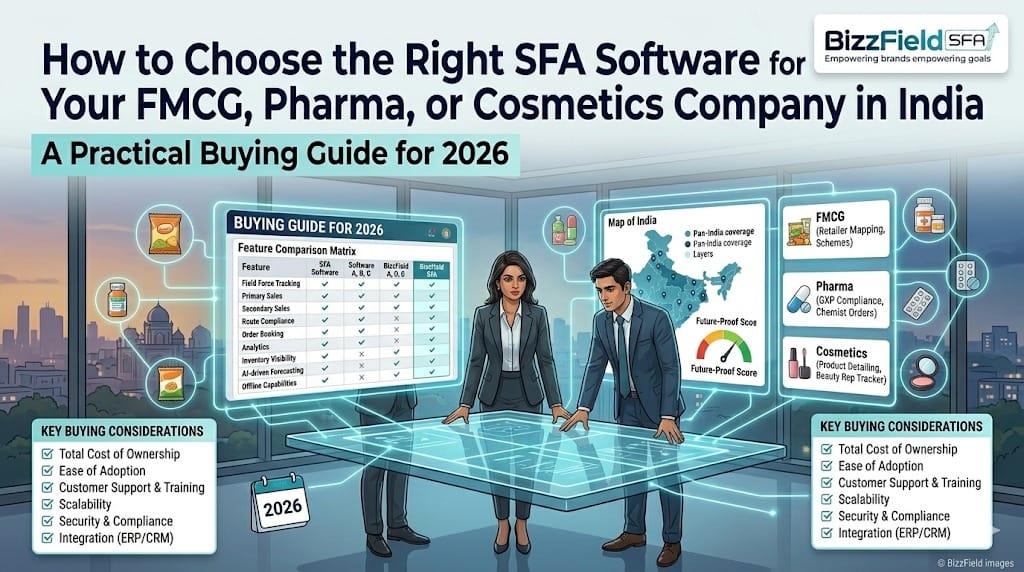
This guide gives you a practical, step-by-step framework for how to choose SFA software — based on what Indian FMCG, Pharma, and Cosmetics companies actually need in 2026.
1. Why Choosing SFA Software Is Harder Than It Looks
Most SFA buying guides list features: GPS tracking, order management, reports, dashboards. These are table stakes. Every platform has them. The real question is not whether a platform has these features — it is whether the platform is architected for how your specific industry, team size, and sales channel actually works in India.
Three common mistakes FMCG and Pharma companies make when evaluating SFA:
Choosing on demo quality, not deployment reality
A polished demo does not tell you how long implementation takes, how quickly field reps adopt the app, or whether the features shown are actually configurable for your beat structure.
Evaluating features without evaluating the DMS
If your SFA has no built-in Distributor Management System, you will still have a secondary sales blind spot. Field rep activity and distributor stock need to be in one platform.
Choosing enterprise pricing for a mid-market team
If you have 30–80 field reps, you do not need software designed for 500+. You need right-sized pricing and a deployment timeline measured in weeks, not months.
2. Step 1 — Define Your Operation Before Looking at Software
Before opening any platform or booking any demo, answer these five questions about your own operation. Your answers will eliminate 80% of platforms immediately.
- How many field reps do you manage, and across how many states?
- Do you manage FMCG TSMs, Pharma MRs, or Cosmetics beauty advisors — or a combination?
- How many distributor tiers does your channel have? (C&F, super stockist, distributor, stockist)
- Do your reps work in areas with reliable data connectivity — or frequently offline?
- What is your primary pain point today: visit verification, order accuracy, secondary sales visibility, or MR reporting compliance?
Your answers define the shortlist. A pharma company managing 20 MRs across UP with no DMS requirement needs a very different platform than an FMCG company managing 150 TSMs across Gujarat with a 4-tier distributor network.
3. Step 2 — The 7 Questions Every Sales Head Should Ask Before Choosing
Q1: Does it include a native DMS — or SFA only?
This is the most important question. An SFA without a DMS gives you field activity visibility but no distributor stock visibility. Secondary sales remain invisible. Ask directly: "Is the DMS built into the platform, or is it a separate integration?"
Q2: How is beat planning configured?
Ask to see the beat plan setup screen in the demo — not just the output. A platform that cannot configure your specific territory structure, channel tiers, and outlet priority logic is not the right fit, regardless of how good the dashboard looks.
Q3: What happens when a field rep has no internet connection?
Require a live demonstration of offline mode — not a verbal assurance. Full offline functionality means the rep can check in, book orders, and file their DCR with no connectivity, and sync when they return to network range.
Q4: What is the implementation timeline for a team my size?
Ask for a specific number — not a range. "30 days for a 50-rep team" is an answer. "4–12 weeks depending on complexity" is a deflection. Enterprise-oriented platforms typically require 3–6 months. Platforms built for growing companies should be live in under 30 days.
Q5: How do field reps learn the app?
Ask for the onboarding process. A well-designed field sales app should require no more than one hour of orientation for a field rep with basic smartphone literacy. If the vendor's answer involves multi-day training sessions, the interface is too complex for field adoption.
Q6: What is the per-user monthly cost for my team size?
Get a per-user, per-month number — not an annual package that obscures the real cost. Enterprise SFA platforms are typically priced at ₹500–1,500 per user per month and designed for 500+ user deployments. Mid-market platforms should be significantly more accessible for 20–150 rep teams.
Q7: Does it handle my specific industry workflows?
FMCG requires beat plans, stockist tiers, and scheme management. Pharma requires doctor segmentation, POB tracking, and sample compliance. Cosmetics requires beauty advisor routing, shelf compliance capture, and tester tracking. Ask the vendor to demonstrate your industry's specific workflow — not a generic tour.
4. Step 3 — What the Indian SFA Market Looks Like in 2026
Any meaningful SFA software comparison India buyers conduct will show the market divides into three broad categories — and knowing which category a platform belongs to tells you immediately whether it is sized for your team. If you want the named-vendor version of this, we maintain a side-by-side comparison of the best SFA software in India — BizzField, Bizom, FieldAssist, PepUpSales and Salesforce, scored on category, deployment time, offline capability and pricing model.
Category 1 — Enterprise Platforms
Built for CPG companies with 500+ field reps, dedicated IT teams, and 3–6 month implementation budgets. Comprehensive feature sets, complex configuration, high pricing. Right for large national brands. Wrong for growing companies with 20–150 reps.
Category 2 — Basic GPS and Attendance Tools
Track location and attendance only. Fast to deploy, low cost, but cannot handle beat planning, order booking, DMS, or industry-specific workflows. Companies typically outgrow these in 3–6 months.
Category 3 — Agile SFA + DMS Platforms (the right category for most Indian companies)
Combines field sales automation with integrated distributor management. Built for Indian channel structures. Deployable in 30 days. Priced per user for 10–200 rep teams. Handles FMCG, Pharma, and Cosmetics workflows from the same platform.
Want the platform-by-platform version of this?
This guide gives you the framework. Our 2026 comparison hub applies it to the five platforms Indian buyers shortlist most often — what category each actually belongs to, how long each takes to deploy, and which ones publish pricing at all.
Where Bizzfield Operates
Most FMCG, Pharma, and Cosmetics companies in India with 20–200 field reps belong in Category 3. This is where Bizzfield operates — SFA and DMS in one platform, built for Indian field sales workflows, deployable in under 30 days.
5. Step 4 — Industry-Specific Requirements to Verify
Before finalising any platform, verify these industry-specific capabilities:
- Beat plan with stockist tier configuration
- Digital order booking with scheme application
- Secondary sales tracking from distributor to stockist
- Native DMS integration — not a third-party add-on
- Doctor and chemist database with visit history and segmentation
- DCR automation with GPS verification at point of visit
- Sample allocation, distribution, and compliance tracking
- POB tracking per doctor per MR
- Beauty advisor beat routes with channel-type configuration (salon, pharmacy, MT)
- Photo-tagged shelf compliance and planogram capture
- Tester stock tracking per outlet
- Shade-level SKU visibility in distributor stock
6. Step 5 — How to Evaluate a Demo Before Committing
Three things to do in every SFA demo before making a decision:
Ask to configure a beat plan live
Using your actual territory structure, not a sample one. If the vendor cannot configure it in the demo, it will not work in deployment.
Ask to see the offline mode
Switch off the demo device's WiFi and show a complete check-in and order booking cycle. If it breaks or requires a workaround, the offline promise is not real.
Ask for a reference customer in your industry and team size range
And contact them directly. A vendor confident in their product will provide this immediately.
Book a Free 15-Min Demo — See What the Right SFA Looks Like for Your Team
· We will show you beat plans, live order booking, and the NSM dashboard — configured for your industry.
Shivam Gupta
Brand Manager with 8+ years of experience in building brands, developing growth strategies, and creating impactful marketing campaigns that drive business success.
Frequently asked questions
Whether the platform includes a native Distributor Management System (DMS). Without a DMS, field rep activity is visible but secondary sales and distributor stock remain blind spots. FMCG companies need both in one integrated platform — not as separate tools.
Platforms built for growing companies should be fully live within 30 days for a team of 20–80 reps. Enterprise platforms designed for 500+ users require 3–6 months. If a vendor cannot commit to a 30-day deployment for your team size, they are likely not the right fit.
Not necessarily — but the platform must support industry-specific workflows for each. A multi-industry SFA platform can manage FMCG TSMs, Pharma MRs, and Cosmetics beauty advisors from the same system with different beat structures, compliance checklists, and reporting configurations per division.
SFA (sales force automation) software runs the field execution layer of a distribution business: beat plans, GPS-verified outlet visits, order booking, scheme application, in-store stock capture and field reporting. A CRM runs a pipeline of named leads and opportunities through stages towards a deal. FMCG, pharma and consumer durables companies with a retail beat need SFA. A company selling five large contracts a quarter needs CRM. Buying one when you needed the other is the most common and most expensive mistake in this category.
Directional bands from Indian vendor quotes: basic GPS and attendance tools run roughly ₹150–₹400 per user per month; mid-market SFA with beat planning, order booking, schemes and true offline mode runs roughly ₹400–₹900; SFA with distributor management, ERP integration and configurable workflows runs roughly ₹900–₹2,000 and above, often with a minimum user count. Licence fees are only part of the number — implementation typically adds 15–35% of the first-year licence value, and outlet master cleanup adds your own team's time on top.
Four to eight weeks is realistic for a single division with one or two ERP or Tally connectors, assuming your outlet and price masters are usable. Most of that time is data, not software: deduplicating and geocoding the outlet master, agreeing scheme slabs, and reconciling the distributor list. If a vendor quotes six months for a 60-rep team, ask exactly which weeks are theirs and which are yours. If they quote one week, they have not seen your outlet master.
It should, and you must verify it rather than accept the claim. A genuinely offline app stores the outlet list, price master and scheme rules on the device, lets the rep check in, book a full order, capture stock and file the day's report with the phone in airplane mode, and syncs on reconnection with a clear conflict rule. Many platforms only cache the last screen or allow an offline check-in but not an offline order. Test it in the demo by switching the device to airplane mode and completing an entire visit cycle.
Only if it reads distributor billing. An order booked by a rep on a phone is a stated intention, not a secondary sale — quantities get cut, SKUs get substituted and lines get dropped when the distributor actually invoices the retailer. Real secondary sales visibility requires a distributor management layer that reads invoices out of the distributor's Tally, Busy or Marg system, or a distributor portal where billing happens. Ask any vendor to point at the exact source field behind the number they call secondary sales.
Adoption is measurable, so demand the measurement. Ask the vendor for the daily active rate against reps rostered, at day 30 and day 90, for a customer of your size and category. Then test the app on the phone your reps actually carry — an entry-level Android with limited RAM and a weak signal — and time a twenty-line order end to end. If order booking takes several minutes or the app is heavy, reps will fall back to WhatsApp and the data will be worthless regardless of what the dashboard promises.
Measure the same metrics you captured as a baseline in the week before the pilot: coverage against the beat plan, productive call rate, lines per bill, average order value, the lag between order booking and distributor billing, and the gap between rep-reported outlet stock and actual distributor stock. Add pilot-only checks — one full day worked in airplane mode, one mid-pilot scheme change made by your own ops team, and one distributor stock reconciliation against Tally. A pilot that only produces good-looking dashboards has proved nothing.
No. BizzField SFA, BizzField CRM and BizzField HRMS are three separate products. They are bought separately, priced separately and share no data with each other. Apply the same scrutiny to any vendor claiming a single suite: ask whether the modules genuinely share a master and a data model, or whether the suite is three acquisitions behind one login page.
WRITTEN BY
Shivam Gupta
Brand Manager
Brand Manager with 8+ years of experience in building brands, developing growth strategies, and creating impactful marketing campaigns that drive business success.
Connect on LinkedIn