
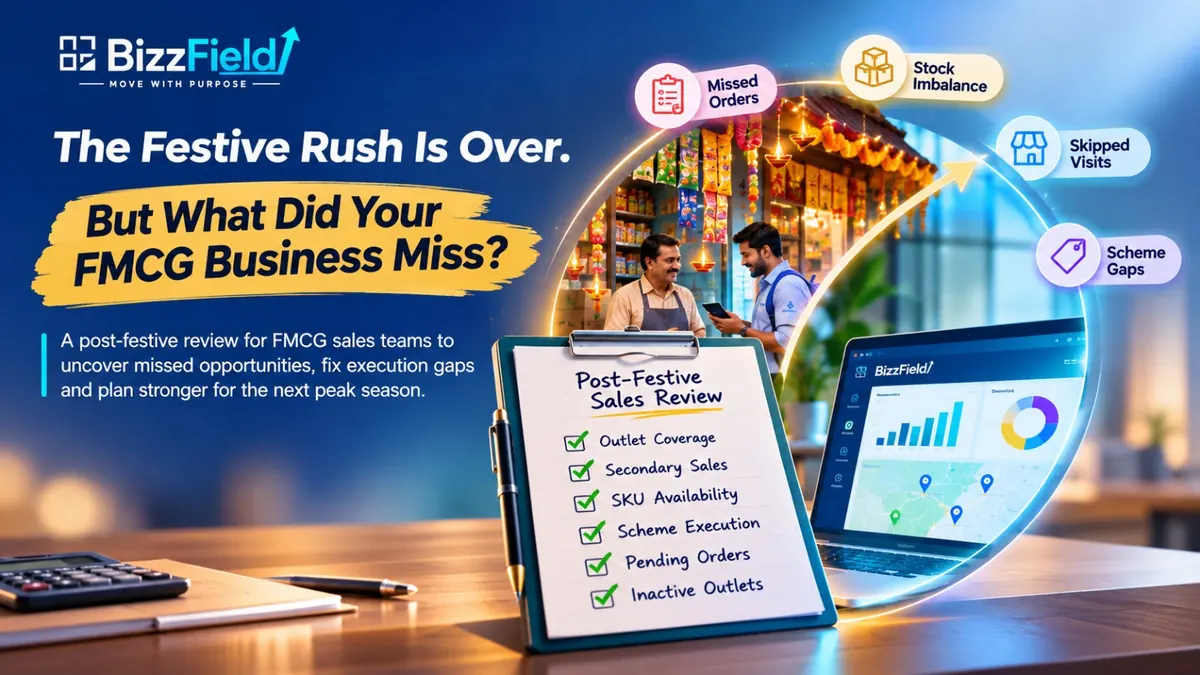
A post-festive review for FMCG sales teams: where sales slip through during peak demand, what to examine now, and how better field visibility helps before the next season.
By the time festive dispatches wind down, most FMCG sales teams have been stretched for weeks. Retailers place advance orders before the festival, and some come back with smaller top-up requests as stock moves faster than they planned. Distributors juggle vehicles, credit limits and delivery slots. Reps carry long beat lists and get pulled off them by urgent calls. The primary sales number usually looks healthy at the end of it.
But being busy with orders and having visibility into the market are two different things. During the rush, attention goes to the orders in hand, and very little goes to what is happening between orders. An outlet that never got a visit, an SKU that ran out in the third week, a retailer who bought elsewhere because delivery slipped: none of these announces itself. They surface later as a weaker month, or they don't surface at all.
So the useful question after the festival isn't only how much was sold. It is what our sales team actually missed while managing the festive rush.
Sales numbers show what moved, not what was missed
Three numbers get blended together in post-festive reviews, and they tell different stories:
- Primary sales are what the company sells to distributors or super stockists.
- Secondary sales are what distributors sell to retailers.
- Retail offtake is what consumers actually purchase from retail shelves. Some businesses also track related retailer-to-consumer movement as tertiary sales.
A strong primary figure confirms that stock entered the channel. It doesn't confirm that stock left it. Distributors often load up before a festival, and if secondary sales and offtake don't keep pace, that inventory sits in godowns and on retail shelves, tying up working capital and shaping what the distributor is willing to order next. The primary number can look good while the market is telling a more cautious story.
Where festive sales usually slip through
Not every business faces all of this. It depends on the category, the territory and how the distribution network is run. But an ASM or distributor will probably recognise most of the following.
The retailer who didn't wait
A retailer wants a few more cartons before Diwali. Some retailers prefer smaller, more frequent replenishment orders, particularly when they are cautious about holding excess stock after the festival. For sales teams, this can mean more frequent visits and closer coordination with distributors. If the rep can't reach the outlet in time, or the delivery slips by a day or two, the retailer may simply call another distributor.
A missed visit is not just a gap in an attendance record. It can mean a replenishment requirement was never understood. One such case is minor. Repeated across outlets, it can show up as soft secondary sales in a territory. And because a lost order often leaves no direct record in the sales report, it can be difficult to identify exactly where the opportunity was missed.
Stock in the wrong place
Demand rarely moves evenly. One outlet or territory runs through a particular pack size while a distributor elsewhere is holding the same SKU unsold. The shelf stays empty in one place, and working capital stays locked in another.
Excess inventory is not just unsold stock. It affects what the distributor can afford to buy in the next cycle, and often what the manufacturer can expect to dispatch. Fixing this needs outlet-level demand feedback and reliable inventory data from the ERP or distributor management system. No single report provides both.
A beat plan that looked complete
On paper, the rep had a full beat planned for the day. In practice, some shops were closed for puja, traffic ate into the morning, and urgent orders pulled the rep to another part of the territory. Several outlets were skipped. Unless the rep reports it and the manager acts on that information, the gap may remain unnoticed until a retailer complains or the monthly numbers arrive.
Schemes that meant different things to different people
A festive scheme is communicated to retailers through the rep, the distributor's salesman and sometimes a WhatsApp forward. Eligibility, minimum quantities and validity dates get understood a little differently each time. Weeks later, the claims team is reconciling disputes, distributors are waiting on credit notes, and some retailers feel they were promised something they didn't get. That is a lot of effort for what should have been a clear communication in the first place.
After the festival: pending orders, returns and quiet outlets
Some orders booked in the last days of the rush are still pending delivery. Returns and damages are coming back. A few outlets that bought regularly have gone quiet, and some bought noticeably less. If the next round of primary orders is placed on the strength of festive dispatch figures alone, the channel may be restocked ahead of actual movement.
Why WhatsApp, calls and spreadsheets stop being enough
None of these tools is the problem. Many well-run distribution businesses depend on them, and for a small team they work fine.
The trouble starts when a large field team and several distributors are all reporting through different channels at once. Orders sit in chat threads until someone enters them. Visit reports are written from memory in the evening. A manager sees what reps choose to send, in whatever format they chose, usually a day or more later. The picture is eventually assembled, but by then the opportunity it was meant to help with has gone.
What SFA software for the FMCG industry actually does in peak season
Sales Force Automation (SFA) is software, usually a mobile app for the field team with a dashboard for managers, that records field activity such as visits, orders, routes and attendance as it happens. In practice, the value of SFA software for the FMCG industry in a post-festive review comes from a few specific capabilities.
Digital order booking.When a rep records the retailer's requirement during the visit itself, there is less dependence on handwritten notes and end-of-day reporting. The order reaches the distributor sooner, and the retailer's request is on record rather than in someone's memory.
Beat planning.Comparing planned visits with actual visits shows managers which outlets were skipped, in which territories and how often. That turns “coverage was a bit patchy” into a list of outlets to revisit.
Retailer management. When order history and visit records sit against each outlet, a rep or manager can see which retailers have stopped ordering or are ordering less than before, and follow up in time.
Secondary sales tracking. Distributor-to-retailer movement gives a different picture from primary dispatches. It shows whether stock is actually flowing out, and which outlets and SKUs are driving it.
GPS and geo-fenced attendance. These records give managers visibility into where the field team was and when. They show that a visit took place at a location, but not whether it was a good visit. Quality still depends on the conversation at the outlet.
Scheme management. When live scheme details reach every rep through the same app, and eligible offers are applied at the time of order booking, there are fewer communication gaps and fewer disputes to reconcile later.
Territory analytics. Side-by-side territory reports help managers spot weaker areas and look into reasons such as low visit frequency, stock gaps or inactive outlets.
One limit is worth stating clearly. SFA is not an inventory management or demand forecasting system. Stock visibility is only as reliable as the connection between the SFA and the ERP, DMS or inventory system that holds the stock data.
What should FMCG sales teams review after the festive season?
A review works best when each item has a question and a follow-up action:
- Primary dispatches versus secondary sales. If secondary movement is well behind primary dispatches, review distributor closing stock SKU by SKU before placing fresh primary orders. Additional dispatches should reflect actual requirements rather than festive sales targets alone.
- Outlet-level orders. Look for retailers whose order size or frequency changed. Those are your first follow-up calls.
- Missed and delayed visits. List the outlets with no visit or a late visit, and ask why. If the pattern is retailer availability, change the visit timing. If it is workload, change the beat.
- SKU availability and excess stock. Compare which SKUs ran short with where surplus sits, and consider rebalancing between distributors before ordering more.
- Pending orders. Find out which orders are still undelivered and why. Pending orders are the ones most likely to push a retailer to a competitor.
- Scheme execution and claims. Check disputed claims for a pattern. If similar disputes keep appearing across outlets, it may be a sign that scheme communication or eligibility guidelines were not clear enough from the beginning.
- Inactive outlets. Separate outlets that went quiet from outlets that were never visited. They need different conversations.
- Territory performance. Compare territories on coverage and conversion, not just volume. A territory recording fewer visits and fewer orders may have a coverage issue. Managers should also review stock availability, retailer buying patterns and local demand before deciding what needs to change.
The value comes from carrying these findings forward: revised beat plans, earlier visits to high-potential outlets, rebalanced stock and clearer scheme communication before the next demand peak.
Plan the next peak while this one is still fresh
Wedding season, summer demand and the next festive cycle will all bring similar pressure, and memory fades quickly. A short, honest review now, written down while records are fresh, is easier than rebuilding the picture next year.
Conclusion
The festive season shouldn't be judged only by how much stock was dispatched or how many orders came in. Retailer coverage, secondary movement, stock availability and the day-to-day gaps in execution matter just as much, because they decide how the next season goes.
If you are looking at SFA software for the FMCG industry to make these gaps easier to see, BizzField SFA covers digital order booking, tour plan and route management, selfie and GPS-based attendance with geofenced check-ins, scheme management, secondary and tertiary sales tracking, and territory reporting, in an app that works offline.
It also integrates with ERP and accounting systems such as SAP, Oracle and Tally rather than replacing them. See the integrations it supports.
Book a BizzField demo to see these workflows against your own outlets, beats and schemes.
Frequently asked questions
Ideally before the next round of primary orders is placed, while order records, visit history and retailer feedback are still fresh. Waiting for monthly closing often means decisions are made on incomplete information.
You need distributor-to-retailer sales by SKU and outlet, plus closing stock. This usually comes from a DMS or an ERP integration. Without it, the comparison depends on manual reports.
No. GPS and geofenced check-ins show that a rep was at a location at a certain time. Whether the visit was useful depends on the order taken, the stock checked and the retailer conversation, which is why visit data should be read alongside order data.
Only to the extent that the data is captured. Offtake is what consumers buy from retail shelves, so it usually needs retailer-level stock or tertiary sales data. Some SFA platforms, including BizzField, offer tertiary sales tracking, but accuracy depends on how consistently that data is recorded.
WRITTEN BY
Shivam Gupta
Brand Manager
Brand Manager with 8+ years of experience in building brands, developing growth strategies, and creating impactful marketing campaigns that drive business success.
Connect on LinkedIn