
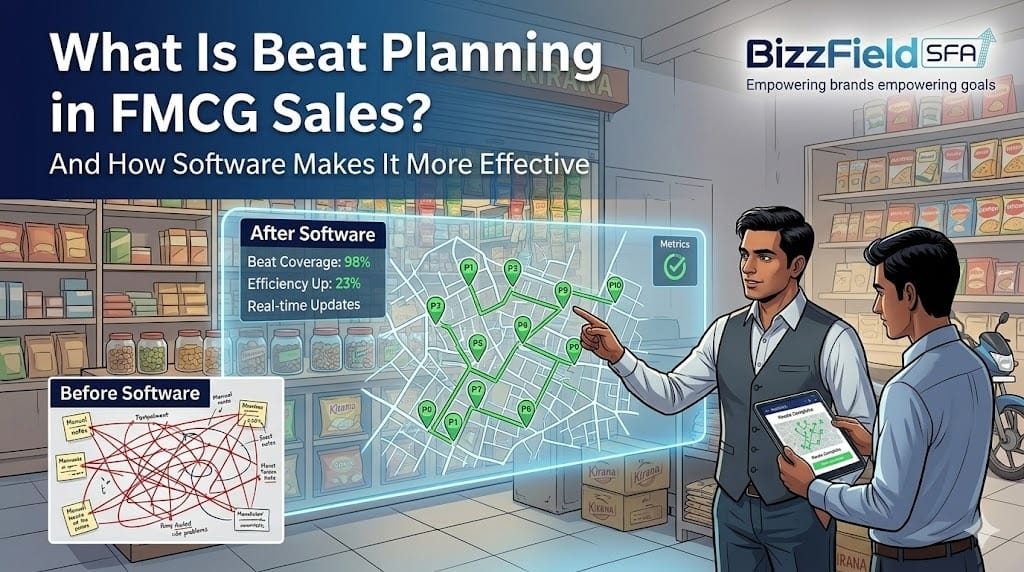
Every FMCG field sales team runs on a beat. The beat is the foundation of how your products reach the shelves — which outlets get visited, how often, by whom, and in what sequence. Get it right and your coverage is consistent, your stockists are well-served, and your secondary sales data is reliable. Get it wrong and entire territories go under-visited, stockists run dry, and your NSM finds out on Friday.
Beat planning is both the most fundamental and the most commonly under-managed part of FMCG field sales operations. Here is what it is and how to make it work better.
1. What Is Beat Planning in FMCG?
Beat planning is the process of designing structured, repeating routes for field sales representatives — defining which outlets they visit, on which days, in what geographic sequence, and how frequently.
A beat is typically a day's work for one TSM (Territory Sales Manager). It includes a list of specific retailers, stockists, or distributors, ordered for efficient travel, with a defined visit frequency based on outlet potential and product category.
The term comes from the traditional "beat" concept used in consumer goods distribution — the rep "beats" (covers) a defined area on a defined schedule. In modern FMCG operations, this is often structured into:
- Daily beats: High-priority modern trade or large-format outlets visited every day.
- Weekly beats: Standard general trade outlets visited 1–2 times per week.
- Fortnightly or monthly beats: Lower-potential or remote outlets visited less frequently.
2. Why Beat Planning Matters for Secondary Sales
The connection between beat planning and secondary sales is direct. Every outlet visit is an opportunity to book an order, check stock, execute a scheme, and verify shelf placement. A missed outlet visit is a missed order — and potentially a stock-out that goes undetected.
When beat planning is weak — too many outlets per rep, inefficient routing, no tracking of visit adherence — the consequences compound:
- High-potential outlets get under-visited because travel inefficiency eats up the day.
- Stock-outs occur because nobody visited the stockist before they ran dry.
- Scheme compliance drops because reps cannot cover all scheme-enrolled outlets on schedule.
- Secondary sales data becomes unreliable because visit records are incomplete.
The Productivity Link
Research across FMCG field operations consistently shows that improving beat plan quality — reducing travel time, increasing productive outlet visits, and ensuring high-potential outlet coverage — is the single highest-ROI operational change for field sales teams before any technology intervention.
3. The 4 Elements of a Good FMCG Beat Plan
Outlet Prioritisation
Not all outlets are equal. A well-designed beat plan segments outlets by revenue potential, visit frequency requirement, and product category relevance — so the TSM's time is allocated proportionally to opportunity, not just geography.
Route Optimisation
The sequence of outlet visits within a beat should minimise travel time and maximise productive selling time. A rep spending 3 hours travelling and 2 hours selling is operating on a poorly designed beat. Route optimisation within the beat is a direct lever on daily output.
Coverage Balance
Each TSM's beat should be calibrated to a realistic number of productive visits per day — typically 15–25 outlets depending on outlet type and visit duration. Overloaded beats lead to rushed visits and skipped outlets. Under-loaded beats leave capacity on the table.
Beat Adherence Tracking
A beat plan has no value if there is no mechanism to verify that it is being executed as designed. Beat adherence — the percentage of planned outlets actually visited — is the primary measure of field execution quality, and it requires a tracking system to monitor.
4. What Beat Planning Looks Like Without and With Software
| Without Software | With SFA Software |
|---|---|
| Beat plans created in Excel by the ASM | Beat plans built in the system, assigned to each TSM's mobile app |
| Distributed on WhatsApp or printed sheets | Updated in real time as conditions change |
| Self-reported by TSMs at end of day | GPS check-ins at each outlet confirm adherence as it happens |
| Adherence verified through Friday call-backs | ASM dashboard shows live beat progress by mid-morning |
| Coverage gaps discovered at monthly reviews | Deviations trigger alerts, not Friday discoveries |
5. How SFA Software Automates Beat Planning for TSMs and ASMs
A beat planning and field sales automation app changes the operational model in three specific ways:
Digital Beat Assignment
ASMs build beats in the system once and assign them to TSMs automatically. Outlet lists, visit frequencies, and route sequences are managed centrally — no more Excel templates or WhatsApp forwards. Changes to the beat are updated in the system and appear on the TSM's phone immediately.
GPS-Verified Visit Execution
TSMs check in at each outlet using the app — the check-in is GPS-stamped at the outlet location and timestamped at the moment of arrival. Visit duration is recorded automatically. Beat adherence is calculated in real time and visible to the ASM throughout the day.
Intelligent Beat Optimisation
Over time, the system accumulates data on outlet visit frequency, order value per visit, and coverage gaps — allowing the ASM to refine the beat plan based on actual performance, not assumptions. High-performing outlets can be visited more frequently; low-performing ones adjusted or reassigned.
· No commitment. Live product in 15 minutes.
Explore More from Bizzfield
Shivam Gupta
Brand Manager with 8+ years of experience in building brands, developing growth strategies, and creating impactful marketing campaigns that drive business success.
Frequently asked questions
A beat plan in FMCG is a structured daily route for a field sales representative, listing the outlets to visit, in what sequence, and how frequently. It is the primary operational tool for managing outlet coverage, secondary sales execution, and field rep productivity.
A beat plan is created by segmenting outlets by potential and visit frequency, grouping them geographically to minimise travel time, and assigning a balanced daily load per TSM. It should be reviewed monthly based on coverage data and outlet performance. A free beat plan template for FMCG TSMs is available at bizzfield.com/resources/beat-plan-template.
Beat planning defines which outlets to visit and how often — it is a strategic coverage decision. Route optimisation determines the most efficient geographic sequence for visiting those outlets within a single day — it is an operational efficiency decision. Good beat planning includes both.
WRITTEN BY
Shivam Gupta
Brand Manager
Brand Manager with 8+ years of experience in building brands, developing growth strategies, and creating impactful marketing campaigns that drive business success.
Connect on LinkedIn