
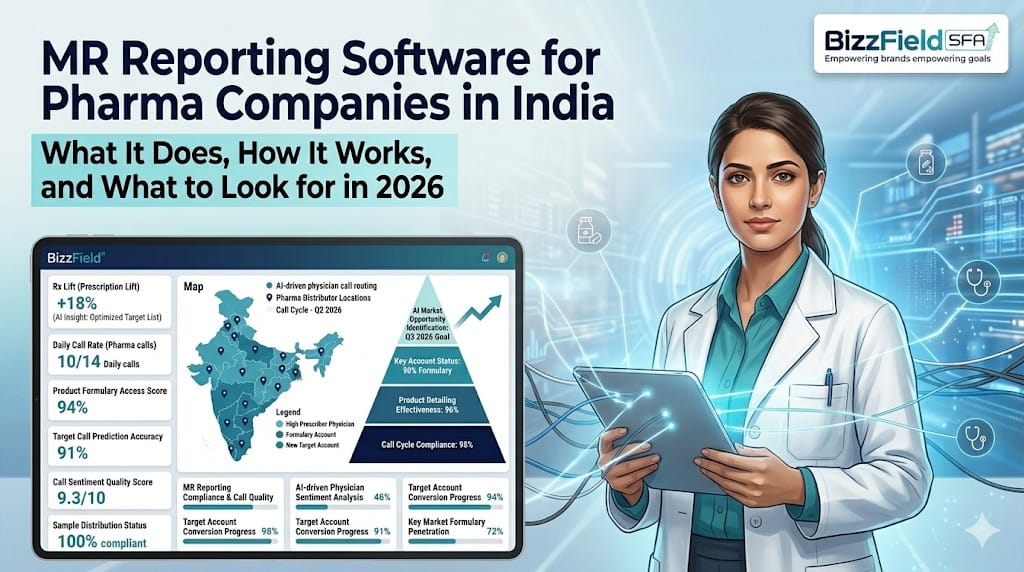
Medical representatives are the revenue engine of every pharma company. They build doctor relationships, communicate product value, manage prescription generation, and maintain chemist supply chains — all on foot, across large territories, every working day.
The quality of an MR's work directly determines how much your products are prescribed. But without the right tools, most of that work is invisible to the managers above them until a weekly report arrives — often inaccurate, always delayed.
MR Reporting Software changes this. It is the category of software that makes pharma field operations visible, accountable, and improvable — in real time.
What Is MR Reporting Software?
MR Reporting Software — also called Pharma SFA (Sales Force Automation) or Medical Representative Management Software — is a mobile and web platform that helps pharmaceutical companies track, manage, and improve the daily activities of their field medical representatives.
It handles the two sides of pharma field operations simultaneously: the MR's side (where to go, what to report, what to submit) and the manager's side (what is happening, who is performing, where the gaps are).
Unlike a generic field tracking app, MR reporting software is built around pharma-specific workflows — doctor and chemist visits, product detailing, sample distribution, prescription-on-board (POB) tracking, tour planning, and regulatory compliance.
"The MR Reporting Software market in India is growing at 15% CAGR and is projected to reach USD 6 billion globally by 2033. Adoption rates among Indian pharma companies are at 65% and rising rapidly — driven by the need for field accountability, compliance documentation, and real-time sales visibility."
How MR Reporting Software Works — Step by Step
Understanding the day-to-day flow helps clarify what changes when a pharma company deploys MR reporting software.
1. Tour Planning
MRs receive their weekly beat plan — list of doctors and chemists to visit, segmented by priority and specialty — directly on the app. No printed lists, no WhatsApp messages.
2. Check-in at Location
When the MR arrives at a doctor's clinic or chemist outlet, they check in on the app. The system records GPS coordinates and timestamp — creating a verifiable visit record at the point of visit, not reconstructed later.
3. Product Detailing and Call Capture
During the visit, the MR logs the call outcome — products detailed, doctor response, samples given, POB status — directly from the app. This is the DCR (Daily Call Report), filed in real time.
4. Order Booking (Chemist/Stockist)
For chemist and stockist visits, the MR books orders through the app — validating SKUs, applying scheme eligibility, and submitting the order to the distributor instantly. No WhatsApp relay. No errors in transcription.
5. Manager Dashboard Update
Every check-in, call report, and order feeds the manager's dashboard in real time. The NSM sees the day's coverage, call quality metrics, sample utilisation, and territory progress — without waiting for any report.
The Single Most Important Thing to Understand
MR Reporting Software doesn't just give you better reports. It gives you the ability to intervene before the damage is done — flag an under-covered territory mid-week, catch a sample over-distribution early, or identify which doctors haven't been visited in 14 days. That is the real value.
The 6 Core Features Every Pharma Company Should Expect
1. GPS-Verified Doctor and Chemist Visits
Every visit geo-stamped and timestamped at the point of check-in. Creates a compliant, auditable field visit record. Look for platforms that verify location without requiring constant connectivity — critical for MRs in semi-urban and rural territories.
2. DCR Automation
Daily Call Reports captured in the app during the visit — not filled in manually at home. Saves MRs 60–90 minutes daily and improves report accuracy. The medical representative reporting software should auto-populate doctor name, date, and location, leaving the MR to add only call-specific outcomes.
3. Doctor Database and Segmentation
Centralised doctor and chemist database with visit history, prescription preference, specialty, and priority tier. MRs see their interaction history before walking into the clinic — enabling personalised detailing, not generic product pitches.
4. Sample Management and Compliance
Sample allocation, distribution per doctor visit, balance tracking, and expiry management — all within the platform. Photo evidence of sample acknowledgement and counter placement supports compliance documentation.
5. POB and Prescription Tracking
Prescription-on-Board (POB) tracking measures whether MR visits are actually generating prescriptions. This is the metric that distinguishes activity from impact. Look for software that connects POB data to individual MRs and doctors over time.
6. Territory and Expense Management
Tour plan creation, territory assignment, TA/DA claim submission, and expense approval — all within the same platform. Reduces HR admin overhead and gives managers a complete picture of field costs alongside field performance.
Why Indian Pharma Companies Are Adopting MR Software in 2026
Three converging pressures are driving adoption among pharma companies of all sizes in India right now:
Compliance Requirements Are Tightening
Pharmaceutical companies need auditable records of MR field activity — visit logs, sample distribution, promotional material placement. Manual records are increasingly difficult to defend in internal or regulatory audits.
Doctor Engagement Has Become More Competitive
MRs who use data — visit history, product response, prescription trends — to personalise their calls build stronger doctor relationships than those detailing from memory. The software creates the data.
Real-Time Management Is Replacing Weekly Reviews
NSMs managing 30–100 MRs across states cannot wait for Friday reports. They need to know today which territories are under-covered and which doctors are not being visited — so they can intervene before it affects prescription volumes.
MR Reporting vs Manual DCR — The Practical Difference
The practical difference is not just speed — it is data quality.
| Manual DCR | MR Reporting Software |
|---|---|
| Filled at home, from memory, in the evening | Captured at the location, during the visit |
| Visit time and outcomes reconstructed — not captured | GPS-stamped, timestamped, outcome-specific |
| Reports look complete but are frequently inaccurate | Compliant, accurate field record — what actually happened |
| NSM sees data on Friday — 4 days late | NSM sees live dashboard — updated throughout the day |
| Sample distribution: trust & hope | Sample tracking per doctor, per visit — with photo proof |
Managers making decisions on accurate, real-time data make faster, better decisions than managers waiting for a Friday Excel. This is the fundamental value proposition of MR reporting software — not just automation, but a data quality upgrade that affects every strategic decision above it.
How to Choose the Right MR Reporting Software for Your Pharma Team
Five questions to ask before choosing a platform:
- Does it work offline? MRs in semi-urban and rural areas need full functionality without constant connectivity.
- Is it built for pharma workflows specifically? Generic SFA tools miss POB tracking, doctor segmentation, and sample management. These are pharma-specific requirements.
- How quickly can it be deployed? Most growing pharma companies need to go live within 30 days — not a 3-month implementation project.
- Does it handle both FMCG and pharma if you have both divisions? A multi-industry platform avoids managing two separate tools for different sales teams.
- What is the per-user pricing for a 10–100 MR team? Enterprise platforms are priced for 500+ users. Mid-market pharma companies need transparent per-user pricing.
💡 The Right Question to Ask Before Choosing
"Does this platform understand what POB tracking is? Does it have a doctor database with visit history? Has it been deployed for pharma MR teams in India?" If the answer to any of these is no — keep looking.
📅 Book a Free Demo — See Bizzfield Pharma MR Reporting Live
15 minutes. Live product. No obligation.
Shivam Gupta
Brand Manager with 8+ years of experience in building brands, developing growth strategies, and creating impactful marketing campaigns that drive business success.
Frequently asked questions
MR Reporting Software is a digital platform that helps pharmaceutical companies track and manage the daily field activities of medical representatives — including GPS-verified doctor and chemist visits, automated DCR filing, sample management, POB tracking, and expense management — giving managers real-time visibility into field operations.
A CRM manages customer relationships and sales pipeline stages — typically for inside sales or account management. MR Reporting Software manages physical field activities: where MRs go, who they visit, what they detail, what samples they distribute, and what prescriptions they generate. In pharma, field activity drives prescription revenue — MR software is the operational tool, CRM is the relationship tool.
Yes. MR reporting software designed for growing pharma companies — not enterprise systems — can be deployed for teams of 10 to 200 MRs in under 30 days, with per-user pricing, minimal IT requirement, and an interface that MRs can learn within a day.
Platforms built for Indian pharma field teams support offline check-ins and DCR capture in low-connectivity areas, syncing visit, sample, and order data automatically once the MR's device reconnects.
WRITTEN BY
Shivam Gupta
Brand Manager
Brand Manager with 8+ years of experience in building brands, developing growth strategies, and creating impactful marketing campaigns that drive business success.
Connect on LinkedIn