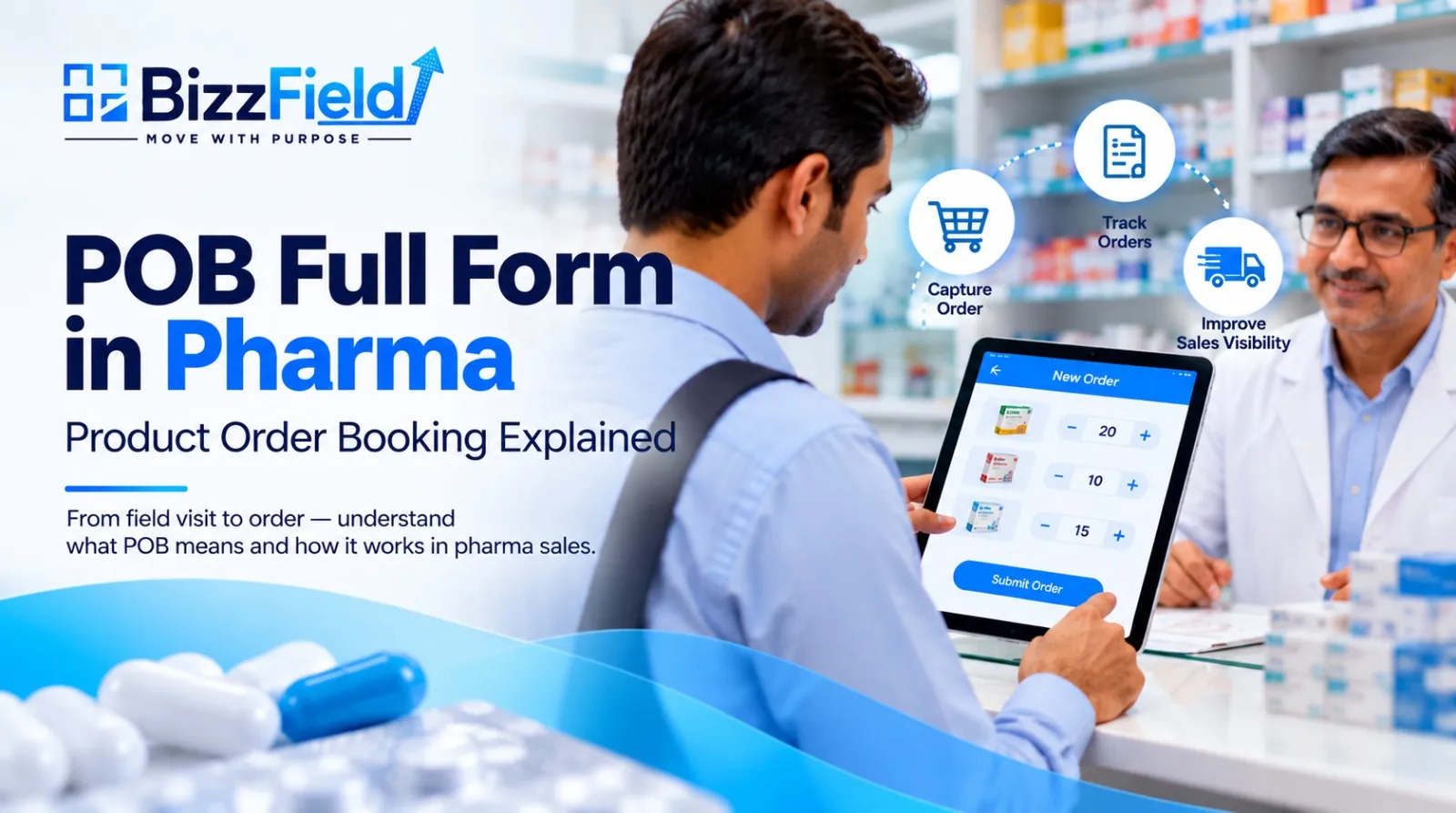
If you've sat in a pharma sales review, you've heard someone say “POB is down this month” or “Rahul's POB is strong in that territory.” And if you're new to the industry, you may have nodded along without being fully sure what it covered.
POB stands for Product Order Booking. It is the record of what a customer wants to buy: which products, and how many. A medical rep or sales officer captures it during a visit, and it then moves into the company's sales and distribution process.
Simple enough. But there's a catch that trips up a lot of teams, so let's get it out of the way early.
What POB Actually Means
POB is the booking of an order. That's all. It doesn't mean the stock has been dispatched, delivered, or invoiced, and it isn't a completed sale yet.
The customer could be a chemist, a retailer, a stockist, a hospital, or any other account your team handles. A typical POB entry captures:
- The customer or outlet
- The product (or SKU) and quantity
- The order date
- The rep who booked it
- The territory
- Any remarks, plus the order status
What happens to the order afterwards depends on how your company is set up. Some teams punch it into a mobile app. Others still rely on notebooks, WhatsApp messages, phone calls, or an Excel sheet that someone updates at the end of the day.
How POB Works in a Normal Field Day
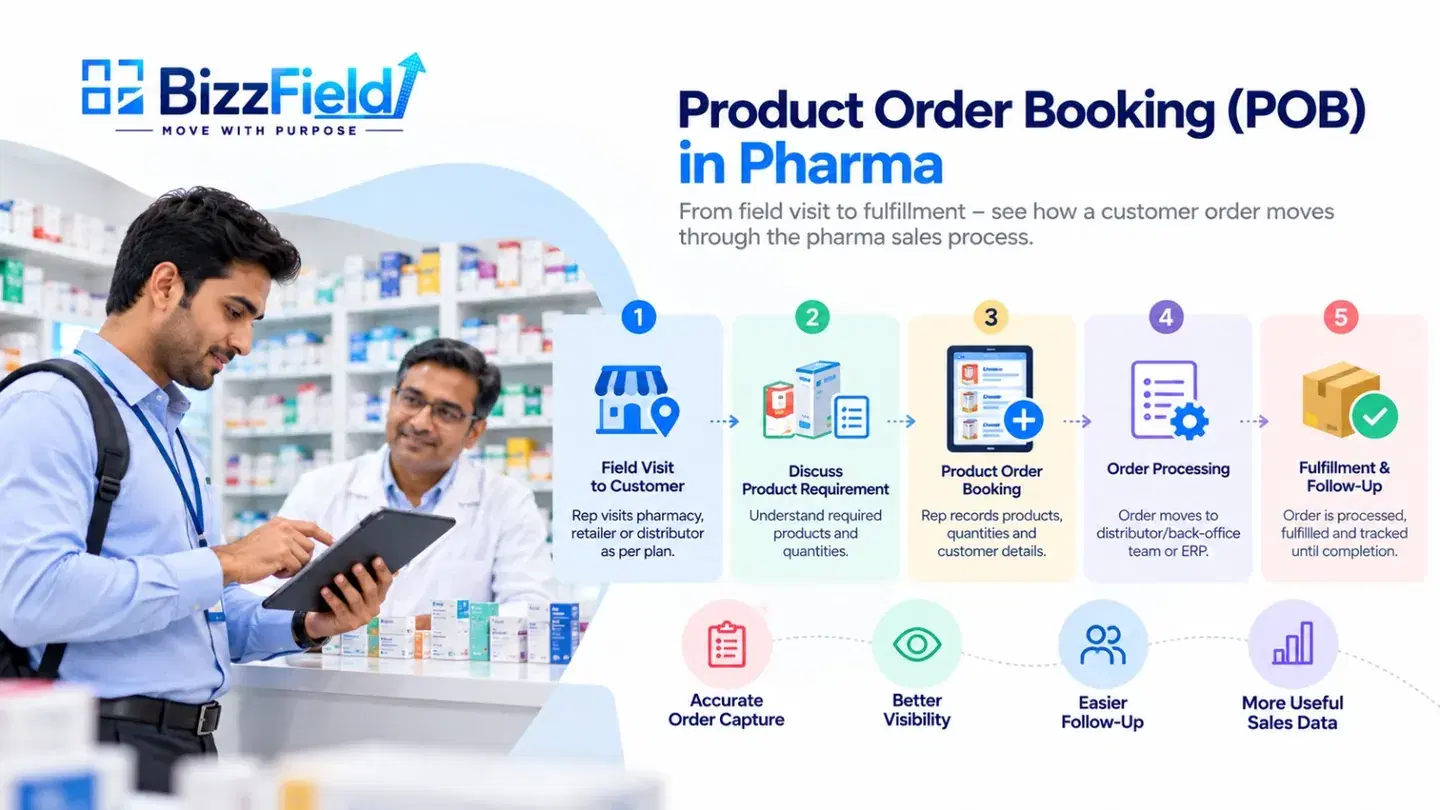
Here's how it usually plays out:
- The rep visits the customer. This follows the visit plan, ideally the one set out in your PJP (Permanent Journey Plan).
- The need comes up. The chemist is running low on a few products, or a distributor wants to restock before the month ends.
- The rep records the order: customer, products, quantities.
- The order goes to the next stage. That could be a distributor, a stockist, your back-office team, or an ERP.
- Someone follows it up. Pending orders get chased, and the team checks what has been fulfilled.
This is why POB matters more than it looks. It's the moment when something said across a counter becomes a number your company can actually work with.
A Quick Example
Say a rep visits a pharmacy and the owner needs three products. The rep notes down:
| Product | Quantity |
|---|---|
| Product A | 20 |
| Product B | 10 |
| Product C | 15 |
That's the POB. If the rep enters it straight into a mobile app, it reaches the system right away. If it goes into a notebook first, someone has to re-enter it later, which is exactly where mistakes and delays creep in.
Why POB Matters for Field Teams
When you have five reps, you can keep track of orders in your head. When you have fifty reps across several territories, you can't.
A clean POB process helps in four practical ways:
- Accurate orders. Fewer misread handwritten notes and fewer wrong SKUs.
- Visibility for managers. You can see what your team is booking without calling each person.
- Easier follow-up. You know what was ordered, so you know what to chase.
- Better reporting. Order data you can slice by product, customer, territory, or rep is far more useful than a pile of notes.
POB vs Primary Sales vs Secondary Sales
These three terms get mixed up constantly, so here is the difference:
| Term | What it means | Where it sits |
|---|---|---|
| POB | Booking a customer's product order | The field-sales activity |
| Primary Sales | Company to distributor/stockist | Company-level transaction |
| Secondary Sales | Distributor/stockist to retailer or market | Distribution-level transaction |
POB isn't a third kind of sale. It describes the act of booking an order, while primary and secondary sales describe where a transaction sits in the supply chain. That's why you shouldn't automatically count POB as either one in your reports. If you work on the distribution side, our piece on how DMS software improves secondary sales visibility goes deeper into that part of the chain.
Where Manual POB Starts Hurting
Notebooks and WhatsApp work fine at a small scale. The trouble starts as you add reps, products, and territories:
- Double entry. The order is written in the field, then typed again at the office. Every extra step is another chance for an error.
- Wrong products or quantities. A pharma portfolio has many pack sizes and SKUs, and a small slip means a follow-up call.
- Delayed visibility. Managers wait for end-of-day messages before they know what was booked.
- Hard-to-find orders. When details are spread over notes, calls, and chats, finding one order later takes real effort.
- Messy reports. Unstructured data is painful to consolidate by customer, product, or rep.
How a Pharma SFA Helps With POB
A Sales Force Automation (SFA) platform ties order booking into the rest of the field workflow, so it stops being a separate admin task. Instead of reps booking orders in one place, reporting visits in another, and managers piecing it together later, everything lives in one flow.
With BizzField's Pharma SFA, your team can handle MR reporting, doctor visits, DCR filing, and territory coverage in the same app they use for the field day. You can read more on how the platform fits together on the BizzField SFA page, and if you also manage distributors, take a look at the Distribution Management System. For teams that want to see where their reps actually are, BizzField Tracker covers real-time GPS tracking and verified attendance.
Put together, that gives your team:
- Order capture on mobile, right at the customer's counter
- Structured customer and product data, so there's less free-typing
- Reports you can break down by rep, territory, customer, or product
What to Look for in a POB System
If you're evaluating tools, ask these questions:
- Can a rep book an order in a few taps, without wading through screens?
- Is product and SKU search quick?
- Can the rep see a customer's past orders before the conversation starts?
- Do managers get clear order-status visibility after submission?
- Does it work when network coverage is poor?
- Does it connect to your ERP or distributor systems if you need that?
- Will reps actually use it? If the app is clunky, they'll go back to the notebook.
The last question matters most. The best POB system is the one your field team will open every single day.
Final Thoughts
POB is Product Order Booking, the step where a customer's need becomes a record your company can act on. Whether you capture it in a notebook or an app, the goal is the same: get the right product, quantity, and customer details to the next person in the chain, without delay and without errors.
As your team grows, doing that manually gets harder. A proper digital process keeps it manageable.
Want to see how this works for a pharma field team?
Frequently asked questions
Product Order Booking, meaning the capture of a customer's requirement for specific products and quantities.
It's the process of recording an order during a sales interaction, usually at a chemist, stockist, or hospital.
No. POB is the act of booking an order. Secondary sales refer to product movement from distributor to retailer.
Field reps usually capture it. After that, sales operations, distributors, or stockists may process it, depending on how your company works.
Customer, product or SKU, quantity, date, rep, territory, remarks, and order status.
It digitises order capture, organises customer and product data, gives managers visibility, and links orders with the rest of the field workflow. If you're also tidying up your field reporting, our guide to RCPA in pharma is a good next read.
WRITTEN BY
Urvashi Srivastav
VP, Business Management & Client Relationships
VP at BizzField, working across business management and client relationships — building strong partnerships, streamlining operations and driving business growth.
Connect on LinkedIn