

Quick summary: What is the PJP full form?
PJP stands for Permanent Journey Plan. It is a recurring visit schedule used in pharmaceutical and FMCG sales that assigns target customers (doctors, chemists, retailers, or distributors) to specific days or cyclical coverage intervals, ensuring predictable and verifiable market coverage.
If you've ever opened a spreadsheet on a Monday morning trying to work out which doctors or retailers a rep is supposed to see that week, you already understand why PJP planning exists.
The PJP full form is Permanent Journey Plan, and it's essentially the answer to a question every field sales manager asks sooner or later: who gets visited, on which day, and how do we know it actually happened? This article looks at what a Permanent Journey Plan means, why pharma and FMCG teams rely on it, how to build one reps can realistically follow, and where it fits alongside beat plans and daily tour plans.
What Is the PJP Full Form?
PJP stands for Permanent Journey Plan— a recurring visit schedule that assigns customers, doctors, chemists, retailers, or distributors to specific days or coverage cycles. In pharma, it's the framework that decides which doctors a Medical Representative (MR) sees, and how often. In FMCG, the same logic applies to outlets, wholesalers, and distributor points, usually grouped by zone or market.
The word “permanent” trips people up. It doesn't mean the plan never changes — it means the coverage structure stays stable for a defined period, so both the rep and the customer know roughly when to expect the next visit. How long that period lasts, and how often it gets revisited, varies by company. Some teams review PJPs monthly, others quarterly, and some only when something in the territory actually changes.
Here's what a pharma PJP might look like in practice for a rep covering 25-odd doctors:
- Monday and Thursday: three or four priority doctors in one part of the territory
- Tuesday and Friday: another cluster of doctors, grouped by location
- Wednesday: a stockist visit followed by a lower-frequency doctor call
This is just an illustration, not a template. The right visit frequency and grouping depends on territory size, travel time, customer priority, and your company's own coverage policy.
Why Is a PJP Important for Pharma and FMCG Sales Teams?
A PJP doesn't guarantee results, but it does solve a specific, everyday problem: without a plan, coverage tends to drift toward whoever is easiest to reach, not necessarily whoever needs a visit most.
- It makes coverage predictable. Instead of reps deciding day-to-day who to see, visits follow a set pattern. That makes it easier to check, over a month or a quarter, whether the full customer base is actually being reached.
- It surfaces gaps in territory management.When visit days are assigned in advance, it's much easier to spot which parts of a territory are getting regular attention and which are being quietly neglected.
- It supports follow-up. A doctor who needs a second visit, or an outlet that needs a scheme update, is easier to slot into an existing plan than into a blank calendar.
- It gives managers something concrete to check against. A written PJP means a manager isn't relying purely on verbal updates from the field — there's an actual plan to compare activity to.
It's worth being honest about the limits here too. A PJP is a planning tool. It doesn't by itself improve doctor relationships, lift coverage, or drive sales — those outcomes depend on execution, product quality, market conditions, and a dozen other factors the plan doesn't control. What a PJP reliably gives you is structure. What comes out of that structure depends on how well it's followed.
How to Create an Effective PJP
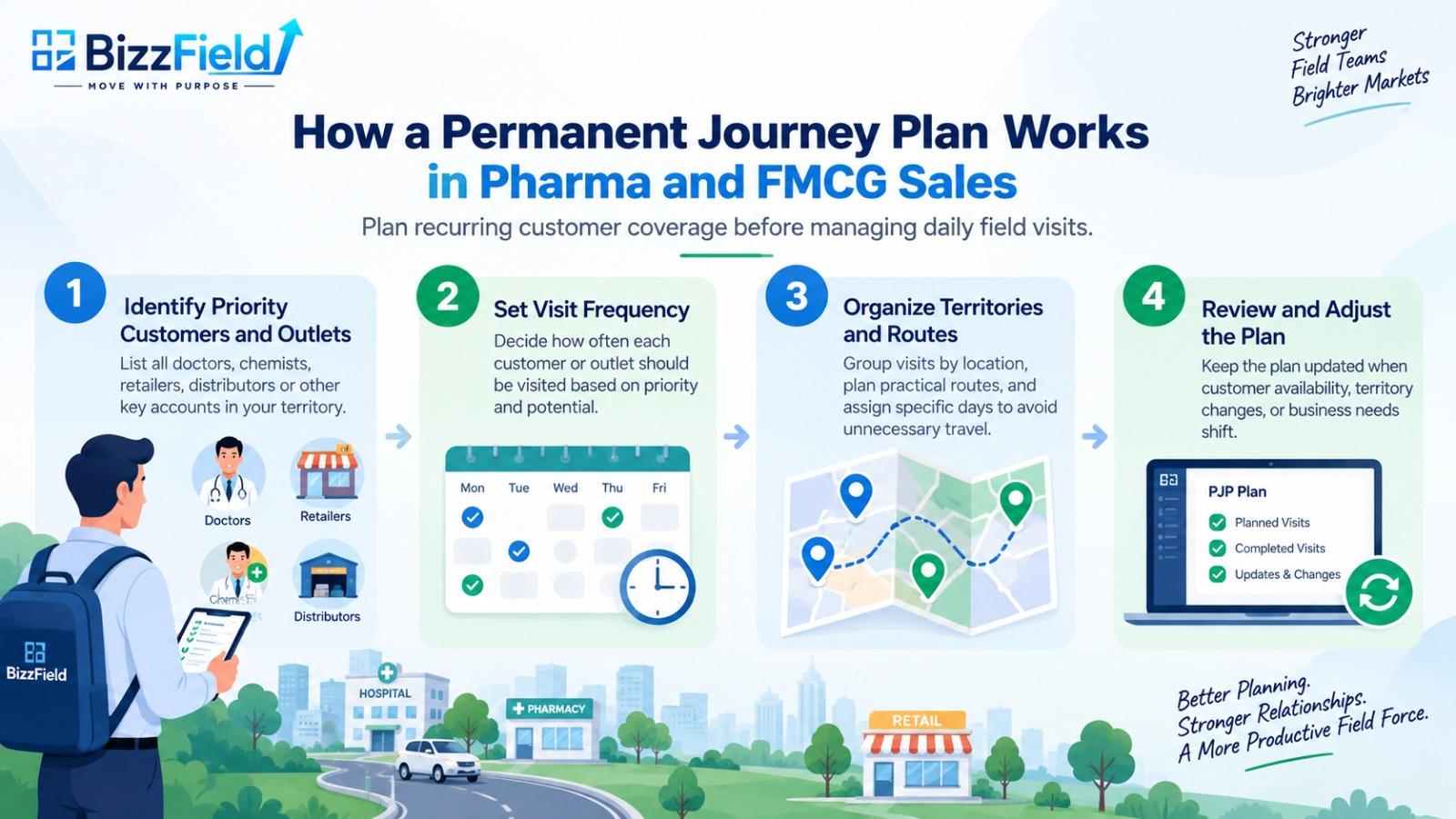
Building a workable PJP tends to follow a similar sequence, whether you're in pharma or FMCG:
- List everyone in the territory. Every doctor, chemist, retailer, or distributor the rep is responsible for, along with location details.
- Classify accounts by importance.Not every customer needs the same visit frequency — a high-prescribing doctor or a high-volume outlet may justify more frequent calls than a smaller one. What counts as “high potential” varies by company and product category, so this needs local judgment, not a fixed rule.
- Assign a visit frequency per segment. Weekly, fortnightly, or monthly, based on the classification above.
- Group visits geographically.Assign specific days so the plan doesn't send a rep zig-zagging across town. This is also where realistic route planning matters — a plan that looks fine on a spreadsheet can still fall apart if the travel between stops isn't practical, which is where sales route management software tends to become useful for teams managing this manually.
- Check workload balance. Make sure visit volume is reasonably even across the team, rather than some reps carrying a noticeably heavier daily load.
- Review and adjust regularly. Doctors change hospitals, outlets close, territories get reassigned — a PJP that never gets updated stops reflecting reality fairly quickly.
A few mistakes show up often enough to be worth flagging: assigning visits without accounting for real travel time, applying the same frequency to every customer regardless of priority, letting the plan go stale when territories change, and tracking only what was planned without checking what actually got completed.
PJP vs Beat Plan vs Daily Tour Plan
Company terminology isn't fully standardized here — some organizations treat the PJP as the long-term coverage plan and the beat plan as its execution layer; others use the two terms almost interchangeably. For this article, PJP is the longer-term coverage framework, and beat planning is how that coverage gets executed day to day.
| Dimension | PJP (Permanent Journey Plan) | Beat Plan | Daily Tour Plan |
|---|---|---|---|
| Time horizon | Recurring coverage cycle (weeks to months) | Per-beat execution plan | Single day |
| Main purpose | Decides who gets covered, and how often | Decides the outlets, days, and route for a beat | Lists a rep's activities for one day |
| Level of detail | Customer/outlet list mapped to a cycle | Outlets, sequencing, route | Day-specific visits and tasks |
| Update frequency | Periodic, or on business change | As territory/execution needs shift | Daily |
| Sets direction for | Beat plans | Daily tour plans | Completed visit reports / DCR |
In plain terms: a PJP decides which customers or outlets a rep is expected to cover, and over what cycle. A beat plan (or, in some companies, the PJP itself) works out the actual outlets, days, and route needed to deliver that coverage. A daily tour plan narrows things further to what a rep is doing on one specific day.
A quick FMCG example: a Territory Manager might set a PJP where Zone A's 18 outlets are covered every Monday and Thursday, and Zone B, a wholesale cluster, every Wednesday. The order those outlets get visited within a day sits at the beat-plan or daily-tour-plan level — depending on how that particular team draws the line.
Common Challenges with Manual PJP Management
Most teams start out managing PJPs in Excel, and for a small team, that's often fine. The friction shows up as headcount grows:
- Multiple people editing the same spreadsheet, with changes that don't always reach the whole team in time
- Schedule updates shared over WhatsApp or phone calls, which are easy to miss or forget
- Plans that quietly go out of date because nobody's job is to update them
- Little visibility into whether planned visits actually happened, versus just being marked as done
- Difficulty adjusting quickly when a territory, staff member, or customer list changes
None of this means manual planning is wrong for every team — it depends on size, process discipline, and how well updates get communicated. But it's usually the point where growing teams start looking at tour plan management software to cut down on that coordination overhead.
How BizzField Can Support PJP and Field Sales Planning
BizzField is a field sales automation platform, and PJP management is one of the areas it's built to support. Rather than maintaining coverage schedules in a spreadsheet and chasing updates over chat, teams can typically plan and adjust beats and tours within the platform, track visit activity against the plan, and get a more current view of what's actually happening in the field.
In practical terms, this generally covers:
- Structured beat and tour planning: so PJP-level coverage decisions can be translated into specific outlets, days, and routes.
- Territory and route organization: which helps keep travel between stops realistic rather than something worked out after the fact.
- Visit tracking and reporting: giving managers a way to see what was planned versus what was actually completed, rather than relying on end-of-week summaries.
Exactly which of these apply — and details like GPS-based check-ins or offline access — depend on how a team configures the platform, so it's worth confirming the specifics on BizzField's own product pages rather than assuming every feature applies out of the box. The underlying point isn't that software replaces good planning; it's that it removes some of the manual coordination that makes planning hard to sustain as a team grows.
Conclusion
A Permanent Journey Plan gives a field sales team a recurring structure for organizing customer visits — nothing more dramatic than that, and nothing less useful either. Built well, it accounts for customer priority, realistic travel, and fair workload distribution, and it holds up better when it's reviewed regularly instead of left untouched for a year.
Streamline your field coverage with BizzField
If your team is still piecing coverage schedules together across spreadsheets and group chats, explore how BizzField SFA and our tour plan management software automate beat and tour planning in one unified mobile platform.
Frequently asked questions
PJP stands for Permanent Journey Plan. It is a recurring visit schedule used in pharmaceutical sales to assign doctors, chemists, or stockists to specific days or coverage cycles.
Generally, a PJP sets the higher-level recurring coverage schedule (which customers are covered over weeks or months and how often), while a beat plan handles daily route execution—specifying the exact outlets, day-to-day sequence, and travel path.
It provides medical representatives (MRs) with a structured, repeatable schedule instead of deciding who to visit each morning. This predictable routine ensures all target doctors and chemists are covered systematically over time.
There is no single rule, but most teams review PJPs monthly or quarterly. Plans should also be adjusted whenever doctor schedules shift, retail outlets open or close, or territory boundaries are restructured.
Yes. Field sales automation and tour plan management software helps teams maintain digital schedules on reps' mobile devices, push live schedule changes, and compare planned visits against GPS-verified actual visits.
In FMCG sales, a PJP organizes retail outlets, wholesalers, and distributors into balanced geographic cycles so territory coverage remains consistent and predictable rather than reactive.
WRITTEN BY
Urvashi Srivastav
VP, Business Management & Client Relationships
VP at BizzField, working across business management and client relationships — building strong partnerships, streamlining operations and driving business growth.
Connect on LinkedIn