
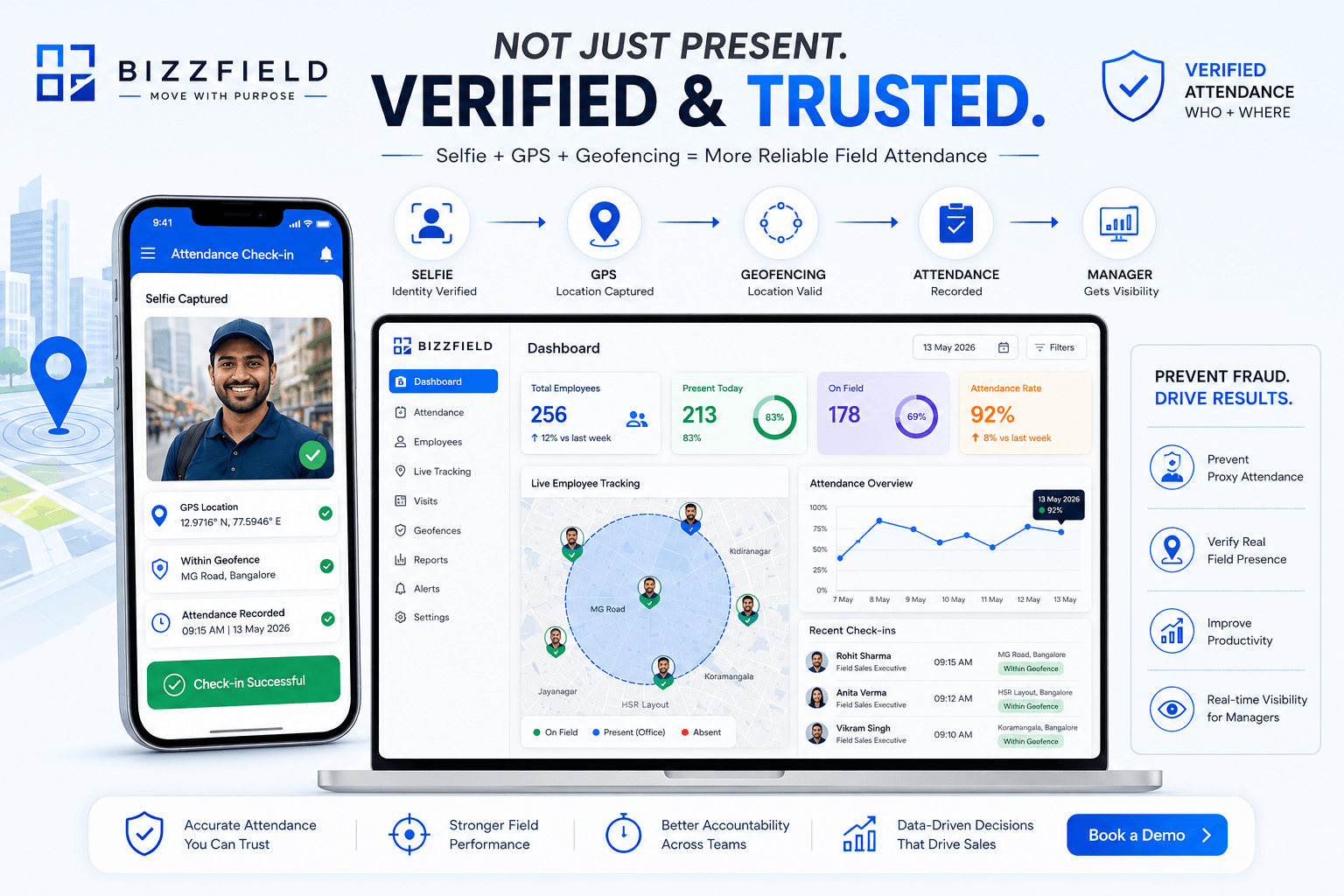
For an office employee, attendance usually answers a simple question: did the employee report to work?
For a field sales representative, the situation is very different. A representative can mark attendance in the morning, appear as “present” in the system, and still leave the sales manager with several unanswered questions.
- Did the representative reach the assigned territory?
- Did they follow the planned route or beat?
- Were the scheduled outlets visited?
- Were doctors or chemists covered?
- Were orders generated?
- Was the day actually spent on field activity?
This is why attendance fraud is a bigger problem for field sales teams. The problem is not limited to employees marking attendance incorrectly. The bigger concern is that a weak attendance process can make it difficult for managers to distinguish between being present and actually executing the day's field-sales plan.
For example, imagine a sales representative marks attendance at 9:30 AM and the company receives a valid attendance record. If the representative then visits only a few outlets instead of the planned territory, the attendance system may still show a normal working day.
In another situation, a representative may send attendance information through WhatsApp or rely on a manually maintained attendance sheet. The manager may have to call the employee, check messages, and compare separate field reports to understand what actually happened.
The attendance record exists. But the field-sales picture is still incomplete. That is the real problem businesses need to solve.
Why Field Sales Attendance Works Differently
Field sales teams operate differently from employees working from a fixed office. Their work happens across territories, outlets, distributors, doctors, chemists, retailers, and other customer locations. Their productivity is therefore connected not just to presence, but to movement, visits, coverage, and sales activity.
This creates several types of attendance-related risks.
Proxy Attendance
One employee may attempt to mark attendance on behalf of another employee. In an office environment, physical supervision may make this easier to identify. In a distributed field team, managers may have less immediate visibility.
Fake Check-ins
An employee may record attendance without beginning the expected field activity. The business receives an attendance entry, but the entry alone does not explain what happened afterward.
Incorrect or Unverified Location
For a field representative, location can matter because the employee is expected to work within an assigned territory. A basic attendance record may confirm that attendance was marked without providing enough context about whether the representative was where they were expected to be.
Attendance Without Field Visits
A representative can be marked present while completing fewer visits than planned. This creates a particularly important gap for sales managers: attendance says “present,” while field execution may tell a different story.
Fake or Incomplete Field Reporting
When attendance and field reporting are managed separately, representatives may submit updates through calls, WhatsApp, spreadsheets, or other manual methods. Managers then have to reconcile different sources of information.
Attendance Without Sales Activity
For a sales organization, presence is not the final objective. The representative is expected to execute activities that contribute to territory coverage and sales — such as outlet visits, doctor visits, order booking, or other assigned activities. If attendance is monitored independently, managers may have limited visibility into that connection.
A Field Representative Can Be “Present” Without Being Productive
This is one of the biggest differences between office attendance and field-sales attendance. Suppose a representative starts the day by marking attendance. From an attendance perspective, the employee is present. But from a sales-management perspective, several questions remain:
- Where did the representative go?
- Which customers were visited?
- Were planned visits completed?
- Was the assigned beat followed?
- Were orders booked?
- Was the territory adequately covered?
This is why attendance should not automatically be treated as proof of productivity. A field representative's job is not simply to be available during working hours. Their job involves executing planned field activities.
So the business needs to look beyond “was attendance marked?” and start asking “what field activity followed that attendance?” That distinction is particularly important when managing a large field force spread across different territories.
Common Types of Attendance Fraud in Field Sales
Attendance fraud does not always look the same. Businesses may encounter different forms depending on how their field teams work and how attendance is recorded.
- Proxy attendance. Another person marks attendance on behalf of the representative.
- Fake check-in. Attendance is recorded even though the representative has not started the expected field activity.
- Location misrepresentation. The attendance record does not provide sufficient confidence that the representative checked in from the expected location.
- Early check-in followed by low activity. A representative marks attendance correctly but completes little of the planned field work afterward.
- Attendance and visit mismatch. Attendance shows a representative as active, while the planned field visits are not completed.
- Manual attendance manipulation. Attendance maintained through spreadsheets, paper registers, calls, or messages can require significant manual verification.
The important point is that not every attendance problem is solved by simply adding another attendance record. The business needs better context around field activity.
Why Does Attendance Fraud Happen in Field Teams?
There is no single reason behind attendance fraud. It can become easier when the organization has limited visibility into remote employees and relies heavily on manual reporting. Some common operational conditions include:
- Large field teams spread across multiple territories
- Managers supervising employees remotely
- Manual attendance processes
- Attendance and sales reporting maintained separately
- Beat plans managed manually
- Field updates shared through WhatsApp or phone calls
- Limited location verification
- No centralized view of field activity
- Managers depending on employees to report their own daily activity
The more disconnected these processes become, the more effort managers may need to spend verifying what actually happened in the field. That makes attendance fraud a management visibility problem, not just an employee attendance problem.
Why Traditional Attendance Methods Are Difficult to Verify
Consider a traditional process: employee → attendance → manager. If the employee marks attendance through a manual register, message, call, or basic check-in system, the manager receives an attendance event. But field sales usually requires a longer chain.
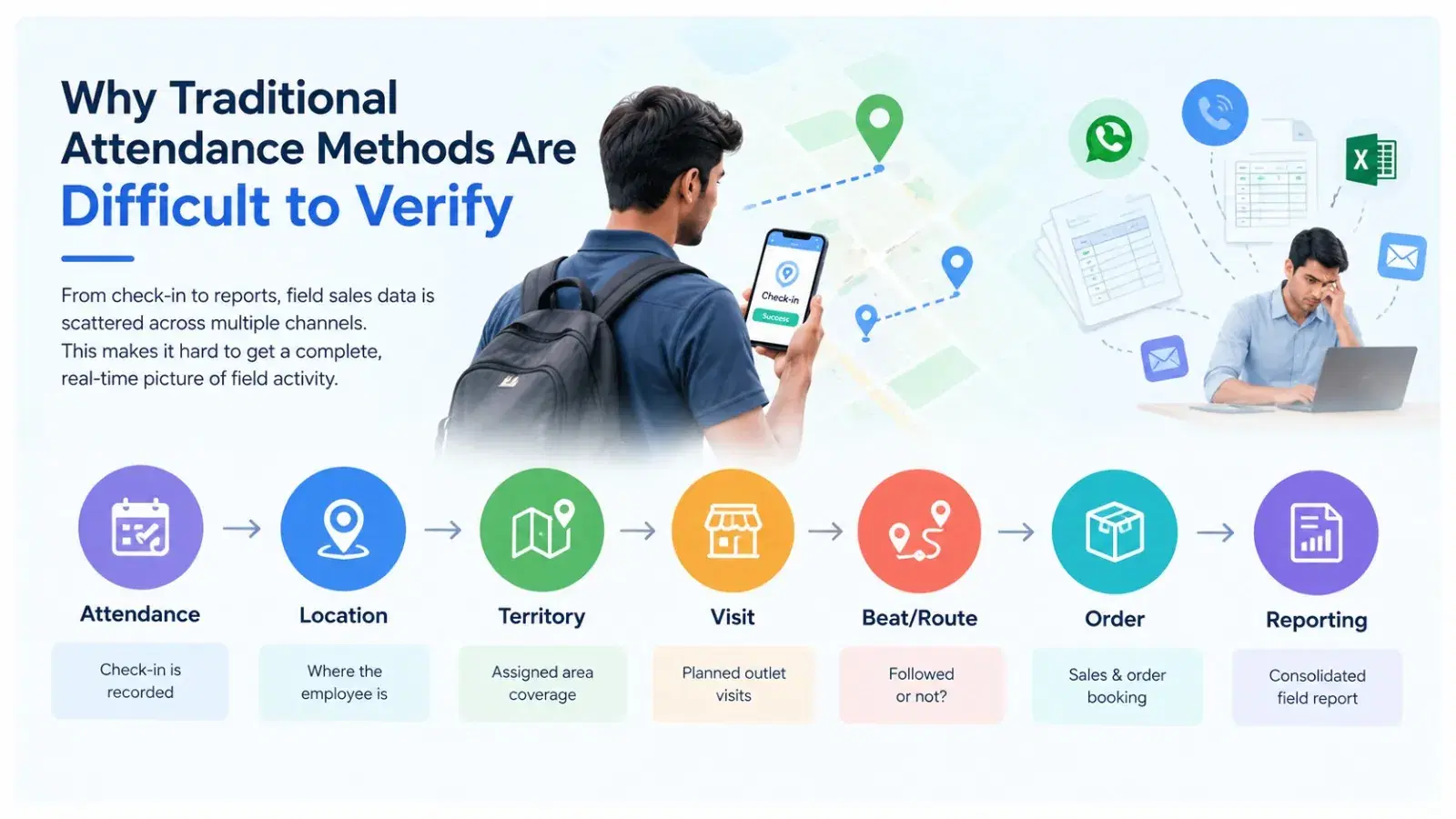
When these activities are maintained separately, managers may need to piece together the information themselves. For example:
- Attendance is recorded in one system.
- Beat plans are maintained in Excel.
- Visit updates arrive through WhatsApp.
- Orders are communicated separately.
- Managers call representatives for clarification.
- Daily reports are consolidated manually.
Each individual process may appear manageable. Together, they create a visibility problem.
What a Basic Attendance Record Cannot Tell a Sales Manager
A basic attendance record can answer “was attendance marked?” But a field-sales manager may need answers to much more specific questions.
| Management Question | Attendance Record Alone |
|---|---|
| Was attendance marked? | Yes |
| Where was the employee? | May require location data |
| Was the location valid? | Not necessarily |
| Was the assigned territory covered? | No |
| Were planned visits completed? | No |
| Was the planned beat followed? | No |
| Were orders generated? | No |
| What field activity happened afterward? | No |
| How did the day perform? | No |
This does not mean that attendance software has no value. It means attendance is only one data point in a field-sales operation. If managers want to understand field execution, they need to connect attendance with the activities that follow it.
Why GPS Attendance Alone Is Still Not Enough
GPS can make attendance verification more useful by adding location information. Instead of simply knowing that an employee checked in, a manager may also have information about where the check-in occurred. But GPS still has a limitation: location is not the same as productivity.
A GPS point can tell a manager where a check-in happened. It does not automatically establish that the representative:
- Followed the planned beat
- Visited the required outlets
- Met the assigned doctors
- Completed the planned territory coverage
- Generated orders
- Performed the expected field activities
So the progression should not be attendance → GPS → problem solved. A field-sales operation needs a broader view: attendance → location → visit → route/beat → sales activity → reporting. That is where an SFA approach becomes relevant. For the mechanics of the verification layer itself, see how selfie check-ins, GPS capture and geofencing work together.
How Can Businesses Reduce Attendance Fraud?
Businesses can use a combination of process controls and technology.
Start With Clear Attendance Rules
Define when and where field representatives are expected to mark attendance. Managers should also establish what counts as a valid field day.
Connect Attendance With Field Activity
Don't review attendance completely separately from field execution. Compare attendance with planned visits, routes, beats, and other assigned activities.
Use Location Verification
GPS can provide additional location context around attendance and field activity.
Use Selfie-Based Attendance
A selfie can provide identity evidence at the time of attendance instead of relying only on a manual check-in.
Use Geofencing Where Appropriate
Geographic boundaries can support location-based controls for attendance or field activities.
Reduce Manual Reporting
If attendance, visits, orders, and reporting are maintained across different channels, managers spend more time reconciling information. Centralizing these activities can reduce that manual dependency.
Review Exceptions Instead of Checking Everyone Manually
The goal should not be for managers to spend the entire day verifying every attendance record. A better approach is to give managers visibility into exceptions, missing activity, location-related issues, and differences between planned and actual execution.
How BizzField Connects Attendance With Field Execution
This is where BizzField's SFA approach becomes relevant. BizzField does not position attendance as an isolated HR event. Instead, attendance can sit within the wider field-sales workflow: selfie/attendance → GPS → geofencing → field visit → beat/route → order → sales activity → reporting. The value comes from the connection between these activities.
Selfie-Based Attendance
Selfie-based attendance adds identity evidence to the attendance process. Instead of relying only on a manual declaration that the representative is present, the attendance workflow can include a selfie at the time of check-in.
GPS Verification
GPS adds location context to attendance and field activity. For distributed sales teams, this helps managers understand the location associated with field execution.
Geofencing
Geofencing can support geographic controls around defined locations or areas. This adds another layer to location-based verification.
Field Visit Visibility
The next question after attendance is what happened in the field. BizzField brings field visits into the same broader SFA workflow, allowing managers to consider attendance alongside actual field activity.
Beat and Route Visibility
Field representatives often work according to planned territories, beats, and routes. Connecting these activities provides greater context around whether planned field coverage aligns with actual execution.
Orders and Sales Activity
For a sales team, field activity ultimately connects to sales execution. Orders and other sales activities provide additional context beyond the initial attendance event.
Centralized Reporting
Instead of depending entirely on phone calls, WhatsApp messages, and spreadsheets, managers can work from a centralized field-sales view. The result is a shift from “did the employee check in?” to “what happened during the field day?”
What Attendance Fraud Looks Like in FMCG and Pharma Sales
Attendance fraud can have different operational consequences depending on the industry.
FMCG Field Sales
For FMCG teams, representatives may be responsible for outlet coverage, retailer visits, beat execution, order booking, and distributor-related activities. A manager therefore needs more than confirmation that the representative was present. The important questions can include:
- Were planned outlets visited?
- Was the assigned beat covered?
- Were orders booked?
- Was retailer coverage completed?
- What happened during the representative's field day?
BizzField's FMCG SFA positioning connects activities such as beat planning, outlet coverage, GPS-related visibility, order booking, and distributor-stock visibility within field-sales management.
Pharma Field Sales
For pharma teams, representatives may work across assigned territories and visit doctors, chemists, and other relevant accounts. Here the management questions can include:
- Did the representative reach the assigned territory?
- Were planned doctor visits completed?
- Were chemist visits completed?
- Was field reporting submitted?
- What activity took place during the working day?
This makes the relationship between attendance and field execution particularly important for pharma field teams.
BizzField vs. an Attendance-Only Approach
The difference can be summarized simply.
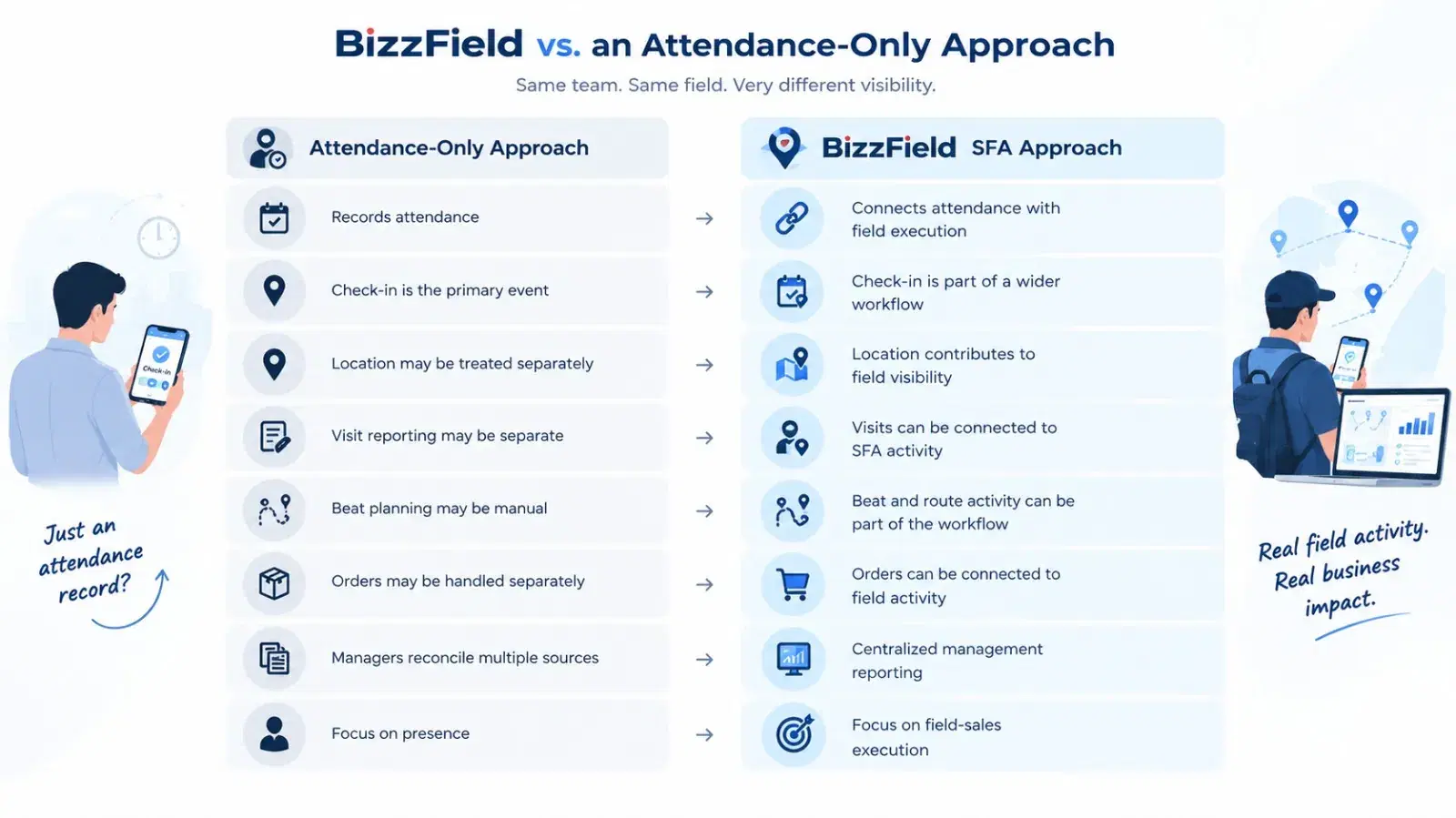
| Attendance-Only Approach | BizzField SFA Approach |
|---|---|
| Records attendance | Connects attendance with field execution |
| Check-in is the primary event | Check-in is part of a wider workflow |
| Location may be treated separately | Location contributes to field visibility |
| Visit reporting may be separate | Visits can be connected to SFA activity |
| Beat planning may be manual | Beat and route activity can be part of the workflow |
| Orders may be handled separately | Orders can be connected to field activity |
| Managers reconcile multiple sources | Centralized management reporting |
| Focus on presence | Focus on field-sales execution |
The point is not that every business needs a full SFA platform simply to record attendance. If attendance recording is the only requirement, an attendance application may be enough. The difference becomes important when the business is trying to manage field-sales execution.
When Is Attendance Software No Longer Enough for a Field Sales Team?
A business may need to look beyond basic attendance when attendance is no longer the main problem. For example, consider an SFA-led approach when:
- Representatives work across multiple territories.
- Managers cannot efficiently verify field visits.
- Attendance and sales activity are maintained separately.
- Orders are coming through WhatsApp.
- Beat plans are managed manually.
- Managers spend significant time chasing daily reports.
- Retailer, doctor, chemist, or distributor information is fragmented.
- Management wants visibility into field execution rather than attendance alone.
These situations indicate that the business is dealing with a broader operational challenge. The question is no longer “how do we record attendance?” It becomes “how do we know what our field team is actually doing?”
Reduce Attendance Fraud by Improving Field Visibility
Attendance fraud becomes a bigger problem for field sales teams because a false or incomplete attendance record can hide more than employee presence. It can hide the difference between being present and executing the planned field-sales activity.
A selfie can provide identity evidence. GPS can provide location context. Geofencing can support location-based controls. But the strongest visibility comes when attendance is considered alongside field visits, beats, routes, orders, sales activity, and reporting. That is the role of an SFA-led approach.
BizzField brings these field-sales activities into a connected workflow, helping managers move beyond an isolated attendance record toward a broader view of field execution. So instead of asking only “did my sales representative mark attendance?” businesses can start asking “did the representative actually execute the field plan?”
If attendance fraud is only one part of your field-sales visibility problem, see how BizzField can fit into your actual sales workflow. Book a BizzField demo.
Frequently asked questions
Because a field representative can mark attendance, appear as present in the system, and still leave the manager unable to tell whether the assigned territory was reached, the planned beat was followed, or the scheduled outlets were visited. A weak attendance process makes it difficult to distinguish between being present and actually executing the day’s field-sales plan.
Proxy attendance, fake check-ins, location misrepresentation, an early check-in followed by low activity, a mismatch between attendance and planned visits, and manual attendance manipulation through spreadsheets, paper registers, calls or messages.
No. Location is not the same as productivity. A GPS point tells a manager where a check-in happened; it does not establish that the representative followed the planned beat, visited the required outlets, met the assigned doctors, completed territory coverage, or generated orders.
There is no single reason. It becomes easier when an organization has limited visibility into remote employees and relies heavily on manual reporting — large teams across multiple territories, remote supervision, manual attendance, attendance and sales reporting kept separately, beat plans managed by hand, and field updates arriving through WhatsApp or phone calls.
Through a combination of process controls and technology: define clear attendance rules and what counts as a valid field day, review attendance alongside field execution rather than separately, add location verification and selfie-based check-in, use geofencing where appropriate, reduce manual reporting, and give managers visibility into exceptions instead of asking them to verify every record by hand.
When attendance is no longer the main problem — representatives work across multiple territories, managers cannot efficiently verify field visits, attendance and sales activity are maintained separately, orders arrive through WhatsApp, beat plans are managed manually, and management wants visibility into field execution rather than attendance alone.
WRITTEN BY
Shivam Gupta
Brand Manager
Brand Manager with 8+ years of experience in building brands, developing growth strategies, and creating impactful marketing campaigns that drive business success.
Connect on LinkedIn