
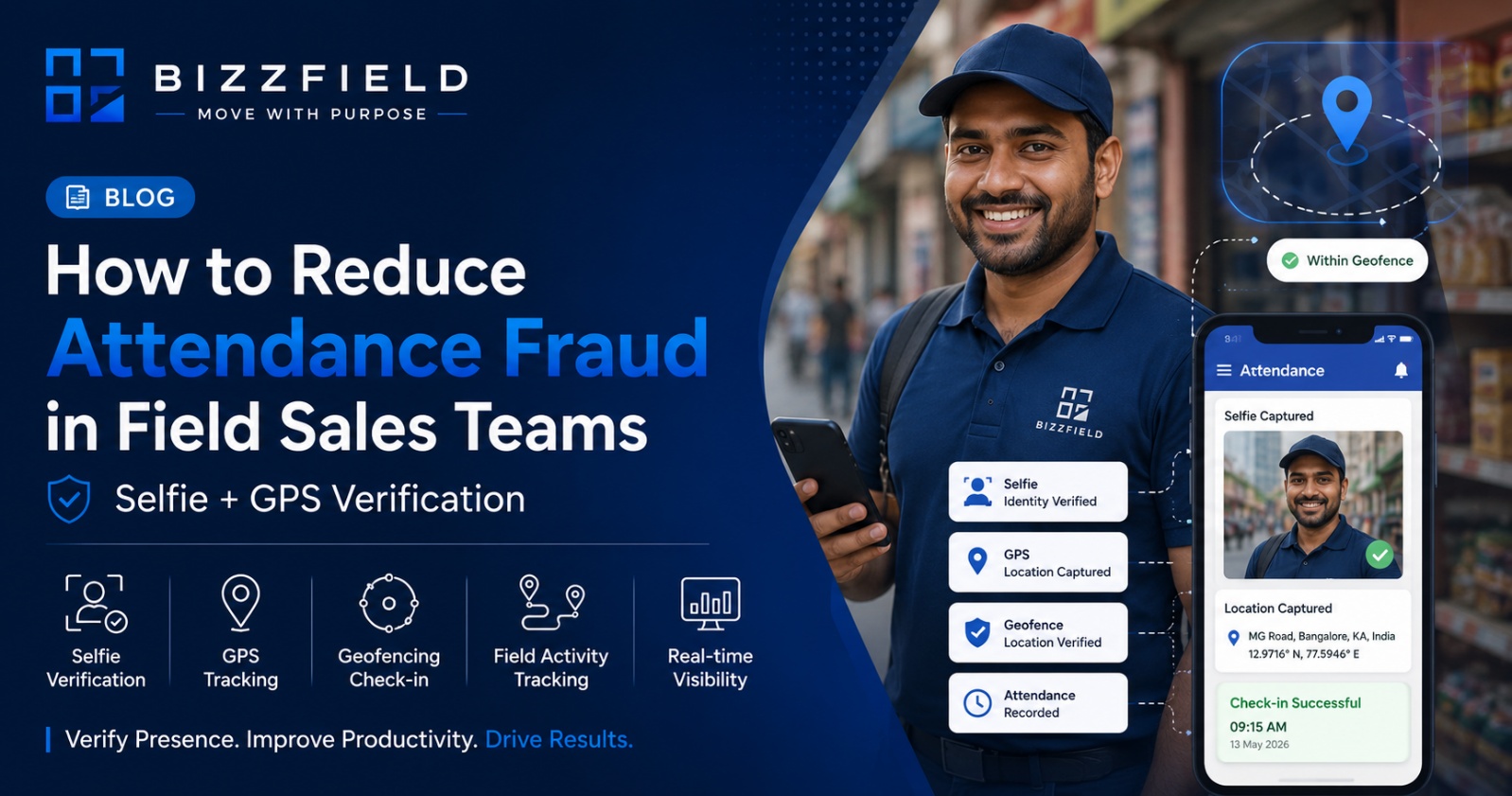
If you manage a field sales team, you already know the uncomfortable truth: attendance data alone doesn't tell you whether your team is actually in the field. A rep can mark "present" and still never leave home. A manager can approve a check-in and have no real way to confirm where it happened. This isn't a minor administrative issue — it's a visibility gap that quietly erodes territory coverage, retailer relationships, and revenue.
This guide breaks down why attendance fraud is so hard to catch in field sales, the specific forms it takes, and how selfie-based check-ins, GPS location capture, and geofencing work together to close the gap — without turning your attendance system into a surveillance exercise.
Why Attendance Fraud Is Difficult to Detect in Field Sales
Office attendance is easy to verify: someone either walks through the door or they don't. Field sales doesn't work that way. Your team is spread across territories, moving between retailers, distributors, and customer sites all day. There's no single "door" to watch.
Traditional attendance systems — punch registers, basic mobile check-ins, or even simple time-stamped apps — were built for people who stay in one place. They record that someone marked attendance, not where they actually were when they did it. That distinction matters more than most sales operations teams realize until the numbers start slipping: territories that look "covered" on paper but aren't converting, retailers who say they haven't seen a rep in weeks, or attendance logs that are suspiciously identical day after day.
Fake or proxy attendance directly affects sales operations in ways that are easy to underestimate:
- Distorted productivity metrics. If attendance is fabricated, every KPI built on top of it — visits per day, territory coverage, call efficiency — is unreliable.
- Missed retailer and distributor relationships. Fewer real visits mean weaker account relationships and slower issue resolution on the ground.
- Payroll and incentive leakage.Attendance often ties directly to allowances, incentives, or compliance — fraudulent records mean you're paying for work that didn't happen.
- Blind spots in decision-making.Managers plan territory strategy based on activity data. If that data isn't grounded in verified presence, the strategy is built on a false picture.
This is why identity and location verification matter as much as the act of recording attendance itself. For field sales teams, attendance verification should establish both who checked in and where they checked in — not just that a check-in happened.
What Is Attendance Fraud in Field Sales?
Attendance fraud in a field context refers to any situation where recorded attendance doesn't accurately reflect a field employee's real presence, identity, or location at the time of check-in. In practice, it shows up as:
- Proxy attendance — one team member marking attendance on behalf of another
- Fake check-ins — attendance recorded without any real field activity behind it
- False location reporting— check-in location that doesn't match where the employee actually is
- Attendance without field presence— a rep marked "on duty" who never left home or office
- Fake field visits — a visit logged as completed that never took place
None of these are necessarily malicious in every case — sometimes it's a rep running late and "backdating" a check-in, sometimes it's genuine gaming of the system. Either way, the operational impact is the same: the data managers rely on stops reflecting reality.
Why Traditional Attendance Systems Fail for Field Sales Teams
Most attendance tools were designed for fixed-location workforces and simply don't translate to a mobile sales force.
- Office-based systems don't reflect field movement. A time-in/time-out log tells you nothing about where someone went afterward.
- A check-in alone doesn't prove physical presence. Tapping "present" on a phone requires no evidence that the person is actually where they claim to be.
- Manual verification doesn't scale. A sales ops manager cannot personally confirm the location of 20, 50, or 200 field reps every day.
- Continuous oversight isn't realistic. Managers can't watch every employee in real time, so gaps go unnoticed until they show up in missed targets.
- Location data is often missing or unreliable. Without a system built to capture and verify location at the moment of check-in, you're left trusting self-reported information.
The result is an attendance system that satisfies a compliance checkbox but doesn't actually tell sales leaders what's happening on the ground.
Common Types of Field Attendance Fraud
Understanding the specific patterns helps sales operations teams know what to look for and design against.
Proxy Attendance
One employee marks attendance on behalf of another — a colleague, friend, or family member checks in using the absent employee's device or credentials.
Fake Location Check-In
Attendance is recorded without the employee being physically present at the required location, often by manually entering or spoofing a location.
False Field Visit
A representative reports a customer or retailer visit that never actually happened, usually to inflate call or coverage numbers.
Location Manipulation
Deliberate attempts to make the system report an inaccurate location — using GPS spoofing apps, mock location settings, or check-ins made from a different device.
Repeated or Unverified Check-Ins
Attendance records that consistently lack corroborating evidence — no photo, no location trail, no linked activity — making them impossible to confirm after the fact.
5 Ways to Reduce Attendance Fraud in Field Sales
There's no single fix for attendance fraud, but combining a few verification layers closes most of the gaps traditional systems leave open.
1. Use Selfie-Based Attendance
Capturing a live selfie at the moment of check-in establishes who is actually marking attendance — not just that someone with access to the app did. This alone significantly reduces proxy attendance, since it requires the actual employee to be present at the device.
2. Verify GPS Location
Recording the employee's GPS coordinates at check-in — and comparing that against their assigned territory or expected work area — confirms where the attendance was marked from, not just that it was marked.
3. Use Geofencing
Geofencing takes location verification a step further by defining approved geographic zones and only allowing attendance to register when the employee is physically within that radius. This restricts check-ins to legitimate locations by design, rather than relying on after-the-fact review.
4. Track Field Activity
Attendance data means more when it's cross-checked against actual field movement — visits logged, routes travelled, time spent at each stop. Inconsistencies between "present" status and field activity are one of the clearest fraud indicators.
5. Give Managers Real-Time Visibility
None of the above matters if managers can't see it. A centralized dashboard that surfaces attendance, location, and activity data in real time lets sales ops flag suspicious patterns early, rather than discovering problems in a monthly report.
Selfie + GPS Verification: How It Works
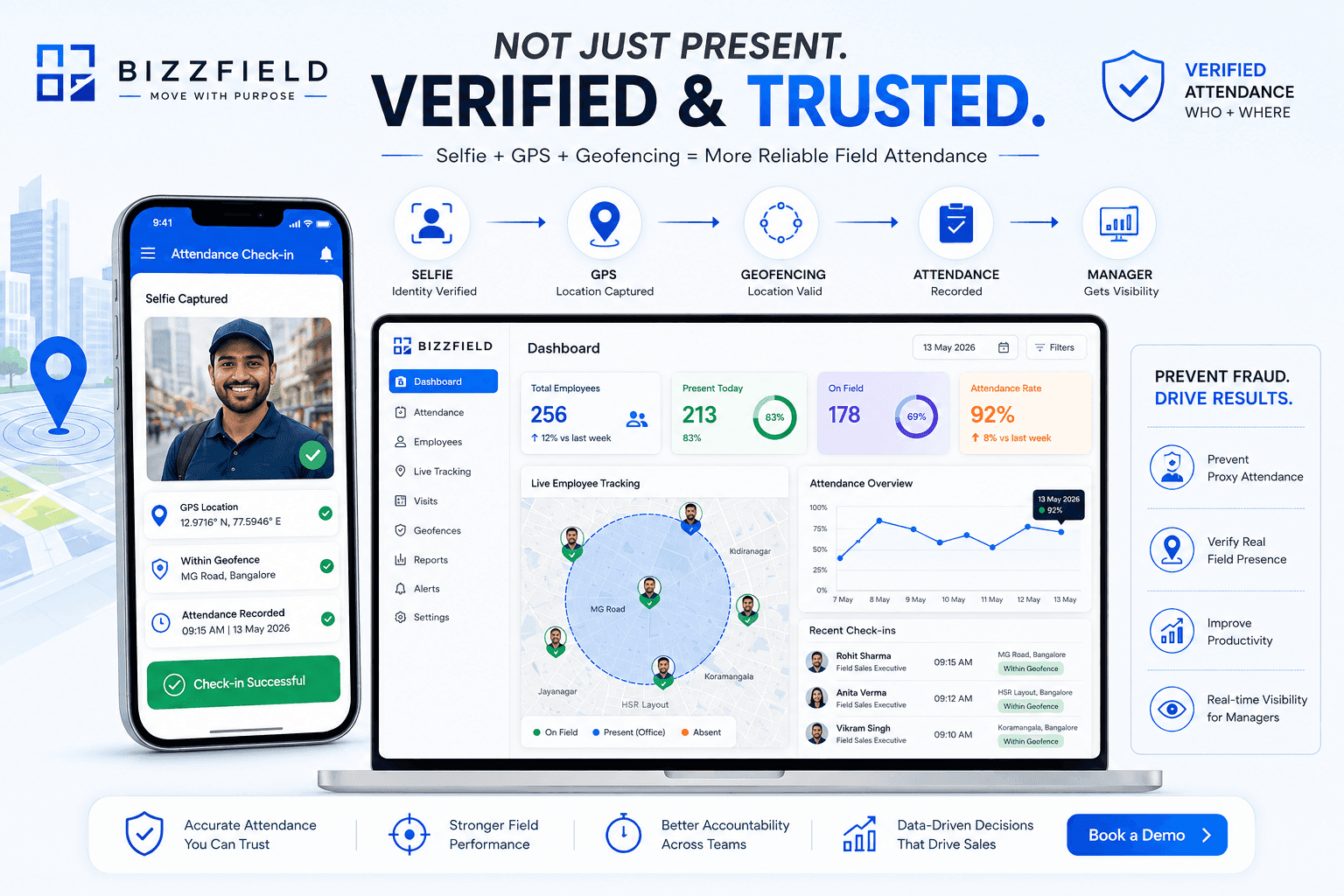
Here's the basic workflow behind selfie and GPS-based attendance verification:
- Employee opens the app
- Selfie captured
- GPS location captured
- Location verified
- Attendance recorded
- Manager gets visibility
Each component plays a distinct role:
| Technology | Purpose |
|---|---|
| Selfie | Identity verification |
| GPS | Location verification |
| Geofencing | Restricts check-ins to permitted areas |
| Location Tracking | Provides visibility into field movement |
| Attendance Records | Creates an auditable attendance history |
It's worth being precise about what this does and doesn't do. These mechanisms don't make attendance fraud impossible — a determined employee can still find workarounds for almost any system. What selfie, GPS, and geofencing verification do is reduce the opportunity for fraud and make attendance data significantly more trustworthy and auditable than a simple manual check-in. That's a meaningful, measurable improvement even if it isn't an absolute guarantee.
How Managers Can Detect Suspicious Attendance
Beyond the verification layer itself, a few practical indicators help sales operations teams spot problems early:
- Attendance location doesn't match the employee's assigned territory
- Attendance is marked outside expected working hours or areas
- Attendance records don't align with reported field visits for the day
- Repeated, unusual check-in patterns from the same location or device
- Multiple inconsistencies between attendance data and location history over time
None of these on their own is proof of fraud — reps do occasionally work outside their usual territory for legitimate reasons. But when several indicators stack up for the same employee, it's a clear signal for a manager to follow up.
What to Look for in Field Attendance Software
If you're evaluating attendance tools for a field sales team, use this checklist to compare options:
- Selfie-based attendance capture
- GPS location verification at check-in
- Geofencing to restrict attendance to approved zones
- Ongoing location tracking, not just point-in-time check-ins
- Complete, auditable attendance history
- Real-time visibility for managers, not just end-of-day reports
- Field visit tracking linked to attendance data
- A manager dashboard that surfaces exceptions, not just raw logs
- Reports and analytics for territory and rep-level review
- A mobile-first experience your field team will actually use
Reduce Field Attendance Fraud with BizzField
BizzField's Attendance Tracking Software is built around a simple idea: attendance for a field sales team should verify presence, not just record a timestamp. Field reps punch in with a selfie and their live GPS location, and every check-in is validated against a defined geofence — so sales operations teams get identity and location confirmation at the moment of check-in, not a manual reconciliation days later. Attempts to fake a location are caught automatically, with built-in anti-spoofing detection that flags mock-location apps.
BizzField's geofencing capability is what makes this enforceable rather than just observable — it restricts attendance to approved locations around every outlet or territory, instead of simply recording a GPS pin after the fact. Organizations using it typically see a 40%+ reduction in fake check-ins within the first 30 days, alongside faster visit-compliance verification and less manager time lost to reconciliation. The same location data also feeds BizzField's field employee GPS tracking, giving managers continuous visibility into where the team is moving throughout the day — not just where they checked in that morning.
All of this runs inside the broader BizzField Sales Force Automation platform, so attendance, geofencing, route data, and visit activity sit in one system instead of disconnected tools. It also works offline, capturing check-ins locally and syncing automatically once connectivity returns — important for teams covering rural or low-signal territories.
The goal isn't to police every movement of your field team. It's to give sales operations leaders a system where attendance data can actually be trusted — so territory plans, incentive payouts, and performance reviews are built on what really happened in the field, not on what was typed into an app.
Want to see selfie and GPS attendance verification in action for your field sales team? Explore BizzField's Attendance Tracking Software or request a demo.
Frequently asked questions
Attendance fraud in field sales happens when recorded attendance doesn't reflect an employee's actual presence, identity, or location — common forms include proxy attendance, fake check-ins, false location reporting, and fake field visits.
A selfie confirms the actual employee is present at check-in, while GPS location confirms where the check-in happened. Together, they replace a simple tap-to-mark-present system with attendance that's tied to a verified identity and location.
Geofencing significantly reduces fake location check-ins by only allowing attendance within an approved radius, but no single tool eliminates fraud entirely. It works best combined with selfie verification, activity tracking, and manager oversight.
Look for selfie capture, GPS verification, geofencing, ongoing location tracking, auditable attendance history, and real-time manager dashboards — not just a basic check-in/check-out log.
WRITTEN BY
Shivam Gupta
Brand Manager
Brand Manager with 8+ years of experience in building brands, developing growth strategies, and creating impactful marketing campaigns that drive business success.
Connect on LinkedIn