
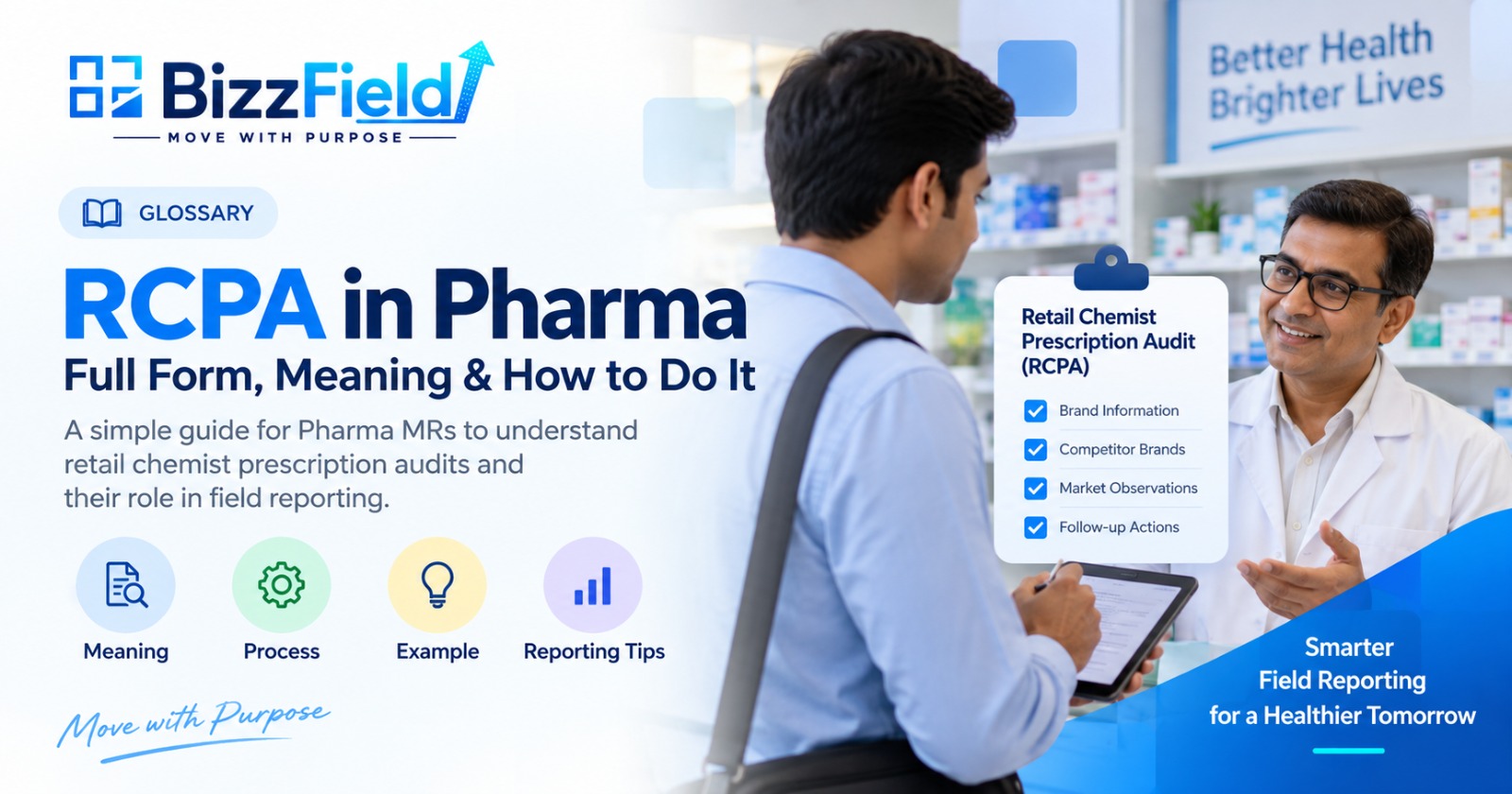
You've just left a busy retail chemist counter. The owner mentioned which brands customers keep asking for, and you jotted a few things on your phone — but by evening, half of it is forgotten. This is exactly why pharma field teams follow RCPA in pharma, a structured way of recording chemist-level feedback. Platforms like BizzFieldhelp field sales teams organise this kind of reporting digitally. Here you'll learn what RCPA means, how it's done step by step, and how it connects to your daily field reporting.
What Is RCPA in Pharma?
RCPA stands for Retail Chemist Prescription Audit (in Hindi: रिटेल केमिस्ट प्रिस्क्रिप्शन ऑडिट). In pharmaceutical field sales, it commonly refers to a structured activity where medical representatives collect relevant, permitted information from retail chemists about prescription-related product movement and reported brand presence.
The purpose is to help field teams understand market observations, organise reporting, and support territory-level discussions. The exact process, data fields and reporting rules depend on the company's operating procedures and applicable requirements — RCPA is not one fixed format used identically everywhere.
RCPA is not a formal clinical, regulatory or financial audit, even though the word “audit” appears in the name. It should never include identifiable patient information. For MRs, it informs follow-up conversations with doctors and chemists. For managers, it shows what is being reported across outlets and territories, and helps them spot patterns that a single MR's notes wouldn't reveal on their own.
It's also worth being clear about what RCPA is not used for. It isn't a way to verify prescriptions against a chemist's actual sales register, and it isn't a substitute for market research conducted through licensed data providers. It's a field-level observation exercise, built on what the chemist is willing to share in conversation.
How to Do RCPA in Pharma?
- Plan the approved visit. Pick chemists from your assigned territory, ideally within your beat plan, so visits are regular rather than random.
- Interact professionally.Introduce yourself, explain what you're asking, and respect the chemist's time. Don't push for information they don't want to share.
- Collect permitted observations.Record the product and market observations your company's reporting process allows. Use the approved fields, follow the data-collection rules, and note only what was actually reported or observed.
- Record accurately and consistently.Use the company format and standard product names, so your entries can be compared against a colleague's from a different outlet.
- Submit and review. Send the report through the approved workflow, ideally the same day, and correct any errors your manager flags.
New MRs sometimes treat RCPA as a box to tick before moving to the next outlet. It works better as a short, honest conversation — a chemist who trusts you is far more likely to share something useful than one who feels quizzed.
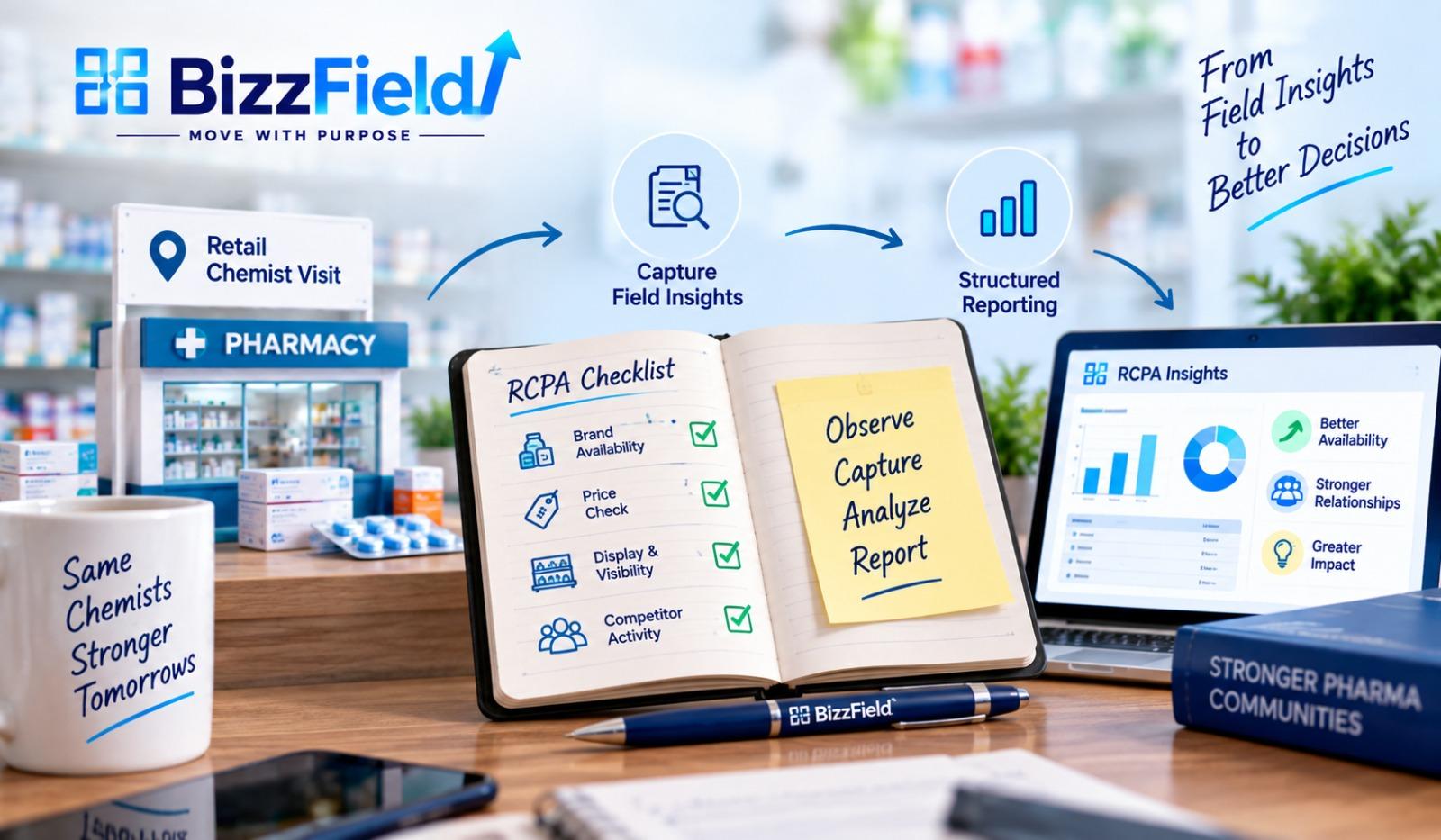
RCPA in Pharma Example
Illustrative Example Only
Ravi, an MR at a fictional company, XYZ Pharma, visits “Sharma Medical Store,” a fictional outlet in his territory. The chemist mentions which brands are commonly requested for a certain condition.
Ravi records the visit date, outlet name and area, XYZ Pharma's product, and the competing brands named, using his company's format. He adds no numbers he didn't hear, and submits the report the same day.
His manager reviews it with other reports from the territory. If a competing brand comes up repeatedly across several chemists, the manager can plan a follow-up with doctors or chemists in that area. The report supports that conversation but guarantees no sales outcome.
RCPA Reporting Principles
These aren't a universal audit standard. They're practical habits for reliable field reporting.
- Accuracy: Record only what was actually reported, not an inference from it.
- Consistency: Use standard product names and outlet details so entries can be compared across MRs and territories.
- Traceability: Keep visit dates and the source of each entry clear.
- Timely submission:Record details the same day, while they're fresh.
- Privacy and compliance: Follow company policy and applicable requirements. Keep patient details out of every entry.
- Review: Let errors be found and fixed through an approved process.
Common RCPA Mistakes to Avoid
- Rounding or guessing numbers instead of recording only what was actually said.
- Copying the previous visit's entry without checking whether anything has changed.
- Mixing personal opinion with the chemist's report — writing that a brand is “clearly winning” rather than what was specifically said.
- Delaying submission until the end of the week, when early details get forgotten or merged.
- Skipping difficult outlets where the chemist is less talkative, leaving gaps in the territory picture.
RCPA and Pharma SFA Software
Notebooks, WhatsApp messages and spreadsheets make consistent reporting hard. A structured Pharma SFA software workflow keeps entries standardised, outlets organised by territory, and manager review in one place.
BizzField'sPharma SFA page lists DCR filing, GPS-verified doctor and chemist visits, and RCPA on competitor movement at the counter as part of its MR reporting. To see how DCR, POB and RCPA fit together, read BizzField's guide to DCR software for pharma. The exact RCPA fields and workflow are set up around each company's own process.
Looking to simplify pharma field reporting? Explore BizzField Pharma SFA to see how digital DCR filing, chemist and doctor visit tracking, and structured field workflows can support your sales team.
Frequently asked questions
Retail Chemist Prescription Audit.
A field-reporting practice where MRs record permitted product and market observations from retail chemists. It isn't a formal clinical or regulatory audit, and company practices vary.
The MR plans an approved chemist visit, speaks with the chemist, notes permitted observations, records them in the company format, and submits them for review.
A DCR (Daily Call Report) records the MR's visits and activities for the day. RCPA records chemist-level product and market observations. Some companies capture both in one workflow.
No. RCPA gives field teams a snapshot of reported brand activity at a chemist counter. It supports follow-up conversations and territory planning, but it doesn't predict or guarantee a change in prescriptions.
WRITTEN BY
Shivam Gupta
Brand Manager
Brand Manager with 8+ years of experience in building brands, developing growth strategies, and creating impactful marketing campaigns that drive business success.
Connect on LinkedIn