
Picture a Friday morning review. Your sales head opens a spreadsheet, and the numbers say your beauty advisors covered every counter last week. Then a salon owner calls to say nobody has visited in a month, a flagship shade is out of stock at the distributor, and the testers you shipped for the new launch are nowhere to be found.
For cosmetics brands, missed visits, missing testers and stock shortages can make it difficult to understand what's happening across retail outlets. Cosmetics selling is a different animal from selling soap or biscuits. Your channel is a patchwork of salon counters, beauty stores, pharmacies and modern-trade outlets, and each one has its own rules for visits, displays and stock. That is exactly the gap cosmetics sales force automation is meant to close.
So let's walk through what it is, what to look for, and how to tell whether a platform like BizzField fits the way your beauty brand actually sells.
In short: cosmetics sales force automation software helps beauty brands manage field sales activities, track retailer visits, coordinate order booking, monitor retail execution, and improve visibility across their sales and distribution networks.
What Is Cosmetics Sales Force Automation Software?
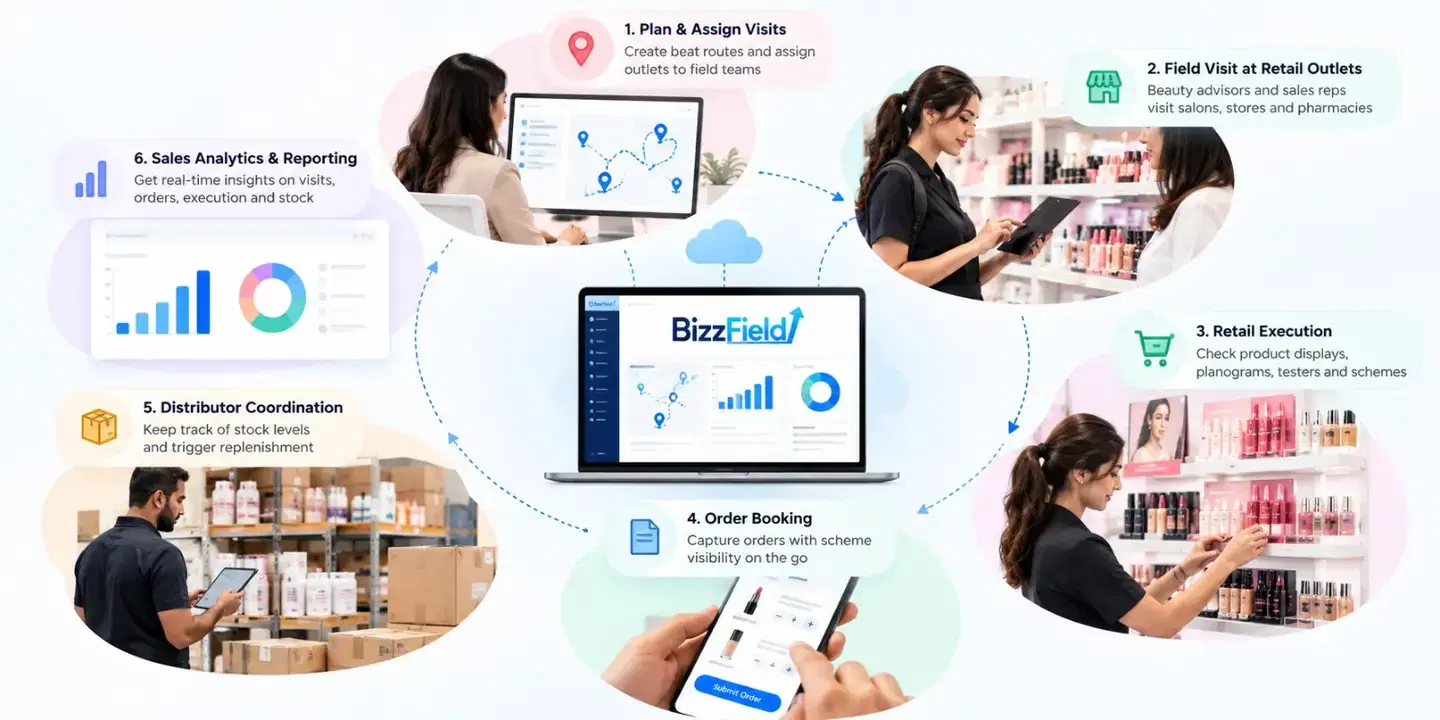
In practical terms, sales force automation (SFA) is a mobile-first system that puts your field team's daily work on one platform: who visited which outlet, what was ordered, what the shelf looked like, and what is happening at the distributor.
For a cosmetics brand, that means managing the work of field sales representatives and beauty advisors across counters, stores and pharmacies, along with the distributors who keep those outlets supplied.
How is that different from a generic sales tracking tool or CRM? A generic tool can log a visit. It usually can't handle the things that make cosmetics tricky: shade-level stock, tester allocation and expiry, planogram and shelf-share checks, and counter-level scheme execution. Those are the workflows that decide whether a product actually sells through, and they need to be built into the software rather than bolted on.
Key Sales Challenges Faced by Cosmetics and Beauty Brands
Not every beauty brand sells the same way. Some run in-store beauty advisors at modern-trade counters, others rely on field reps calling on salons and pharmacies, and many do a mix through distributors. Still, a few problems show up again and again:
- Distributed teams are hard to see. Route plans live in spreadsheets, so a missed outlet or a skipped beat can go unnoticed for days.
- Outlet coverage is uneven. High-potential retailers get under-visited while easy ones get visited repeatedly.
- Counter execution is self-reported. Without photos or location data, it's hard to verify that displays and planograms are what the report says they are.
- Testers and display material leak. When they're tracked on paper, losses are invisible until month-end.
- Scheme execution is unverifiable. You can announce an offer, but confirming it reached the counter is another matter.
- Distributor stock runs dry at the wrong time. Fast-moving shades and seasonal kits can run out before anyone triggers replenishment.
- Data arrives late. By the time field information is consolidated, the decision it should have informed has passed.
These challenges highlight why cosmetics brands need better visibility into field activity, retail execution and distributor stock.
Essential Features of Cosmetics Sales Force Automation Software
When choosing cosmetics sales force automation software, focus on the features your sales team needs to manage field visits, retail execution and distributor coordination. For each one below, we cover what it does, the problem it addresses and what it changes for the business.
Field Sales and Visit Tracking
Planned visits and visit records live in one place, and GPS-verified check-ins confirm that a counter visit happened at the right place and time.
Without this, field reports are easy to write and hard to verify.
This lets managers see deviations the same day rather than at month-end, and accountability becomes a matter of data rather than trust. BizzField also offers a location tracking app and geofencing software for teams that want tighter verification.
Beat Planning and Route Management
Reps get structured beat routes across salon counters, beauty stores, pharmacies and modern trade, with outlet priority and visit frequency built in. Visit protocols can also differ by channel type.
This becomes difficult when planning lives in spreadsheets, because coverage gaps stay hidden.
As a result, reps start the day knowing what's expected, and managers can spot under-visited, high-potential outlets before revenue is affected. See BizzField's route management module for the wider picture.
Retailer and Outlet Management
Outlet-level activity records are tied to every visit, order and compliance check, so each retailer has a traceable history.
The challenge is particularly noticeable when retailer information is scattered across chats, notebooks and personal spreadsheets.
Whoever picks up the territory next doesn't start from zero. For brands working with larger chains, BizzField also covers modern trade management.
Order Booking and Sales Management
Beauty advisors can book orders directly from the counter in one flow: product selection, combo deals and scheme application, with live promotional and seasonal offers visible during booking.
Without this, orders and offers are handled separately, so schemes get misapplied or missed.
For the business, this means cleaner orders and visibility into scheme conversion per outlet, so you can see which promotions actually drive counter sales. More on this in BizzField's retailer order management and scheme and offer management pages.
Beauty Advisor and Counter Sales Tracking
Cosmetics sales has extra requirements at the counter, so this one deserves more detail. Beauty advisors get structured routes and verified check-ins, capture photo-tagged shelf status at every visit, and log tester allocation, placement and expiry per outlet, including at shade level. Display material and promotional kit placement can be photo-verified during the visit.
Without this, shelf compliance is self-reported, and testers and displays end up tracked on paper.
This creates an audit trail of counter activities. Managers can identify non-compliant displays and arrange corrective action, while tester discrepancies become easier to spot during the month. For attendance and brand standards, there are related modules for attendance tracking and brand compliance. Exactly which counter activities you track depends on your configuration, so raise your specific needs in a demo.
If your field workforce also needs GPS tracking and attendance outside the counter, BizzField Tracker offers real-time tracking, verified attendance and automated travel summaries.
Distributor Coordination and Sales Visibility
SFA and distributor management sit on one platform, so order booking connects to distributor inventory, with stock visibility down to shade level and alerts before stock-outs.
The challenge is that distributors can run out of fast-moving shades or festive kits before anyone triggers replenishment.
That means fewer lost sales at the counter and a clearer view of secondary sales from distributor to retail. Read more about distribution management.
Sales Analytics and Performance Reporting
Managers get a dashboard showing coverage, compliance status, scheme conversion and rep activity, backed by sales reporting and analytics.
Without it, consolidating reports by hand delays decisions.
Review meetings can then start from same-day numbers instead of a debate about whose spreadsheet is right.
Benefits of Sales Force Automation for Cosmetics Brands
The main benefits depend on which parts of the sales process need better control.
- Verified check-ins give managers a clearer picture of completed field visits.
- Beat planning helps representatives cover assigned outlets more consistently.
- Photo-based shelf checks make it easier to identify retail execution issues.
- Order booking with scheme visibility helps teams apply promotions correctly.
- Sales dashboards reduce the need to consolidate reports manually.
- Distributor stock visibility helps teams identify potential replenishment needs earlier.
Results depend on your sales process, channel mix, implementation and how consistently your team uses the software. Be wary of any vendor, including us, that promises a specific percentage uplift before understanding your operation.
How to Choose the Right Cosmetics Sales Force Automation Software
Use this checklist when you shortlist vendors:
- Does it fit your sales model? Salon counters, pharmacies, modern trade and distributor-led sales all behave differently. Ask to see your channel mix, not a generic demo.
- Can it verify visits? Look for GPS-verified check-ins and clear deviation reporting.
- Does it handle beats and outlets properly? Visit frequency, priority and channel-specific protocols matter.
- Will it support your order and scheme flow? Check combos, offers and scheme tracking during booking.
- Does it cover beauty advisor and counter workflows? Photo-tagged shelf checks, planogram compliance and tester tracking at shade level should not be afterthoughts.
- How does it connect to distributors and your ERP? Ask what integrations exist for your systems and what they involve. See BizzField's integrations page as a starting point.
- Will your team actually use it? Look at mobile usability and offline access, since many counters have patchy connectivity. BizzField's guide to offline SFA apps covers how field teams keep selling when the network drops.
- What do reporting, implementation and support look like? Ask about setup time, training and who you call when something breaks.
- Does it scale across brands? If you run skincare, colour cosmetics and haircare divisions, check whether separate beat plans and reporting can sit in one account.
Why Consider BizzField for Cosmetics Sales Management?
If these challenges sound familiar, these are the capabilities of BizzField Sales Force Automation software worth evaluating, based on what the platform documents for cosmetics:
- Cosmetics-specific workflows. Relevant workflows include shade-level tracking, tester management, planogram compliance and beauty advisor route planning.
- Photo evidence at the visit. Shelf status, display placement and tester status are captured during the visit.
- SFA and DMS together. Order booking connects to distributor inventory, so secondary sales are visible from distributor to retailer.
- Offline-capable mobile app. Visits and orders can be recorded without a data connection and sync when the network returns, which suits counters with weak signal.
- Multi-brand configuration. Separate beat plans, compliance checklists and reporting per division, with a consolidated view for leadership.
Neyah Cosmetics is one example. Its Operation Head, Abde Munaf, says the team had “almost no visibility on our beauty advisors in the field” before moving to real-time tracking. That is one company's experience, not a guarantee, but it shows the problem is solvable. You can read more customer stories in BizzField's case studies.
During a demo, ask the team to show how the software handles your actual outlet visits, order booking and distributor workflows.
Get Better Visibility into Cosmetics Field Sales
When sales managers can see which outlets were visited, whether displays meet brand standards and where stock is running low, they can follow up on issues with better information.
If you'd like to see how it could fit your beauty advisors, retailers and distributors, book a BizzField demo.
Have more questions? Browse BizzField's full FAQ.
Frequently asked questions
It's a mobile platform that manages the field work of beauty advisors and sales reps: route planning, verified outlet visits, shelf compliance, tester tracking, order booking and distributor visibility. Its purpose is to give managers reliable, timely information about what's happening in the market.
Start by replacing self-reported updates with verified ones. GPS-based check-ins, structured beat plans, photo-tagged shelf checks and dashboards turn field activity into data managers can act on the same day.
Yes, where the software is built for it. Look for advisor-specific routes, verified counter visits, shelf and planogram capture, and tester tracking. Exact capabilities depend on the platform and its configuration, so confirm them in a demo.
By keeping outlet activity, orders and distributor stock in one place. When order booking connects to distributor inventory, managers can see secondary sales and catch shade-level stock risks before they become lost sales.
Prioritise verified visit tracking, beat planning, order booking with scheme visibility, photo-based shelf compliance, tester and shade-level tracking, distributor integration, offline mobile use and clear reporting.
Map your own channels, team structure and biggest pain points first, then ask each vendor to demonstrate those exact scenarios. Check integration needs, offline behaviour, rollout effort and support before you decide.
WRITTEN BY
Shivam Gupta
Brand Manager
Brand Manager with 8+ years of experience in building brands, developing growth strategies, and creating impactful marketing campaigns that drive business success.
Connect on LinkedIn