
India's beauty and personal care market is growing at 10.8% CAGR and is projected to reach ₹2.2 lakh crore by 2035. For cosmetics brands managing distribution through salon counters, beauty stores, pharmacies, and modern trade — the sales challenge is not demand. It is execution.
Shelf space is limited and contested. Testers expire untracked. Beauty advisors cover 8–12 counters a day with no digital record of what they found. Scheme compliance is self-reported. Distributor stock for fast-moving shades runs out before anyone is alerted.
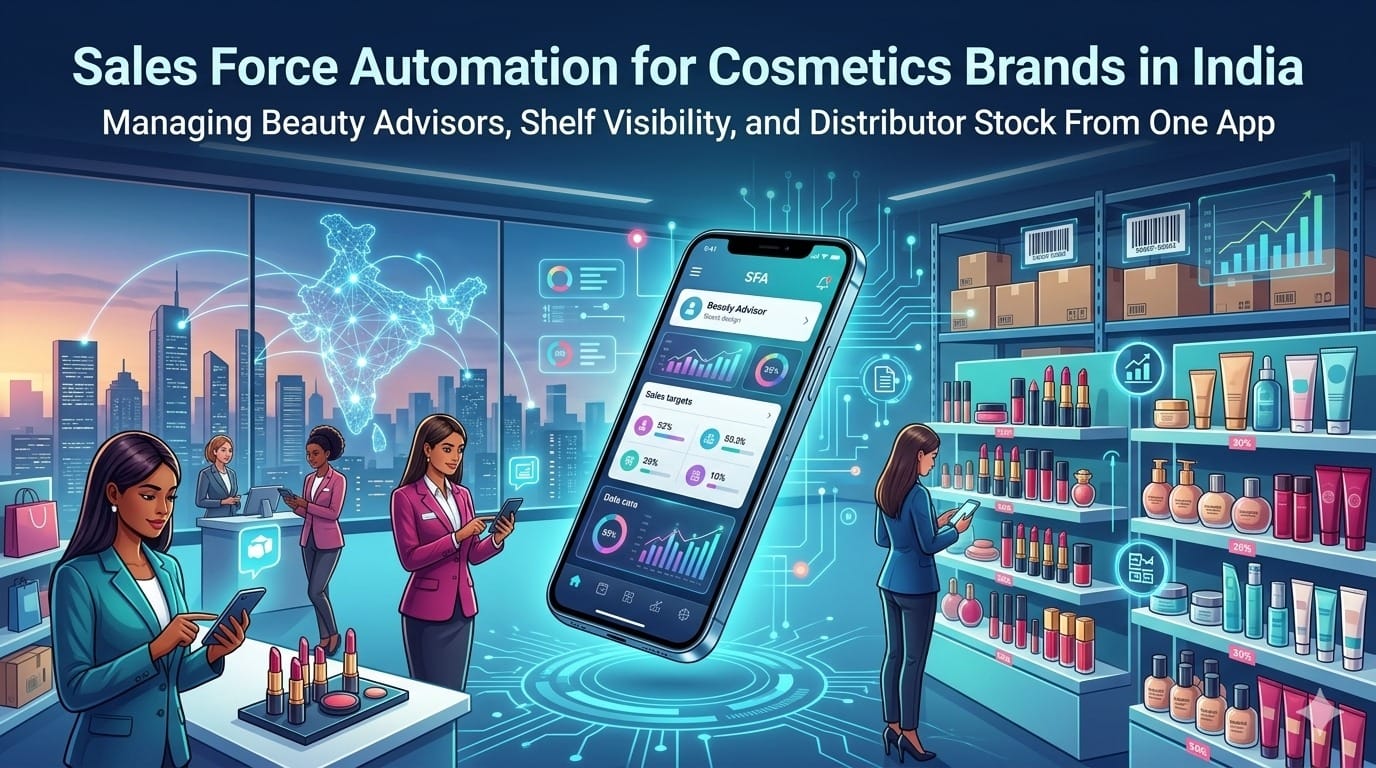
Cosmetics sales force automation India is the technology that solves this execution problem — making beauty advisor coverage, shelf compliance, tester management, and distributor stock visible and manageable from one platform.
1. Why Cosmetics Field Sales Is Different From FMCG
Generic field sales automation tools are built primarily for FMCG companies — where the key metrics are order volume, beat adherence, and stockist coverage. For cosmetics brands, these metrics matter, but they are not sufficient.
In cosmetics, the visit itself is the product. A beauty advisor's job is to ensure the brand looks right at the counter — correct shelf placement, active testers in the right shades, promotional materials displayed according to brand guidelines, and scheme communication happening at the point of sale.
This means cosmetics SFA software needs to capture not just visit completion and order booking — but visit quality: what was on the shelf, what was missing, what needs to be corrected before the next visit.
The Cosmetics Field Sales Gap
Most beauty brands in India know their sell-in numbers (what went to the distributor) but have limited visibility into sell-out (what actually moved from the shelf). Tester stock, display compliance, and scheme execution at the counter are the variables that bridge this gap — and they require field automation to track at scale.
2. What Sales Force Automation Does for Cosmetics Brands Specifically
Cosmetics Sales Force Automation India platforms are built to handle the specific workflows that beauty brands require:
- GPS-verified beauty advisor check-ins at salon counters, beauty stores, pharmacies, and modern trade outlets.
- Photo-tagged shelf compliance and planogram verification during each visit.
- Tester stock tracking per outlet — allocation, condition, shade availability, and expiry.
- Digital order booking with scheme application and combo deal visibility.
- Shade-level distributor stock visibility with automated reorder alerts.
- Manager dashboard with coverage, compliance, and order data updated in real time.
The combination of these functions gives cosmetics brand managers something they typically do not have: a live picture of what the brand looks like at the counter right now — not next Thursday when the market visit happens.
3. Beauty Advisor Route Management and Coverage Tracking
Effective beauty advisor field tracking software starts with structured beat planning — assigning specific counters to specific advisors on specific days, with visit frequency and priority built into the plan.
Without structured routes, beauty advisors naturally gravitate toward accessible, familiar counters — often leaving high-potential but geographically inconvenient outlets under-visited. Sales software corrects this by making the planned beat visible to both the advisor and their manager.
GPS-verified check-ins confirm each counter visit happened at the right location and time. The manager sees, in real time, which counters have been visited today and which are behind schedule — enabling same-day reallocation if needed, not a post-factum Friday report.
4. Shelf Compliance and Planogram Verification
Planogram compliance — ensuring the brand's products are displayed in the right positions, quantities, and configurations at every outlet — is one of the most consistently under-tracked metrics in cosmetics field sales. Without a system to capture it, non-compliance goes undetected until a manager does a market visit.
With shelf share tracking software built into the SFA app, beauty advisors photograph the shelf at each visit. The photo is timestamped, geo-tagged, and linked to the counter record. The brand manager reviews compliance across all counters from the dashboard — without leaving the office.
Non-compliant displays are flagged automatically for corrective follow-up. The brand manager goes from discovering planogram violations on a Thursday market visit to receiving photo-tagged alerts on Tuesday morning — with enough time to correct before the weekend footfall.
5. Tester Stock and Display Material Management
Tester stock is one of the most expensive and most poorly tracked assets in cosmetics field operations. Testers expire unused. Display materials go missing. Shade availability gaps at high-traffic counters cost the brand sales without anyone knowing.
Tester stock management within the SFA app tracks allocation, deployment, shade availability, and expiry per outlet. Beauty advisors update tester status during each visit — creating a digital record that replaces paper logs and verbal updates.
Automatic expiry and low-shade alerts notify the manager before a tester issue affects the customer experience. Display material distribution is tracked per counter — so the brand knows which outlets have the seasonal POS kit and which are still waiting, without a separate tracking spreadsheet.
6. Distributor and Shade-Level Stock Visibility
Fast-moving shades — bestselling lip colours, seasonal foundation shades, limited-edition kits — run out at the distributor level before beauty advisors are alerted. The result is lost sales at the counter and frustrated customers who are told the product is unavailable.
An integrated SFA and Distributor Management System solves this with shade-level stock visibility — the brand manager can see, in real time, which distributors are low on which SKUs and trigger replenishment before a stock-out occurs.
When beauty advisor order booking feeds directly into distributor inventory, the data connection is automatic — no manual stock reporting, no weekly email from the distributor. The NSM sees distributor stock and field coverage on the same dashboard.
Learn more about Bizzfield's distributor management →
7. What to Look for in SFA Software for Cosmetics Brands
Five things to verify before choosing a cosmetics SFA platform:
- Shade-level and SKU-level tracking — not just product-level. Cosmetics brands need visibility at the individual variant level.
- Photo evidence captured in the app. Shelf compliance, tester placement, and display materials need photo documentation during the visit, not verbal reports.
- Multi-channel beat configuration. Salon counters, pharmacies, modern trade, and beauty stores have different visit protocols. The beat plan must reflect this.
- Native DMS integration. Shade-level distributor stock and beauty advisor order booking in one connected system.
- Intuitive UX for beauty advisors. Minimal learning curve, fast adoption. An app that beauty advisors find difficult will not be used consistently.
Bizzfield's cosmetics SFA platform covers all five — and is the only SFA in India with shade-level tester tracking and planogram compliance built natively for cosmetics brands. Trusted by Neyah Cosmetics. → bizzfield.com/cosmetics-sfa
Book a Free Demo for Cosmetics Brands — See Neyah Cosmetics Case Study
15 minutes. Live product. Cosmetics-specific features.
Shivam Gupta
Brand Manager with 8+ years of experience in building brands, developing growth strategies, and creating impactful marketing campaigns that drive business success.
Frequently asked questions
Sales Force Automation for cosmetics brands is a mobile platform that manages beauty advisor field operations — GPS-verified counter visits, photo-tagged shelf compliance, tester stock tracking, digital order booking, scheme execution, and distributor stock visibility — replacing manual paper records with a real-time connected system.
Beauty advisors capture photo-tagged shelf status at each counter during their visit using the SFA app. The photos are timestamped and geo-tagged, and planogram compliance is tracked per outlet on the manager's dashboard. Non-compliant counters are flagged automatically for corrective action before the next field visit.
Yes. A cosmetics-specific SFA platform tracks tester allocation, deployment, shade availability, and expiry per counter. Low-stock and expiry alerts are triggered automatically — replacing the weekly paper review with a real-time notification system that prevents tester gaps before they affect the customer experience.
Beauty advisors capture a timestamped, geo-tagged photo of the shelf at every counter visit. The manager reviews compliance across all counters from a dashboard, and non-compliant displays are flagged automatically for corrective action before the next visit.
Yes. Tester allocation, deployment, shade availability, and expiry are tracked per counter inside the app. Low-stock and expiry alerts reach the manager automatically, replacing the weekly paper review with a real-time notification.
When beauty advisor order booking is connected to a distribution management system, the brand gets shade-level visibility into distributor stock rather than just category-level totals — so replenishment can be triggered before a fast-moving shade runs out at the counter.
WRITTEN BY
Shivam Gupta
Brand Manager
Brand Manager with 8+ years of experience in building brands, developing growth strategies, and creating impactful marketing campaigns that drive business success.
Connect on LinkedIn