
Quick Answer: What Are Primary, Secondary and Tertiary Sales?
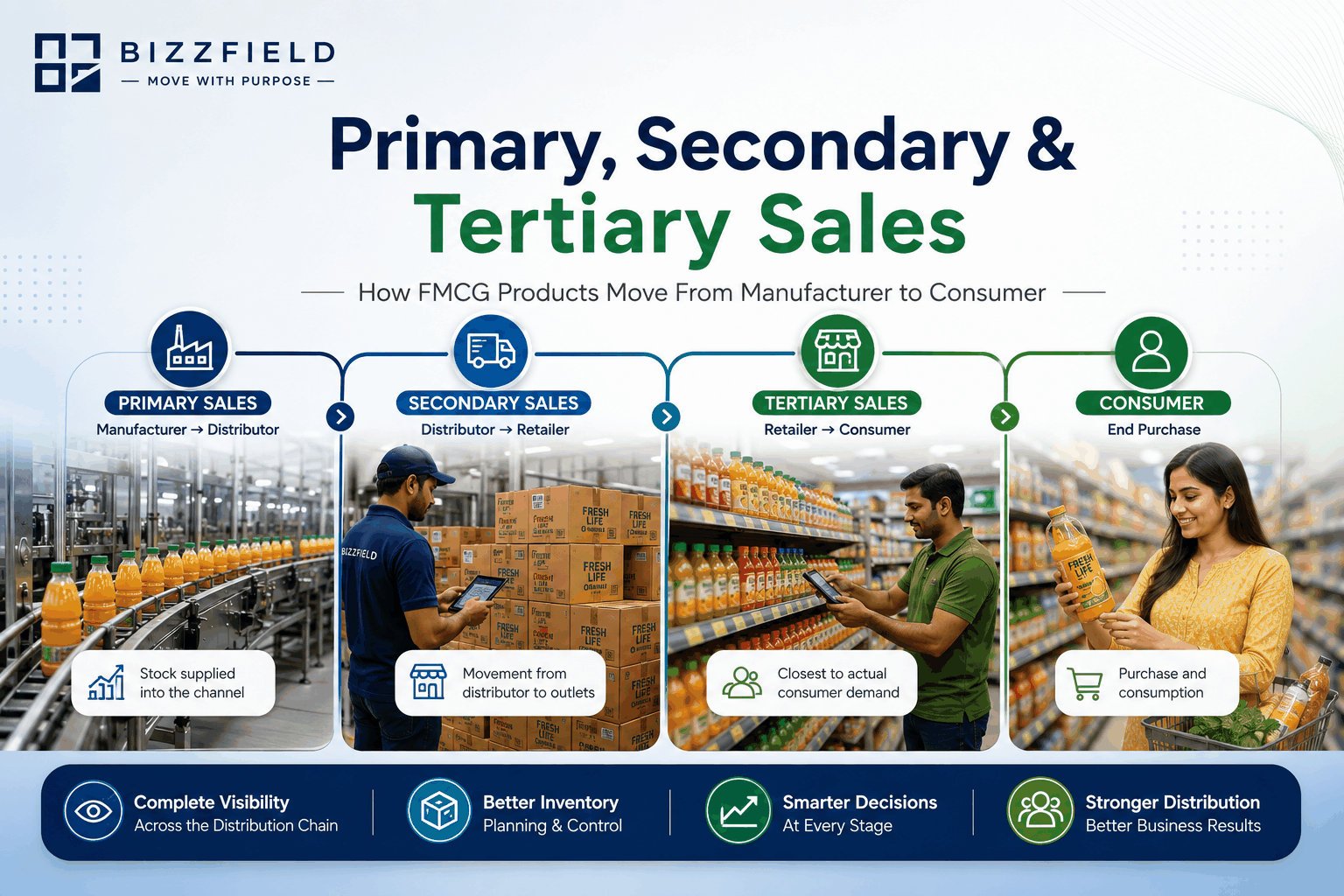
In FMCG, primary sales are the sale from a manufacturer to a distributor. Secondary sales are the sale from a distributor to a retailer. Tertiary sales are the sale from a retailer to the final consumer. Together, these three transactions describe how a product moves through the distribution chain — a framework often summarized as primary secondary tertiary sales.
- Primary sales: Manufacturer → Distributor
- Secondary sales: Distributor → Retailer
- Tertiary sales: Retailer → Consumer
- Primary sales show what a company has sold into the channel, not what consumers are buying
- Secondary sales reflect distributor-to-retailer movement and territory performance
- Tertiary sales are the closest measure of actual consumer demand
- Tracking only primary sales can hide overstocking and slow-moving inventory at distributor or retail level
What Are Primary, Secondary and Tertiary Sales?
A packaged product rarely moves in one step. It generally travels through a chain: Manufacturer → Distributor → Retailer → Consumer. Each handoff in that chain is a separate transaction, and each has its own name in FMCG sales terminology.
- Manufacturer → Distributor = Primary Sales
- Distributor → Retailer = Secondary Sales
- Retailer → Consumer = Tertiary Sales
This is the standard mental model used across FMCG sales and distribution management, though exact definitions can vary slightly between companies depending on how they structure their channel (for example, whether a super-stockist sits between the company and the distributor). For this guide, the three-stage framework above is used consistently.
What Is Primary Sales in FMCG?
Primary sales generally refer to the sale of goods from a manufacturer or company to its distributor or stockist. This is the first transaction in the chain, and it's recorded when the distributor places and receives an order from the company.
For example, if a beverage company supplies ₹5 lakh worth of stock to a regional distributor, that ₹5 lakh is booked as primary sales.
Primary sales help companies understand:
- Company-to-distributor revenue
- Distributor order volume and frequency
- Stock loaded into the distribution channel
- Supply and production planning needs
Important distinction: primary sales show what the company has sold into the channel. They do not necessarily show how quickly that stock is moving further down the chain — that's a separate question, answered by secondary sales.
What Is Secondary Sales in FMCG?
Secondary sales generally refer to the sale of goods from a distributor to a retailer or outlet. This transaction happens once the distributor's field team or sales reps sell stock into individual shops, kirana stores, or retail chains within their territory.
Continuing the example, if the distributor who received ₹5 lakh of stock goes on to sell ₹2 lakh of it to retailers in a given period, that ₹2 lakh is secondary sales.
Secondary sales are useful for understanding:
- Retailer-level demand within a territory
- How efficiently a distributor is moving stock
- Outlet coverage and distribution effectiveness
- Territory and beat performance
A company can have strong primary sales while secondary sales lag behind. This can happen for several reasons — a distributor stocking up ahead of a scheme, seasonal buying patterns, or simply slower outlet-level sell-through. A gap between the two figures may indicate a supply-demand mismatch, but it doesn't automatically confirm a problem; it's a signal worth investigating rather than a conclusion on its own.
What Is Tertiary Sales in FMCG?
Tertiary sales generally refer to the sale of goods from a retailer to the final consumer — the actual purchase at the shop counter. This is the last transaction in the chain and the one closest to real consumer off-take.
For instance, if a retailer stocks the product from the earlier example and sells units to shoppers over a week, those individual purchases are the tertiary sales for that outlet.
Tertiary sales help reveal:
- Genuine consumer demand
- Product popularity at the shelf
- Actual market consumption patterns
- Retail performance by outlet or SKU
Tertiary sales are closer to actual consumer purchase and off-take than primary or secondary sales. That said, manufacturers don't always have direct, real-time access to this data — it typically has to be captured through retailer audits, point-of-sale data, or field visibility tools, since the transaction itself happens between the retailer and the shopper.
Primary vs Secondary vs Tertiary Sales: What's the Difference?
The table below summarizes who is involved at each stage, why the transaction matters, and what it tells a business — useful for a quick side-by-side comparison.
| Factor | Primary Sales | Secondary Sales | Tertiary Sales |
|---|---|---|---|
| Seller | Manufacturer/Company | Distributor/Stockist | Retailer/Outlet |
| Buyer | Distributor/Stockist | Retailer/Outlet | Consumer |
| Purpose | Load stock into channel | Move stock to outlets | Complete the sale to end user |
| Example | Company ships ₹5L to distributor | Distributor sells ₹2L to retailers | Retailer sells units to shoppers |
| Business significance | Supply planning, revenue booking | Territory & distributor performance | Real consumer demand |
Primary vs Secondary Sales: What's the Difference?
The core difference is where the transaction sits in the chain. Primary sales happen between the company and the distributor; secondary sales happen between the distributor and the retailer. Consider a company that sells ₹10 lakh of goods to its distributors in a month. If those distributors go on to sell ₹6 lakh of that stock to retailers in the same period, then primary sales = ₹10 lakh and secondary sales = ₹6 lakh.
This gap doesn't automatically mean lost sales or unsold inventory — it reflects channel movement at two different stages, and stock can still move in later periods. What it does mean is that companies shouldn't judge market performance from primary sales alone, since that figure only reflects what left the company's warehouse, not what's actually moving at retail.
Secondary vs Tertiary Sales: What's the Difference?
Secondary sales track distributor-to-retailer movement; tertiary sales track retailer-to-consumer movement. For example, if a distributor supplies 500 units to retailers in a territory, and those retailers go on to sell 420 units to consumers, secondary sales = 500 units and tertiary sales = 420 units.
The 80-unit difference reflects stock still sitting on retail shelves — it hasn't reached the consumer yet. Secondary sales measure channel movement into stores; tertiary sales measure the final step, actual consumer off-take. Both numbers matter, but they answer different questions: one is about distribution reach, the other about demand.
Why Tracking All Three Sales Types Matters in FMCG
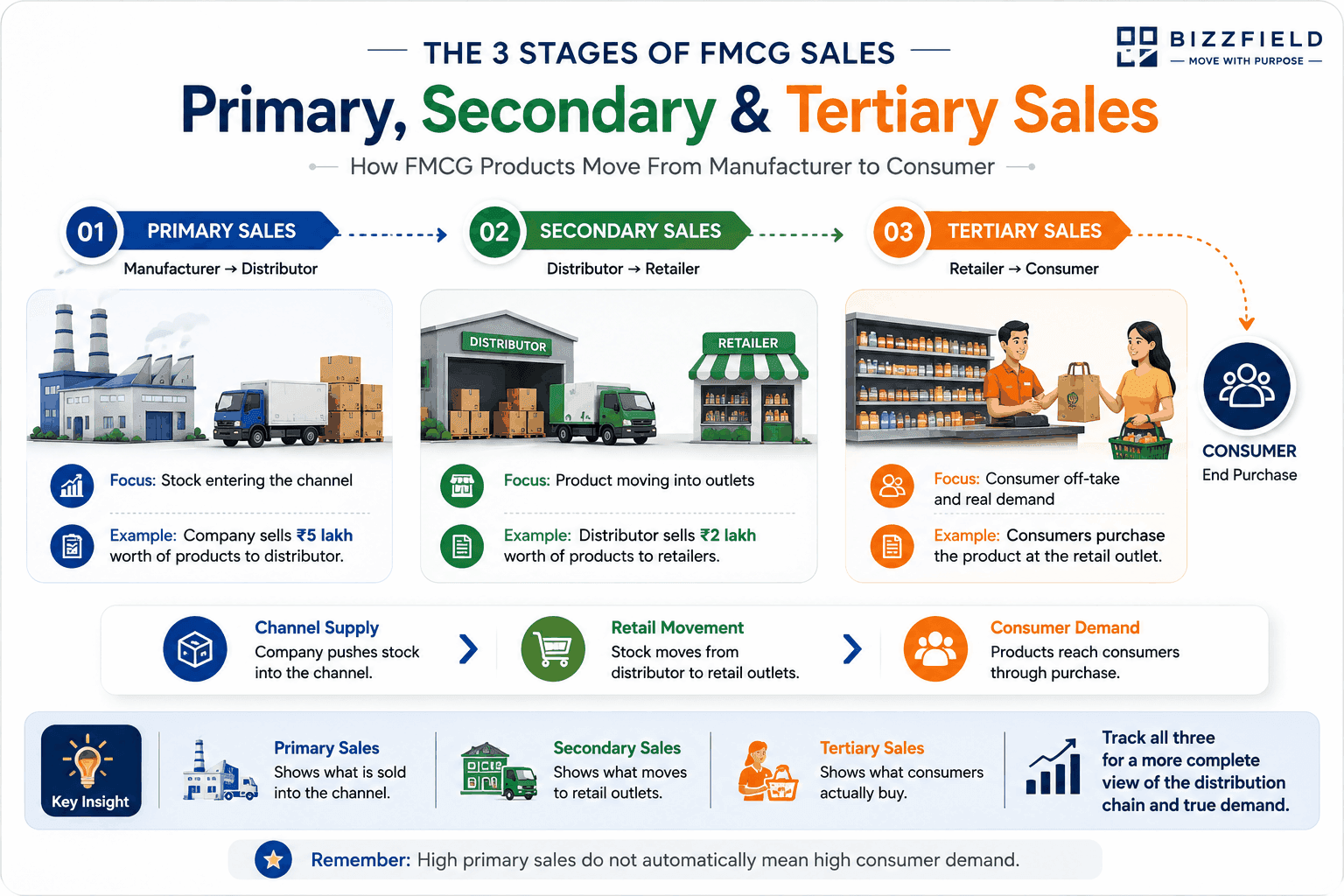
Each sales type answers a different business question, and none of them replaces the others.
Primary sales help with:
- Production planning
- Distributor supply scheduling
- Channel loading decisions
- Company-level revenue planning
Secondary sales help with:
- Evaluating distributor performance
- Retail coverage and territory tracking
- Understanding product movement into outlets
- Spotting distribution gaps
Tertiary sales help with:
- Reading actual consumer demand
- Identifying product off-take trends
- Understanding market-level consumption
- Assessing retail-level performance
These are not competing metrics fighting for attention — they're three different views of the same distribution chain, and a fuller picture emerges only when all three are read together.
What Happens If Companies Track Only Primary Sales?
Relying on primary sales alone creates blind spots. A few common risks:
- Overstocking at distributor level — distributors may keep ordering to hit targets even if retail movement is slow.
- Weak visibility into market movement — the company sees revenue booked, not stock actually consumed.
- Poor demand forecasting — production and supply decisions get based on channel loading rather than real demand.
- Inventory accumulation — stock can pile up at the distributor or retailer without the company noticing.
- Misleading sales performance— a "good month" on primary sales can mask a slowdown at retail.
The central point worth remembering: high primary sales do not automatically mean strong consumer demand. It can be a sign of a healthy channel, or it can be a sign of stock quietly building up somewhere between the warehouse and the shopper. Without secondary and tertiary sales data, it's difficult to tell which one is happening.
How Technology Helps Track Primary, Secondary and Tertiary Sales
Tracking three separate transaction stages manually — through spreadsheets, phone calls, or distributor self-reporting — is slow and often inaccurate by the time the numbers reach a manager. Modern field sales and distribution systems aim to connect Field Sales → Distributor → Retailer → Sales Data into one workflow, so each stage is visible without waiting for someone to compile a report.
At a high level, this generally involves:
- Primary, secondary and tertiary sales tracking
- Distribution Management System capabilities for distributor stock and order visibility
- Order management and territory-level reporting
- Retailer and outlet management
- Sales dashboards that consolidate channel data
For teams weighing whether they need a full field-execution platform or a distribution-only system, it's also worth understanding DMS vs SFA and how the two typically differ in scope. Instead of viewing primary, secondary and tertiary transactions as isolated numbers, connected systems let businesses build a more complete picture of how a product actually moves through the chain — from company shipment to shelf.
How BizzField Supports FMCG Sales & Distribution Visibility
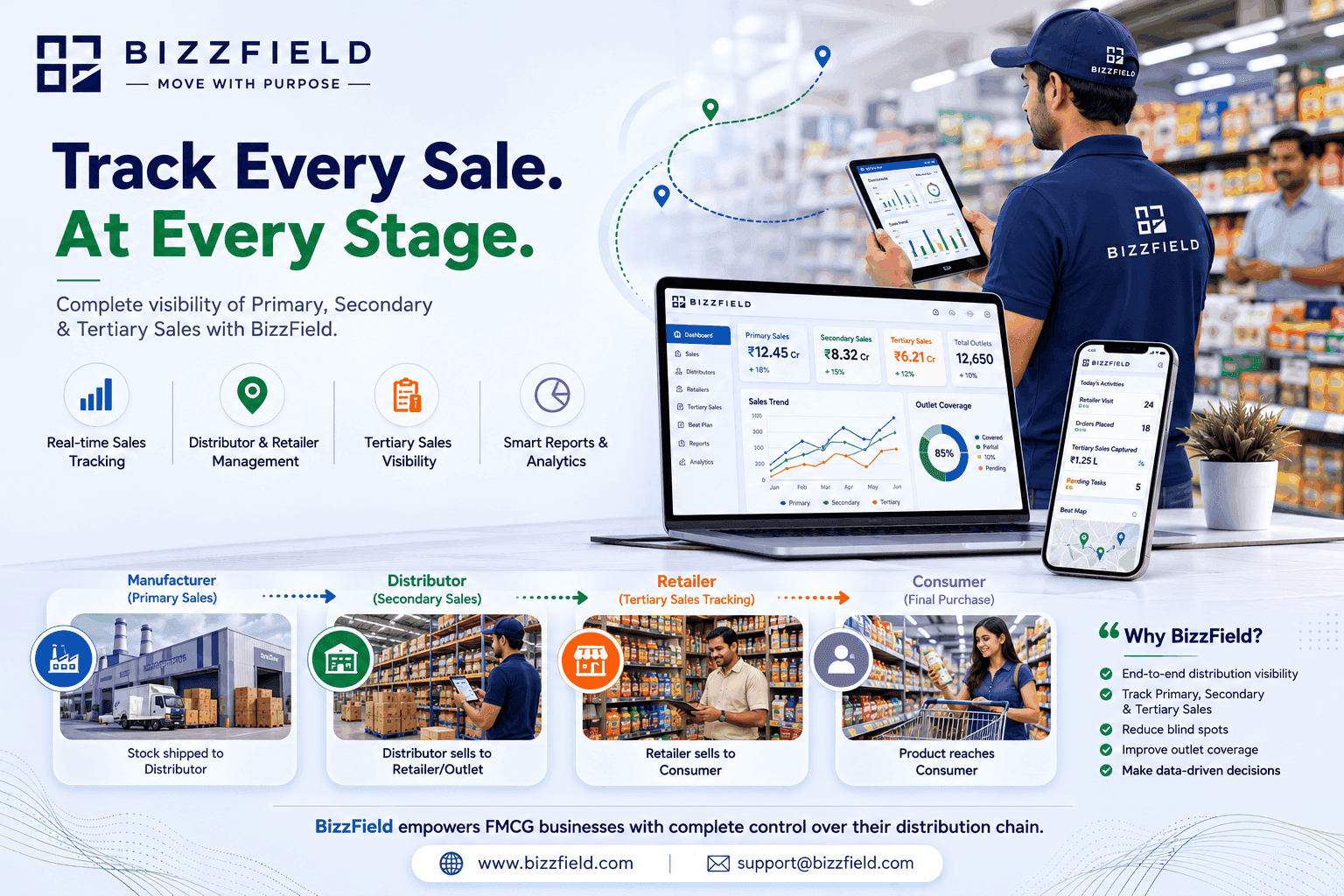
For FMCG businesses evaluating sales and distribution technology, BizzField provides a relevant example of how field execution and distribution visibility can be brought into a connected workflow. BizzField SFA combines field sales tracking with distributor management, so primary sales (company to distributor) and secondary sales (distributor to retailer) can be viewed within the same platform rather than across separate tools. It also offers tertiary sales tracking capability, aimed at giving businesses visibility closer to the retail and consumer end of the chain, alongside beat planning, outlet coverage, and order booking for FMCG field teams.
Conclusion
Primary, secondary and tertiary sales describe three distinct stages of the same journey: Primary = Company → Distributor, Secondary = Distributor → Retailer, Tertiary = Retailer → Consumer. Each one answers a different business question — what's been shipped, what's reaching retail, and what consumers are actually buying — and none of them tells the full story alone. FMCG businesses evaluating better sales and distribution visibility can explore how a connected DMS and sales execution workflow fits their operating model.
Frequently asked questions
Primary sales are the sale from a manufacturer to a distributor, secondary sales are the sale from a distributor to a retailer, and tertiary sales are the sale from a retailer to the consumer. Together, this is often referred to as primary secondary tertiary sales, and each stage represents a different point in the FMCG distribution chain.
Primary sales happen between the company and its distributor, while secondary sales happen between the distributor and retailers. Primary sales reflect stock loaded into the channel; secondary sales reflect stock that has actually moved on to retail outlets.
Secondary sales track distributor-to-retailer movement, while tertiary sales track retailer-to-consumer purchases. Secondary sales show how much stock reached the shelf; tertiary sales show how much of that stock consumers actually bought.
Secondary sales are important because they show whether distributors are successfully moving stock into retail outlets, which reflects territory coverage and distributor performance. Without this data, a company only knows what it shipped, not what's reaching stores.
Tertiary sales tracking refers to capturing data on retailer-to-consumer transactions, typically through retail audits, point-of-sale records, or field visibility tools, since manufacturers don't usually have direct access to this data by default. It's used to understand real consumer demand and product off-take.
Software can track primary, secondary and tertiary sales by connecting field sales activity, distributor order and stock data, and retailer-level sales information into a single system. This typically involves a combination of order management, distributor management, and field sales tracking tools working together rather than as separate, disconnected records.
WRITTEN BY
Shivam Gupta
Brand Manager
Brand Manager with 8+ years of experience in building brands, developing growth strategies, and creating impactful marketing campaigns that drive business success.
Connect on LinkedIn