
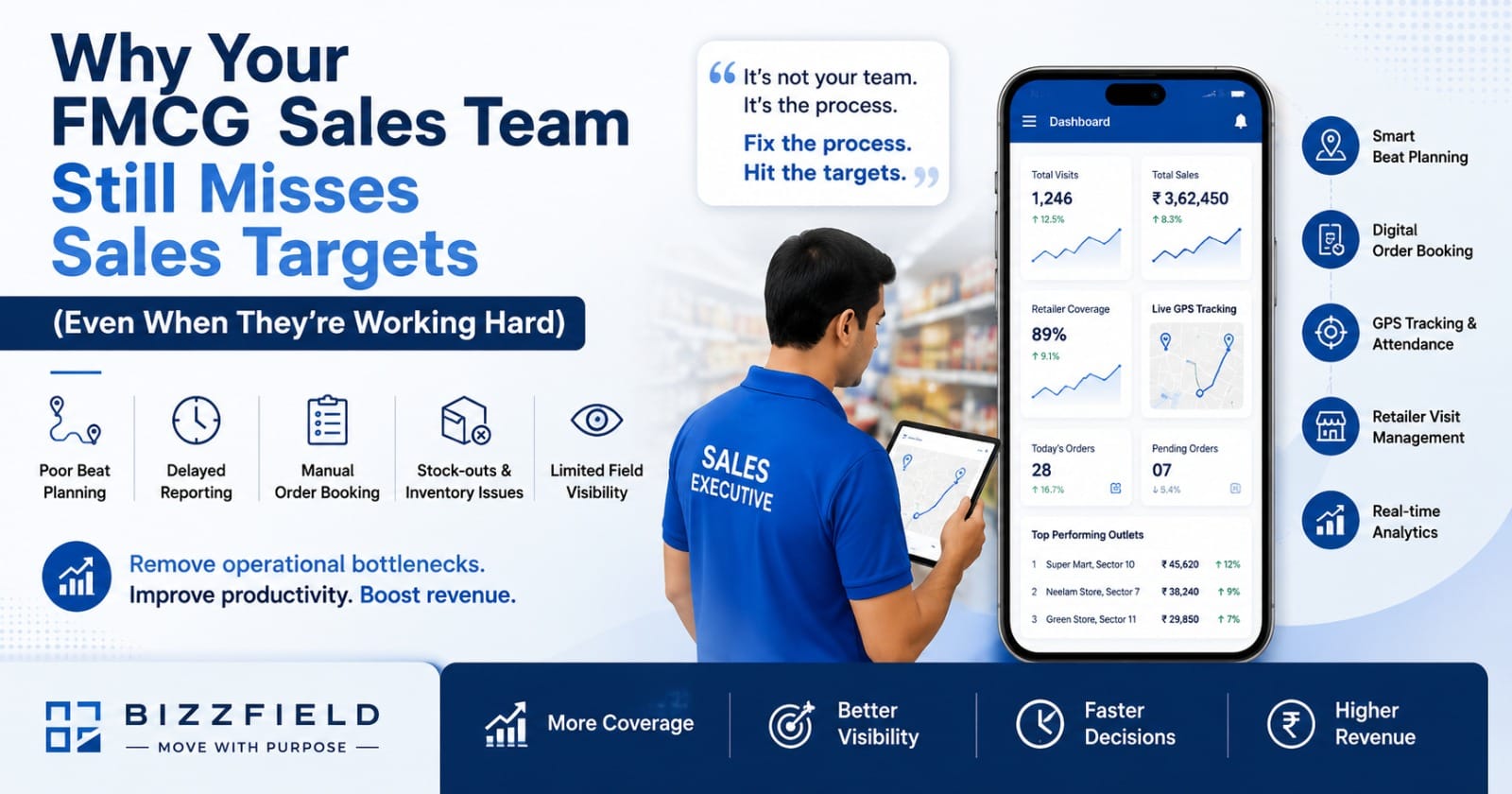
By the Bizzfield Sales Ops Team — last updated July 2026
Every month begins with ambitious sales targets.
Sales managers expect wider market coverage. Field representatives plan retailer visits. Distributors prepare inventory, and leadership looks forward to steady growth.
Yet month after month, many FMCG companies in India face the same outcome. Retailers remain uncovered. Orders fall short. Stock-outs increase. Managers react too late. And despite everyone's efforts, revenue doesn't match expectations.
The immediate assumption is usually that the sales team isn't working hard enough.
In reality, that's rarely the problem.
Across Bizzfield's work with FMCG businesses of different sizes, one pattern becomes clear: sales targets are missed because of operational inefficiency in FMCG sales — not a lack of effort.
When field representatives spend their day planning routes, updating spreadsheets, chasing approvals, calling distributors, or preparing manual reports, they're not doing what creates revenue — selling.
These small operational delays may seem harmless individually. Together, they quietly reduce field sales productivity, limit retailer coverage, slow decision-making, and create missed sales opportunities that accumulate over time. In a market as fragmented as India's — where a single territory can span hundreds of small outlets across Tier 2 and Tier 3 towns — those delays compound faster than they would anywhere else.
Today's top-performing FMCG companies don't simply ask their sales teams to work harder. They remove the obstacles that prevent them from selling effectively.
That's where Sales Force Automation (SFA) creates a competitive advantage. Instead of relying on disconnected tools, manual processes, and delayed reports, modern FMCG sales operations run on real-time data to improve execution, strengthen retailer relationships, and make faster business decisions.
In this guide, we'll explore the operational challenges that silently impact FMCG sales performance — and how leading companies overcome them.
📌 Quick Answer
The short answer to why FMCG sales teams miss targets is operational inefficiency, not lack of effort. Manual beat planning, delayed reporting, paper order booking, poor field visibility, stock-outs, inconsistent retail execution, and weak distributor coordination consume selling time before a rep meets a retailer. Sales Force Automation removes these delays and restores field sales productivity.
- Missed FMCG sales targets are usually an operations problem, not an effort problem.
- Seven bottlenecks — beat planning, reporting, order booking, visibility, stock-outs, retail execution, and distributor coordination — quietly reduce selling time.
- Losing one productive hour per rep per day can cost hundreds of retailer visits a month.
- Real-time visibility lets managers fix coverage gaps the same day instead of at month-end.
- Spreadsheets don't fail because they're bad — they fail because they can't move at field speed.
- The fix is removing obstacles to selling, not raising targets.
The Real Reason FMCG Sales Teams Miss Their Targets
Ask ten sales leaders why FMCG sales teams miss targets and most will point at execution in the field. But execution is only one part of the equation.
Behind every missed sales target is usually a chain of operational delays.
Think about a typical day for a field sales representative. Before visiting the first retailer, they may already be checking yesterday's Excel sheet, confirming stock availability with distributors, updating WhatsApp groups, planning routes manually, or waiting for manager approvals.
None of these activities generate revenue.
By the time the representative starts selling, a significant portion of the day has already been consumed by administrative work.
Now multiply that across an entire sales team. Losing even one productive hour per representative each day can translate into hundreds of missed retailer visits every month.
The businesses that consistently outperform competitors aren't necessarily hiring larger sales teams. They're enabling existing teams to spend more time where it matters — in front of retailers.
7 Operational Bottlenecks That Quietly Reduce FMCG Sales
Many FMCG businesses focus on increasing targets before fixing the processes that support them. That's like trying to drive faster with the handbrake still engaged.
Here are the seven operational bottlenecks that silently reduce FMCG sales performance.
1. Poor Beat Planning Reduces Retailer Coverage
A sales representative's productivity isn't measured by the distance they travel. It's measured by the number of productive retailer visits they complete.
Unfortunately, many FMCG businesses still rely on fixed beat plans, spreadsheets, or local knowledge to decide daily routes.
The result is predictable. Representatives revisit the same retailers, spend unnecessary time travelling, and miss high-priority outlets that could have generated additional orders. Over weeks and months, inefficient route planning significantly reduces retailer coverage without anyone noticing.
Modern Sales Force Automation software solves this with intelligent beat planning. Instead of manually deciding where to go next, representatives receive optimized daily routes based on retailer priority, territory, visit frequency, and historical performance.
The outcome isn't just shorter travel time. It's more productive calls, wider retailer coverage, and higher daily order volumes.
💡 Insight
In our experience, improving route efficiency by even 15–20% can create additional selling opportunities without increasing the size of your sales team.
2. Delayed Reporting Leads to Delayed Decisions
In FMCG, timing matters. A stock-out discovered after three days has already cost sales. A retailer complaint reviewed next week has probably become a lost customer.
Yet many businesses continue making today's decisions using yesterday's information. Field representatives complete their visits. Reports are prepared in Excel. Managers review them later. Regional teams discuss them during weekly meetings. By then, the opportunity to act has often disappeared.
Real-time sales visibility changes this completely. Managers don't have to wait until the end of the day to understand what's happening in the market. They can monitor retailer visits, sales performance, stock availability, attendance, and order bookings as they happen.
Instead of reacting after problems occur, they solve them before they impact revenue. That's one of the biggest differences between companies that consistently hit targets and those that spend every month trying to recover missed opportunities.
3. Manual Order Booking Slows Revenue Growth
Every delay between taking an order and delivering it increases the risk of lost sales.
Despite rapid digital transformation, many FMCG businesses still rely on paper order books, phone calls, spreadsheets, or delayed ERP entries. Each manual step creates another opportunity for errors — incorrect quantities, wrong SKUs, missed orders, delayed dispatches, and frustrated retailers.
Digital order booking eliminates these delays by allowing field representatives to capture orders directly from the retailer using a mobile app. Orders are instantly shared with distributors or integrated with ERP systems, reducing processing time while improving order accuracy.
For retailers, this means faster deliveries. For businesses, it means healthier cash flow, better inventory planning, and fewer missed sales opportunities.
4. Limited Field Visibility Is Costing You More Than You Think
A sales manager's biggest challenge isn't always poor performance — it's not knowing what's actually happening in the field.
Questions like these often go unanswered until it's too late: Were all planned retailers visited? Which outlets were skipped? Is a territory underperforming, or is it simply under-covered? Which sales rep needs support? Where are we losing orders?
Without real-time visibility, managers spend more time collecting updates than improving performance. Decisions are based on phone calls, spreadsheets, or WhatsApp messages instead of live field data.
High-performing FMCG businesses work differently. They don't wait for end-of-day reports. They monitor retailer visits, attendance, GPS check-ins, order bookings, and sales performance through a single dashboard. Managers can identify gaps early, coach teams faster, and respond before small issues become monthly revenue losses.
Visibility isn't about tracking people. It's about improving execution.
5. Stock-Outs Don't Just Lose Sales — They Lose Retailer Trust
A retailer who doesn't find your product today may recommend another brand tomorrow. That's why stock-outs are far more expensive than a missed order.
When inventory visibility is poor, field representatives often discover product shortages only after reaching the outlet. By then, the sale is already lost.
Retailers quickly replace unavailable products with brands that can deliver consistently. Once shelf space is lost, winning it back becomes much harder.
Leading FMCG companies treat stock-out prevention as a visibility problem, not a supply problem. Sales teams know product availability before visiting retailers. Managers receive alerts for low stock. Distributors can replenish inventory faster, preventing disruptions before they affect customers.
The result is simple: better product availability, stronger retailer relationships, and fewer missed sales opportunities.
6. Inconsistent Retail Execution Weakens Brand Presence
Getting products into stores is only half the job. How those products are displayed often determines whether customers buy them.
Promotional displays, shelf placement, merchandising standards, and point-of-sale materials should be consistent across every outlet. In reality, they rarely are. Without proper visibility, some retailers execute promotions perfectly while others don't display them at all.
This inconsistency hurts brand recall, promotional ROI, and customer experience.
Digital retail execution changes this by allowing field representatives to capture store photos, complete merchandising audits, verify planogram compliance, and report issues instantly. Managers gain complete visibility into retail execution without visiting every outlet themselves.
Consistency at the shelf translates into consistency in sales.
7. Weak Distributor Coordination Creates Hidden Revenue Leaks
Distributors are the backbone of FMCG operations, yet communication between sales teams and distributors often remains fragmented.
Orders are shared through calls or messaging apps. Inventory updates arrive late. Delivery confirmations are delayed. Retailer complaints move slowly through multiple people before action is taken. Each delay affects customer satisfaction and sales performance.
A connected Sales Force Automation platform keeps distributors, field teams, and managers working from the same information. Orders are shared instantly. Inventory updates remain visible. Secondary sales can be monitored in real time.
Instead of reacting to supply chain issues, businesses can prevent them before they affect retailers. When everyone works from the same data, decisions become faster and execution becomes smoother.
Why Leading FMCG Companies Are Pulling Ahead
The biggest competitive advantage in FMCG today isn't a larger sales force. It isn't a lower price. And it certainly isn't asking field teams to work longer hours.
It's operational efficiency.
Leading FMCG companies use technology to remove repetitive work, automate routine tasks, and give managers real-time visibility into field operations. As a result, their sales teams spend more time building retailer relationships and less time managing spreadsheets.
That shift may seem small on paper. But over thousands of retailer visits every month, it compounds into a measurable gap in field sales productivity India's fastest-growing FMCG brands are already exploiting — in execution, in coverage, and ultimately in revenue.
Excel vs Sales Force Automation: Which Supports Growth?
Growing FMCG businesses often start with spreadsheets because they're familiar and inexpensive. But as operations expand, spreadsheets struggle to keep pace with the speed and complexity of modern field sales.
The comparison below isn't about which tool is better in the abstract. It's about which one can move at the speed your field actually operates at.
| Capability | Excel / Spreadsheets | Sales Force Automation |
|---|---|---|
| Beat planning | Fixed routes, set manually, rarely revised | Optimized daily by priority, territory, and visit history |
| Reporting speed | Compiled end-of-day, reviewed next week | Live as visits happen |
| Order booking | Paper, phone, or WhatsApp; re-keyed into ERP | Captured at the retailer, synced to ERP instantly |
| Field visibility | Manager phones the rep to ask | GPS-verified check-ins on one dashboard |
| Stock-outs | Discovered at the outlet, after the sale is lost | Flagged before the visit, alerts to the manager |
| Retail execution | Self-reported, no evidence | Photo audits and planogram checks per outlet |
| Distributor sync | Calls and messages; updates arrive late | Shared instantly; secondary sales visible in real time |
| Cost of a mistake | Found at month-end review | Corrected the same day |
The goal isn't to replace Excel everywhere. It's to remove the operational delays that spreadsheets were never designed to solve.
5 Signs Your FMCG Business Has Outgrown Spreadsheets
If any of these sound familiar, your sales process may be slowing business growth.
- Sales representatives spend more time updating reports than visiting retailers.
- Managers rely on phone calls for field updates.
- Orders are still captured manually before reaching the ERP.
- Stock-outs are discovered after retailers complain.
- You struggle to identify underperforming territories until month-end.
These aren't just process issues. They're signs that your sales operation has become too complex for manual systems.
Businesses that recognize these challenges early gain a significant competitive advantage by digitizing field operations before inefficiencies begin affecting long-term growth.
How Bizzfield Helps FMCG Sales Teams Perform Better
Technology should simplify work — not create more of it. That's the philosophy behind Bizzfield Sales Force Automation.
Instead of adding another tool to your sales stack, Bizzfield is sales team productivity software that connects field teams, managers, distributors, and leadership on one platform, making everyday FMCG sales operations faster and more transparent.
With Bizzfield, your teams can:
- Plan optimized beat routes for better retailer coverage.
- Capture orders instantly from the field.
- Verify retailer visits with GPS-enabled check-ins.
- Track attendance without manual reporting.
- Monitor secondary sales and distributor performance.
- Conduct retail audits and merchandising checks digitally.
- Access live dashboards for faster business decisions.
For field representatives, this means less paperwork and more selling time. For managers, it means complete visibility without constant follow-ups. For business leaders, it means making decisions based on real-time market data — not assumptions.
The biggest benefit isn't automation itself. It's giving your sales team more time to do what they do best: build retailer relationships and drive revenue.
Final Thoughts: Better Sales Results Start with Better Sales Operations
When FMCG sales targets are missed, the first instinct is often to push the sales team harder. But more pressure rarely solves operational problems.
If field representatives spend hours on manual reporting, inefficient routes, disconnected communication, and delayed order processing, they're losing valuable selling time before they even meet a retailer.
That's why leading FMCG companies focus on improving the sales process before increasing sales targets.
By digitizing routine tasks, improving field visibility, and connecting sales teams, distributors, and managers through a single platform, they create an environment where every retailer visit becomes more productive.
Sales Force Automation isn't about replacing your sales team. It's about removing the obstacles that prevent them from performing at their best.
The businesses that invest in operational excellence today will be the ones leading their markets tomorrow.
🚀 Ready to Build a Smarter FMCG Sales Operation?
Growth doesn't always require a bigger sales team. Sometimes, it starts with giving your existing team the right tools to work smarter. Bizzfield Sales Force Automation helps FMCG businesses streamline field operations, improve retailer coverage, digitize order booking, strengthen distributor collaboration, and make faster decisions with real-time sales visibility.
Whether you're managing a regional sales force or a nationwide distribution network, Bizzfield empowers your team to spend less time on manual tasks and more time driving sales. Book a personalized demo and see how a connected sales ecosystem can help your business improve productivity, execution, and sustainable revenue growth.
Bizzfield Sales Ops Team
The Bizzfield Sales Ops team works directly with FMCG field sales leaders across India to diagnose the operational bottlenecks that quietly cut into sales targets and fix them with Sales Force Automation.
Frequently asked questions
In many cases the problem isn't poor selling — it's operational inefficiency in FMCG sales. Manual reporting, poor beat planning, delayed order processing, limited field visibility, and stock-outs reduce productivity and make it harder for sales teams to achieve their targets consistently.
Sales Force Automation (SFA) is software that digitizes field sales operations. It helps businesses manage beat planning, retailer visits, order booking, attendance, GPS tracking, reporting, merchandising, and performance analytics from a single platform.
SFA reduces time spent on manual tasks such as reporting, route planning, and order processing. With more time available for retailer interactions, sales representatives can improve retailer coverage, increase productive calls, and close more orders.
Excel works until field operations outgrow it. Spreadsheets can't optimize a beat plan, verify a visit happened, flag a stock-out before the rep arrives, or show a manager what is happening right now. The issue isn't that Excel is bad — it's that it cannot move at the speed a field team operates at.
Yes. Businesses don't need a large sales team to benefit from SFA. Even growing FMCG companies in India can improve field sales productivity, gain better visibility, and make faster decisions by digitizing their field operations early.
You may have outgrown manual processes if your team still relies on spreadsheets, struggles to verify retailer visits, faces frequent stock-outs, experiences delayed reporting, or spends more time updating data than selling. These are clear indicators that digital field sales management can improve efficiency.
WRITTEN BY
Shivam Gupta
Brand Manager
Brand Manager with 8+ years of experience in building brands, developing growth strategies, and creating impactful marketing campaigns that drive business success.
Connect on LinkedIn