
Many businesses hear terms such as DMS, SFA, CRM and sales automation and assume they are interchangeable. They are not.
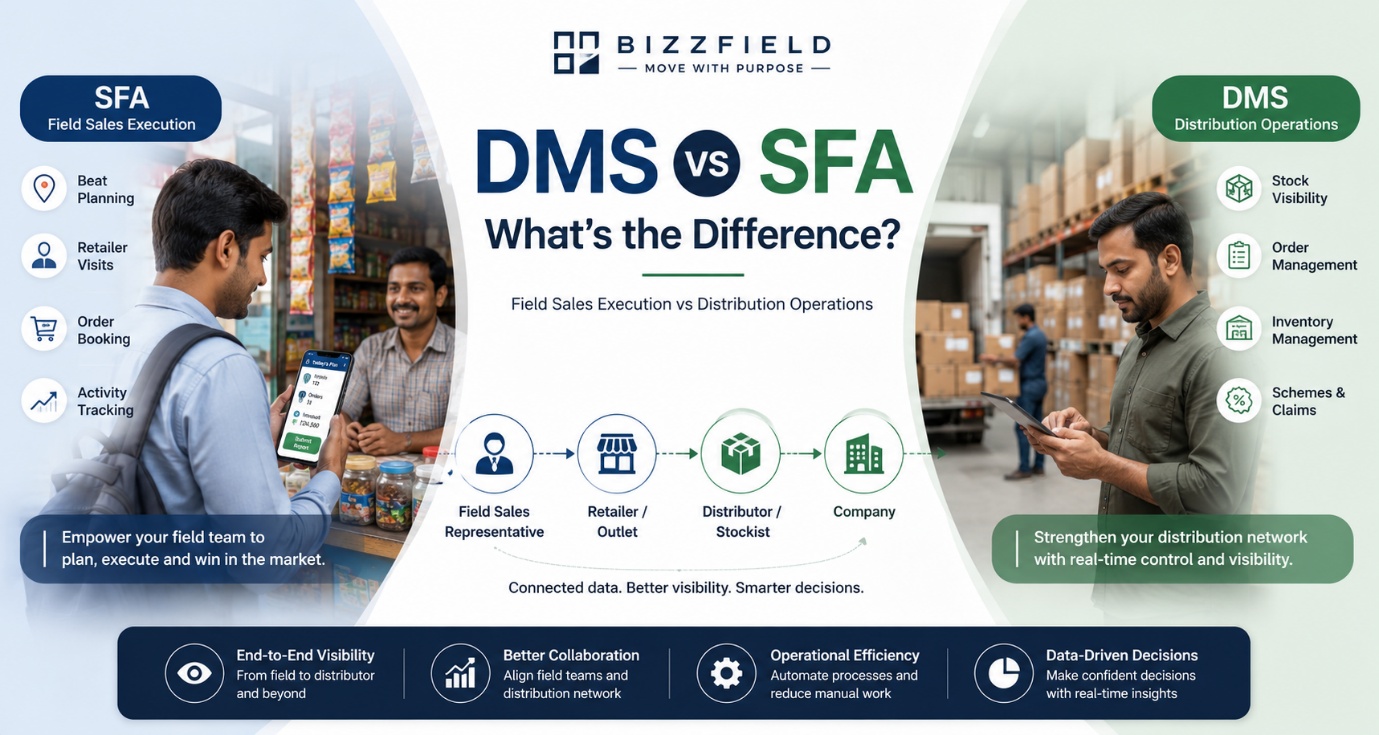
SFA is primarily designed for field-sales execution, while DMS is primarily designed for distribution operations. SFA helps sales representatives plan visits, execute beats and capture orders. DMS focuses on distributors, stockists, inventory, schemes and distribution visibility.
So, when comparing DMS vs SFA, the real question isn't which software is "better" — it's which part of your sales operation needs better control, and whether you need to manage both field execution and distribution. For an FMCG, pharma or other distribution-led business evaluating SFA software, the answer may be SFA, DMS, or both, depending on how the sales and distribution network operates.
Quick Answer: DMS vs SFA
SFA (Sales Force Automation) primarily manages field-sales execution — visits, beat/PJP planning and order booking by sales reps. DMS (Distribution Management System) primarily manages distribution operations — distributor orders, inventory and stock visibility, schemes and claims. Businesses running both a field team and a distributor network often need both, or an integrated platform.
- SFA = field-sales execution.
- DMS = distribution management.
- SFA typically handles field visits, beat/PJP planning, order booking and field-force productivity.
- DMS typically handles distributors, inventory, orders, stock visibility, schemes and claims.
- Businesses managing both field sales and distribution may need both systems.
- An integrated approach can connect field execution with distribution operations.
What Is SFA Software?
SFA (Sales Force Automation) software manages and improves field-sales execution. It's typically used by sales representatives, field teams and sales managers who need visibility into what's happening in the market.
An FMCG sales representative may have dozens of retailers to cover across a defined beat. SFA structures that activity through sales-rep attendance, beat and PJP (tour) planning, retailer visits, order booking, daily call reports, geo-tagging and field-force productivity tracking.
The central SFA question is: "What is my sales team doing in the market, and how effectively are they executing?" For a sales manager, that means visibility into planned versus completed visits and order capture, rather than relying on manual reports.
What Is DMS Software?
DMS (Distribution Management System) software manages distributor and distribution-network operations. It's typically relevant to businesses working with distributors and stockists. Rather than focusing on the field representative's activity, DMS looks at what's happening with distribution, orders and stock.
Typical DMS activities include distributor management, order processing, inventory visibility, and tracking across primary, secondary and tertiary sales, along with stock management, claims, schemes and distributor reporting.
The central DMS question is: "What is happening across my distribution network, orders and stock?" A distributor-led FMCG business, for example, needs visibility into stock levels, distributor orders, schemes and claims — in addition to sales performance.
For a deeper look at the distribution side, see our guide to a distribution management system.
DMS vs SFA: What's the Difference?
The simplest way to understand the difference between DMS and SFA is to look at what each system is primarily responsible for.
The following comparison shows the typical difference in focus, users and operational responsibilities between SFA and DMS.
| Area | SFA | DMS |
|---|---|---|
| Primary focus | Field-sales execution | Distribution operations |
| Main users | Sales reps, sales managers | Distributors, stockists |
| Field visits | Core functionality | Usually secondary |
| Beat/PJP planning | Yes | Usually not the core function |
| Order booking | Yes | Yes, from a distribution perspective |
| Distributor management | Limited / connected | Core functionality |
| Inventory & stock visibility | Limited / visibility-oriented | Core functionality |
| Primary sales | Can integrate/track | Core |
| Secondary sales | Often tracked | Core |
| Field productivity | Core | Not primary |
| Retail execution | Core / strong | Supporting |
| Distribution operations | Supporting | Core |
This doesn't mean every SFA or DMS platform has identical capabilities — vendors build different modules, and some products overlap. It's more accurate to say SFA typically prioritizes field-sales execution, while DMS typically prioritizes distribution operations.
SFA vs DMS: Which One Does Your Business Need?
Scenario 1: You Mainly Need Field Sales Control
This usually applies if your challenges include poor field visibility, missed visits, manual reporting, weak beat planning or low sales-rep productivity — for example, a pharma or FMCG sales manager who can't tell whether reps are covering planned outlets.
Scenario 2: You Mainly Need Distributor Operations
This usually applies if the bigger issues are distributor stock visibility, distributor orders, inventory, claims or scheme management — where the priority is stronger control over the distribution network rather than field-force execution alone.
Scenario 3: You Manage Both Field Sales + Distribution
This applies if your organization has a field team visiting retailers and a distributor network handling stock and fulfilment. One system may not cover every requirement here — businesses in this position may benefit from both SFA and DMS, or an integrated approach. Neither category is universally better; the right fit depends on which operational gap is costing you the most.
Do You Need Both DMS and SFA?
Not every business needs both. But companies managing both a field sales force and a distribution network may benefit from both, or an integrated approach.
Think of the workflow like this: Sales Representative → Retailer/Outlet → Distributor → Company. SFA captures the field-execution side of that journey; DMS manages the distributor-side operations. Together, they connect what happens in the market with what happens across the distribution network. The decision should be based on your operating model, not the feature list of any single vendor.
How DMS and SFA Work Together
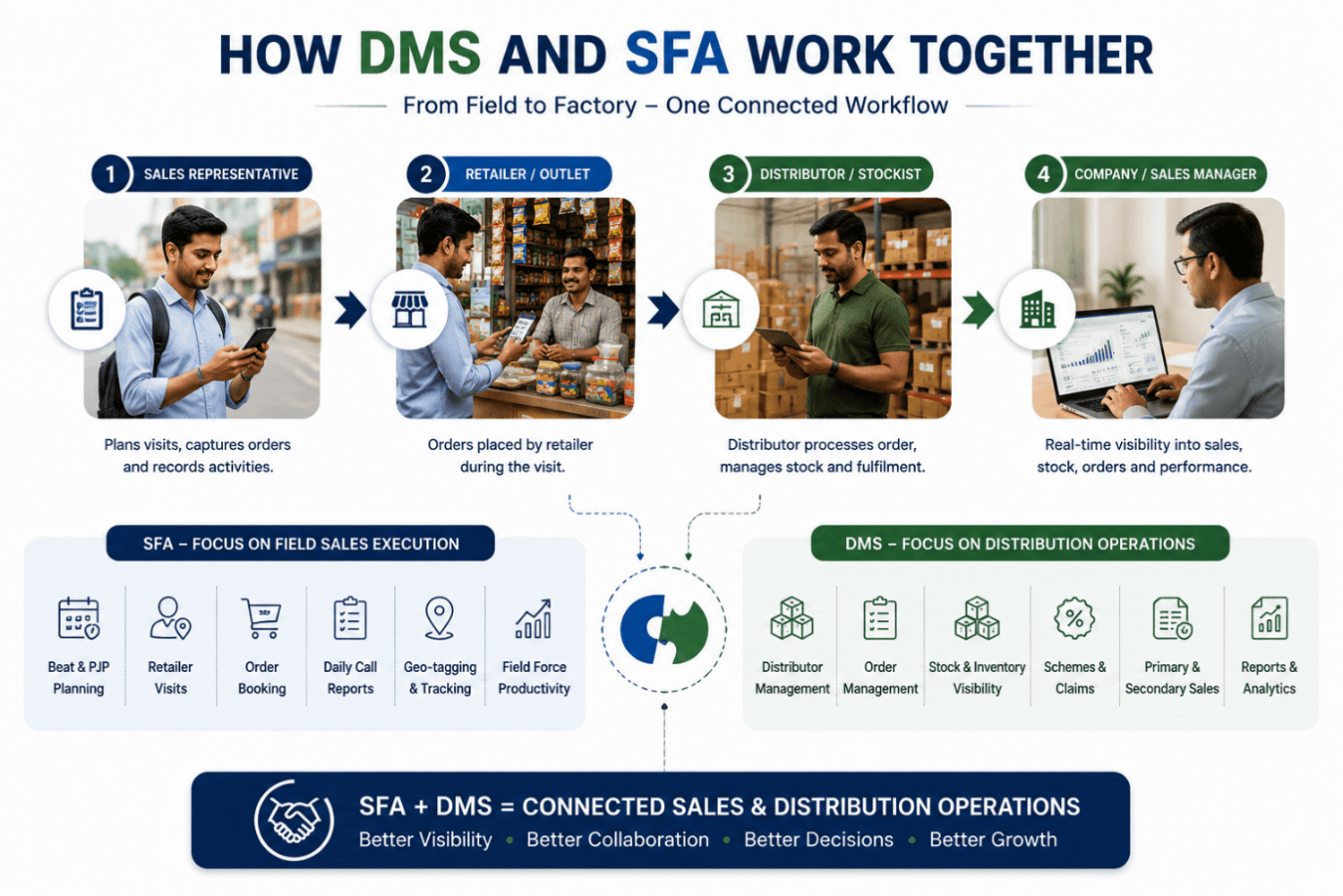
Field execution + distribution visibility = connected sales operations. A sales representative visits a retailer; SFA records the visit and captures the order; the order moves into the distribution process; the distributor processes fulfilment; and stock and order information becomes visible to management, who can compare field execution against distribution performance. The exact level of integration depends on the platforms and workflows involved.
Example: An FMCG Business Using SFA and DMS Together
Consider an FMCG company where field representatives visit retailers while a separate distributor network manages stock and fulfilment:
- Sales representative visits a retailer.
- SFA records the visit and captures the order.
- The order moves into the distribution process.
- The distributor handles fulfilment and stock.
- Management can compare field activity against distribution information.
In this sequence, SFA supports the field-execution layer while DMS supports the distribution layer. The two data sets remain distinct in focus but connected in workflow.
Can One Platform Handle Both SFA and DMS?
Yes — some modern sales and distribution platforms bring SFA and DMS workflows together. Relevant areas for businesses evaluating an integrated approach include primary and secondary sales, distributor management, field-force management, order and inventory management, scheme and offer management, geo-tagging, tour planning and offline working.
BizzField SFA can be considered in this context as a platform positioned around connected sales and distribution workflows, with capabilities that touch both field-sales and distribution-related operations. Businesses evaluating sales force automation software should look beyond individual features and ask whether the platform fits the actual flow between field teams, retailers, distributors and management.
DMS vs SFA: Quick Decision Guide
Use this guide to identify which software category best matches the operational problem your business is trying to solve.
| If your biggest problem is... | Consider |
|---|---|
| Field-force productivity | SFA |
| Sales-rep tracking | SFA |
| Beat/PJP management | SFA |
| Daily call reporting | SFA |
| Distributor stock visibility | DMS |
| Distributor operations | DMS |
| Inventory management | DMS |
| Primary sales | DMS |
| Field sales + distribution together | SFA + DMS / integrated platform |
Conclusion
DMS and SFA are complementary rather than identical systems. SFA focuses on field-sales execution; DMS focuses on distribution operations. In a DMS vs SFA decision, whether you need one system or both depends on your sales structure, distributor network and operational requirements.
If your business needs to connect field execution with distribution workflows, an integrated approach may be worth evaluating. BizzField's sales force automation platform is one option for businesses looking for a more connected sales and distribution workflow.
Explore BizzField's Connected Approach
Frequently asked questions
SFA primarily manages field-sales execution — visits, beat planning, order booking and sales-force activity. DMS primarily manages distribution operations — distributors, inventory, orders, stock visibility, claims and schemes.
No. SFA focuses primarily on field-force execution and productivity, while DMS focuses primarily on distributor and distribution-network operations. Some platforms overlap, but the core focus differs.
It depends on your business model. If field-sales execution is your main requirement, SFA may be sufficient. If distributor and inventory management is the priority, DMS may come first. Businesses managing both may benefit from an integrated platform.
Not necessarily. SFA may cover overlapping workflows like order capture or secondary-sales tracking, but a dedicated DMS typically provides deeper distributor-side capabilities.
Not necessarily. DMS provides distribution visibility but may not offer the full field-force execution capabilities needed for beat planning, PJP management and sales-visit tracking.
Yes. A typical flow connects a sales representative's retailer visit and order capture with distributor fulfilment, stock information and management reporting.
WRITTEN BY
Shivam Gupta
Brand Manager
Brand Manager with 8+ years of experience in building brands, developing growth strategies, and creating impactful marketing campaigns that drive business success.
Connect on LinkedIn