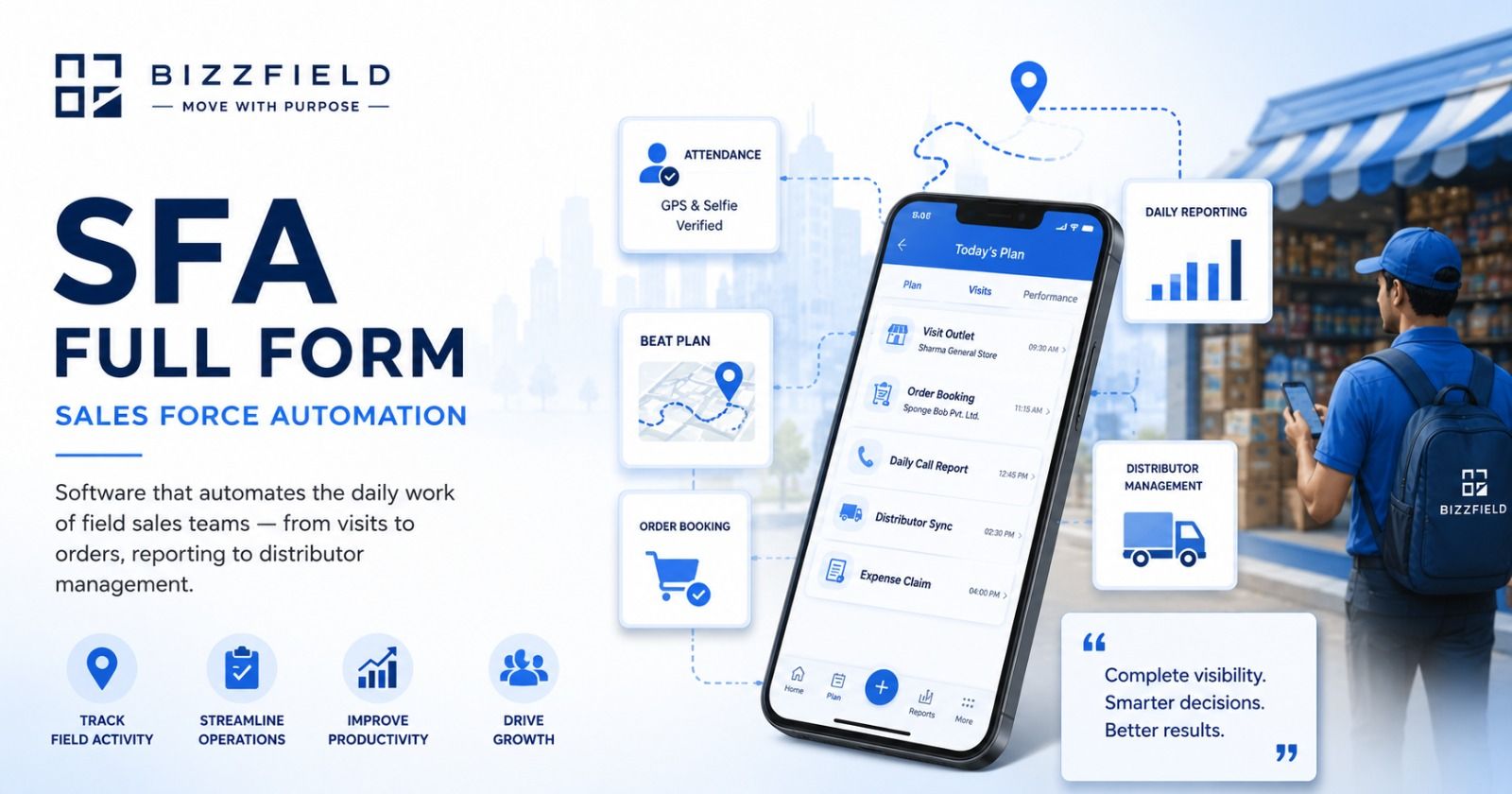
SFA stands for Sales Force Automation. It is software that automates the daily work of a field sales team — attendance, beat planning, in-outlet order booking, daily call reporting and distributor management — replacing paper registers, WhatsApp updates and end-of-day spreadsheets.
What SFA stands for
Break the SFA full form apart and each word is doing real work. Sales focuses specifically on field-sales activities — customer visits, order booking, collections and target execution — rather than marketing campaigns or post-sale support. Force is the people doing the selling in the field: sales reps, territory managers, medical representatives, beauty advisors, distributor sales officers — anyone whose job takes them to a counter, a clinic or a retail outlet rather than keeping them at a desk. Automation is the part that digitises, standardises and cuts down the manual recording and reporting behind that field activity — attendance, order booking, visit logging and reporting move from paper and WhatsApp into a structured digital record, with the rep still doing the visiting, selling and recording, just through the app instead of a register.
Put together, that's the full meaning behind the acronym: SFA software is built specifically to manage a field sales team, as distinct from an inside sales team working from a desk or a marketing team running campaigns.
What SFA software actually does
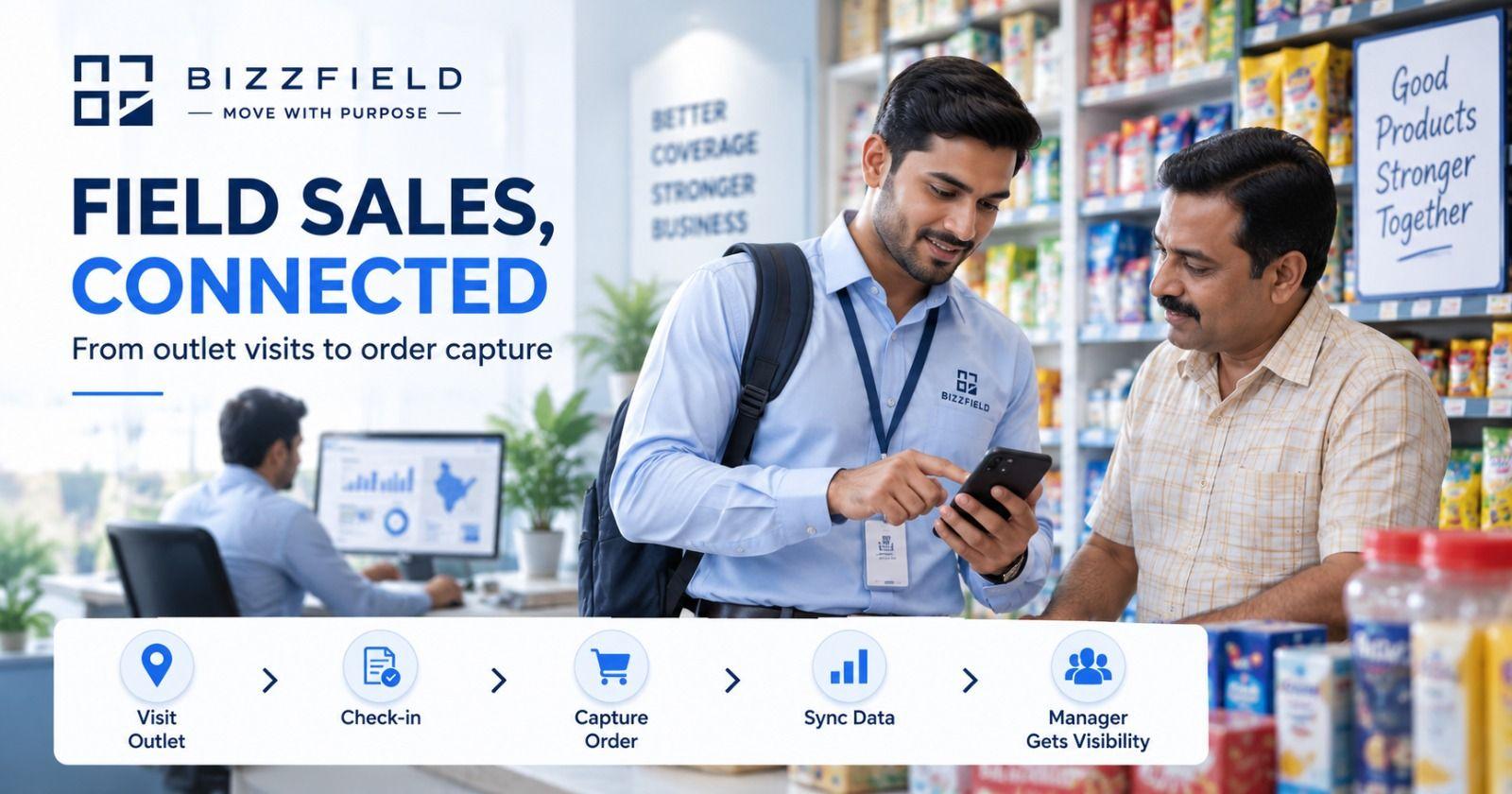
Once you're past the SFA full form itself, the more useful question is what the software actually does for a field rep's day:
- Attendance with GPS and selfie verification
- Beat and route planning — who visits which outlet, on which day, in what order
- In-outlet order booking, including offline capture in low-connectivity areas
- Daily call reporting
- Distributor and stock visibility
- Scheme and offer handling
- Expense claims
- Manager dashboards for same-day coverage and productivity visibility
None of that is complicated in isolation. What makes it valuable is that it replaces a stack of spreadsheets, phone calls and WhatsApp messages that were never built to give a manager an accurate, real-time picture of what happened on the ground. For a fuller look at how this plays out day to day, see what Sales Force Automation covers and why FMCG, pharma and cosmetics companies in India use it.
SFA full form in Hindi
SFA का पूरा नाम Sales Force Automation है। हिंदी में भी ज़्यादातर लोग इस अंग्रेज़ी नाम को अंग्रेज़ी अक्षरों में ही खोजते हैं, इसलिए “Sales Force Automation” को यहाँ अंग्रेज़ी में ही रखा गया है। यह एक ऐसा सॉफ्टवेयर है जो फील्ड में काम करने वाली सेल्स टीम की रोज़मर्रा की गतिविधियों — अटेंडेंस, बीट प्लानिंग, ऑर्डर बुकिंग और डेली कॉल रिपोर्टिंग — को डिजिटल और ट्रैक करने योग्य बनाता है, कागज़ी रजिस्टर और व्हाट्सएप अपडेट की जगह लेकर।
SFA ka full form kya hai? जवाब है Sales Force Automation। SFA software kya hai? यह वही सिस्टम है जो एक फील्ड सेल्स टीम की विज़िट, ऑर्डर बुकिंग और कवरेज को डिजिटल रूप से मैनेज करता है।
Is SFA the same as CRM?
Short answer: no, though the two get confused often enough that it's worth a clear line between them. CRM (Customer Relationship Management) is built around managing relationships and pipeline — leads, opportunities, deal stages and the full history of interactions with an account. It suits longer, relationship-driven sales cycles like B2B or financial services.
SFA is built around managing field execution — where a rep went, whether they were actually there, what they sold, and how consistent that coverage was across a beat or territory. It suits high-frequency, location-based selling like retail outlet visits or doctor calls.
| SFA | CRM | |
|---|---|---|
| Built for | Field sales reps who visit outlets | Sales teams managing deals and contacts |
| Core object | The outlet visit | The lead, contact or opportunity |
| Typical user | ASM, RSM, MR, field rep, sales ops | Inside sales, account managers, business development, sales management |
| Works offline | Often important for field teams operating in low-connectivity areas | Usually not required |
| Optimises | Coverage, productivity, secondary sales visibility | Pipeline conversion and customer relationships |
| Common in India | FMCG, pharma, agri-input, durables distribution | SaaS, B2B services, real estate, BFSI |
Some businesses need both — a CRM for the relationship side, an SFA tool for field execution — run as separate, connected systems rather than one tool trying to do both jobs. For more detail, see the full SFA vs CRM comparison.
SFA vs Field Force Automation
SFA and field force automation are related but not the same scope. SFA is sales-focused — built around what a selling rep does: visits, order booking, beat coverage and targets. Field force automation is the broader category. It can cover any team that works away from an office, not only sales — service engineers, delivery staff, merchandisers, collections agents and auditors, alongside sales reps.
In practice, the two often share the same spine — attendance, routing, field data capture. Where a team is entirely about selling, SFA is usually the right fit. Where the field workforce spans sales alongside service, delivery or audit work, a broader field force automation approach covers more ground. See how FMCG companies apply field force automation across sales, merchandising and audit-heavy roles.
Where you will hear “SFA” used
The term shows up most in industries where a large share of the sales team is out in the field every day rather than sitting behind a phone: FMCG, pharmaceuticals, cosmetics and personal care, agri-inputs and consumer durables. Job titles that use it daily include ASM, RSM, NSM, sales ops and MR (medical representative). A regional sales manager might use it plainly in a review meeting — “Our SFA numbers show beat compliance dropped to 78% in the northern territory this week” — without anyone in the room needing the acronym explained.
If your business has sales officers doing beat-based outlet visits, or medical reps making doctor calls, “SFA” is probably already part of your team's vocabulary, even if the tool attached to it has a different brand name.
Other terms you will meet alongside SFA
SFA doesn't exist in isolation — it sits inside a broader vocabulary of field sales and distribution terms:
- DCR (Daily Call Report)— the record of a field rep's visits and outcomes for a given day, most common in pharma.
- PJP (Permanent Journey Plan) — a longer-cycle version of a beat plan, mapped out weeks or months ahead.
- RCPA (Retail Chemist Prescription Audit) — a periodic check on which brands a chemist is stocking against, used mainly in pharma to track competitor activity at the retail counter.
- POB (Purchase Order Booking) — the order captured during or after a field visit.
- DMS (Distributor Management System) — tracks distributor stock, orders and secondary sales; distinct from but often connected to SFA. See how DMS and SFA differ.
- Beat plan — the structured route and outlet or doctor list assigned to a rep for a given day or cycle.
- Secondary sales — sales from distributor to retailer, as opposed to primary sales (manufacturer to distributor).
For a closer look at how DCR, POB and RCPA work together in a pharma field team's day, see what DCR software for pharma covers.
Who uses SFA software in India
SFA software tends to get adopted at a fairly specific inflection point: once a field team grows large enough, spreads across enough territory, or becomes hard enough to track through phone calls and WhatsApp alone that a sales manager can no longer keep an accurate picture of it manually — the exact size varies by industry and how spread out the team is. The companies that lean on it most heavily run distributed, outlet-based or visit-based sales models: FMCG brands managing retailer coverage across a state, pharma companies tracking doctor and chemist visits, cosmetics brands overseeing beauty advisors across counters. In these setups, a regional or national sales manager cannot be present for every visit, so the software gives managers visibility into field activity they cannot personally observe throughout the day.
If you're past the point of trusting WhatsApp updates to tell you what your field team did today, it might be worth seeing what the software actually looks like in practice. Explore SFA
Frequently asked questions
SFA is Sales Force Automation — software built to manage and verify what a field sales team does day to day. In sales specifically, it covers beat planning, attendance, order booking and reporting for reps working outside an office.
SFA का पूरा नाम Sales Force Automation है। हिंदी में समझें तो यह एक ऐसा सिस्टम है जो फील्ड सेल्स टीम की विज़िट, ऑर्डर बुकिंग और कवरेज को डिजिटल रूप से ट्रैक और मैनेज करता है।
No. SFA and CRM overlap in that both manage sales activity, but SFA is field-first and outlet-centric while CRM is pipeline-first and contact-centric. See the full SFA vs CRM comparison for the complete breakdown.
SFA software is used for beat and route planning, GPS-verified attendance, in-outlet order booking, daily call reporting and distributor visibility — so a sales manager can see what the field team actually did today, not what a Friday roll-up says happened.
The same expansion — Sales Force Automation — but FMCG uses the term more than most sectors because of how visit-heavy its sales model is: high outlet counts, a distributor-led route to market, and daily beats that need verifying at scale.
WRITTEN BY
Shivam Gupta
Brand Manager
Brand Manager with 8+ years of experience in building brands, developing growth strategies, and creating impactful marketing campaigns that drive business success.
Connect on LinkedIn