
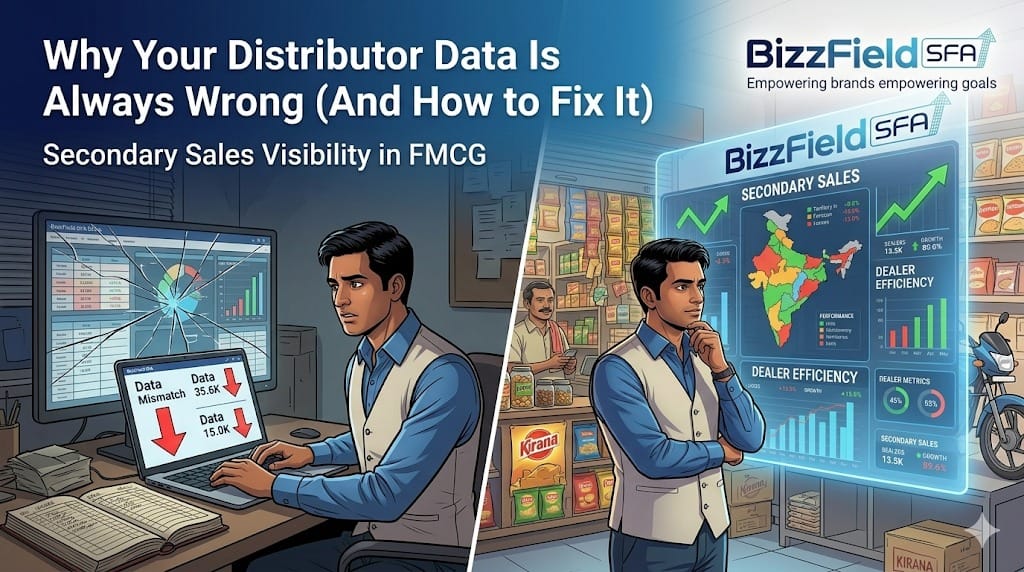
Ask any FMCG NSM what their biggest data problem is, and the answer is almost always the same: secondary sales.
Primary sales — what the company sells to its distributors — is clean, real-time, and tracked in the billing system. Secondary sales — what the distributor sells to retailers and stockists — is largely invisible until someone sends a report.
And by the time that report arrives, it is 4 to 7 days old, manually compiled, unverified, and missing the details that would actually help you act on it.
1. What Is Secondary Sales in FMCG?
Secondary sales refers to the transactions that happen when a distributor sells your products to retailers, stockists, or sub-distributors. It is the second step in the channel — after you have sold to the distributor (primary sales) and before the product reaches the consumer.
In FMCG, secondary sales are the more operationally critical number. Primary sales tell you what left your warehouse. Secondary sales tell you what is actually moving in the market. A distributor can be fully stocked while secondary sales have stalled — and you will not know until a territory review surfaces the problem.
2. Why Secondary Sales Data in India Is Almost Always Wrong
There are three structural reasons why secondary sales data in most Indian FMCG companies is unreliable:
Self-reported by distributors
Most FMCG companies receive secondary sales data as a weekly Excel file submitted by the distributor's back-office team. This data is entered manually, often on Friday evening, from paper records kept during the week. It is self-reported, unaudited, and approximately 4–7 days old when it arrives.
No standard format across distributors
Different distributors use different formats, different SKU names, and different levels of outlet-level detail. Compiling this into a meaningful NSM dashboard requires hours of manual work — and the result is still incomplete.
Stock data derived from inference, not measurement
In the absence of real-time data, most companies estimate distributor stock by calculating: opening stock + primary purchases − secondary sales = closing stock. This works only if the secondary sales figure is accurate. If secondary sales are wrong or delayed, the derived stock figure is wrong.
What This Means in Practice
An NSM making territory decisions based on last Friday's secondary sales report is making decisions on data that may be 10+ days old by the time they act. In a fast-moving consumer goods environment where stock positions change daily, this lag directly costs revenue.
3. The Real Cost of Secondary Sales Blind Spots
Secondary sales visibility gaps create three specific, quantifiable problems for FMCG businesses:
Undetected stock-outs
A stockist runs out of your product on Tuesday. Your TSM is scheduled to visit on Friday. Your NSM sees the weekly report on Monday. By then, six days of sales have gone to a competitor. With real-time secondary sales visibility, the stock-out would trigger an alert on Tuesday afternoon.
Scheme leakage
Trade schemes are one of the largest cost items in FMCG distribution. Without verified secondary sales data, scheme claims are settled on the basis of what the distributor reports selling, not what actually moved. The gap between claimed and actual secondary sales is where scheme budgets leak silently.
Inaccurate demand forecasting
If secondary sales data is delayed or incomplete, your demand forecasting is built on a distorted picture of market velocity. This leads to either over-stocking distributors (high working capital cost) or under-stocking them (lost sales). Both are avoidable with accurate, real-time secondary sales data.
4. What Real-Time Secondary Sales Visibility Looks Like
When a Distributor Management System (DMS) is integrated with SFA software, secondary sales visibility works entirely differently from the Excel-and-email model:
- When a field rep visits a stockist and books an order, that order updates the distributor's inventory in real time.
- When a distributor sells to a retailer, the transaction is recorded in the system at the point of sale, not compiled at the end of the week.
- The NSM's dashboard shows secondary sales by territory, by distributor, and by SKU — updated throughout the day.
- Stock-out alerts are triggered automatically when a distributor's stock of any SKU drops below the reorder threshold — before the stock-out occurs, not after.
The result is not a better version of the same Friday Excel. It is a fundamentally different operating model — where decisions are made on current data, not on last week's approximation.
5. How DMS Software Fixes the Data Problem Permanently
The secondary sales tracking software in a DMS replaces the manual reporting chain with an automated one. Here is what changes at each stage:
Order capture
Distributor orders are placed through the DMS app — no longer phoned in or messaged. Every order creates a verified record with timestamp, SKU, quantity, and outlet details. There is nothing to manually compile because the data is already structured.
Stock updates
As distributors sell to retailers, inventory levels update in the DMS. The company sees distributor stock in real time — not derived from a calculation, but recorded from actual transactions.
Scheme compliance
Scheme claims are generated from actual transaction records in the DMS — not from distributor-submitted Excel files. The company can verify every claim against the underlying sales data before settlement.
Bizzfield's distribution management system for FMCG →
Explore More from Bizzfield
Book a DMS Walkthrough — See Real-Time Secondary Sales in 15 Minutes
· No commitment. Live product. FMCG-specific features.
Shivam Gupta
Brand Manager with 8+ years of experience in building brands, developing growth strategies, and creating impactful marketing campaigns that drive business success.
Frequently asked questions
Primary sales is the transaction from the company to its distributor — tracked through the billing system. Secondary sales is the transaction from the distributor to the retailer or stockist — typically self-reported and often delayed. Secondary sales is the more operationally important figure because it reflects actual market movement.
A DMS captures secondary sales at the point of transaction — when the distributor processes an order — rather than waiting for a weekly manual report. This gives the NSM outlet-level, SKU-level secondary sales data in real time, replacing delayed and unverified Excel submissions.
Secondary sales tracking software records and reports the transactions between distributors and their retail customers in real time. It is typically a module within a Distributor Management System (DMS), integrated with field sales data from the SFA platform to provide a complete view of how products are moving through the channel.
Without a verified secondary sales record, trade scheme claims are settled against what the distributor reports selling rather than what actually moved. A DMS generates claims from the underlying transaction records, so every claim can be checked against real sales before settlement.
WRITTEN BY
Shivam Gupta
Brand Manager
Brand Manager with 8+ years of experience in building brands, developing growth strategies, and creating impactful marketing campaigns that drive business success.
Connect on LinkedIn