
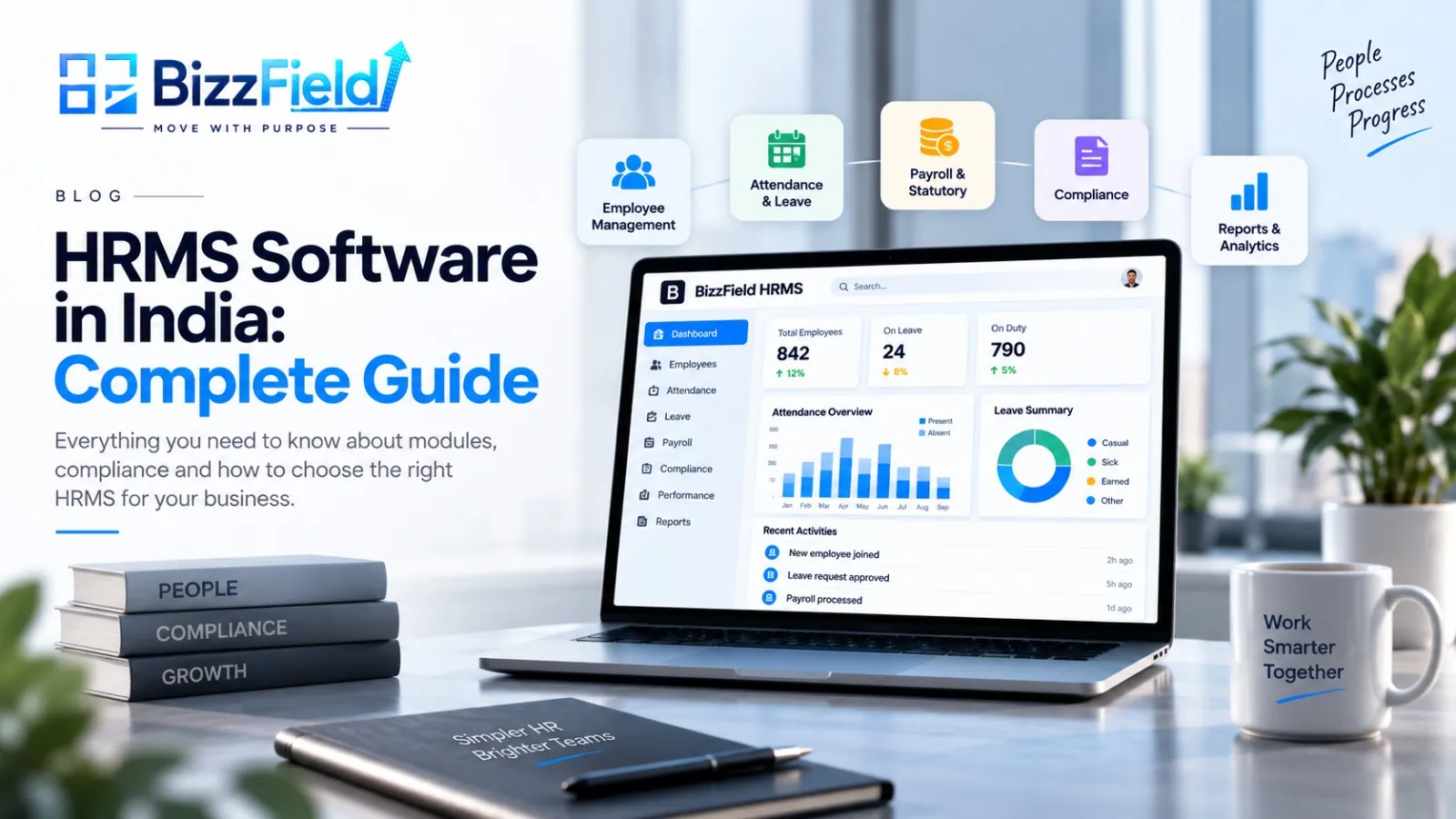
HRMS software is a single system for managing employee records, attendance, leave, payroll and statutory compliance. In India that means handling EPF, ESI, Professional Tax, Labour Welfare Fund and TDS alongside normal HR operations — which is why Indian companies rarely use HR software built for other markets.
How HRMS Software in India Changed: From Muster Rolls to Cloud Platforms
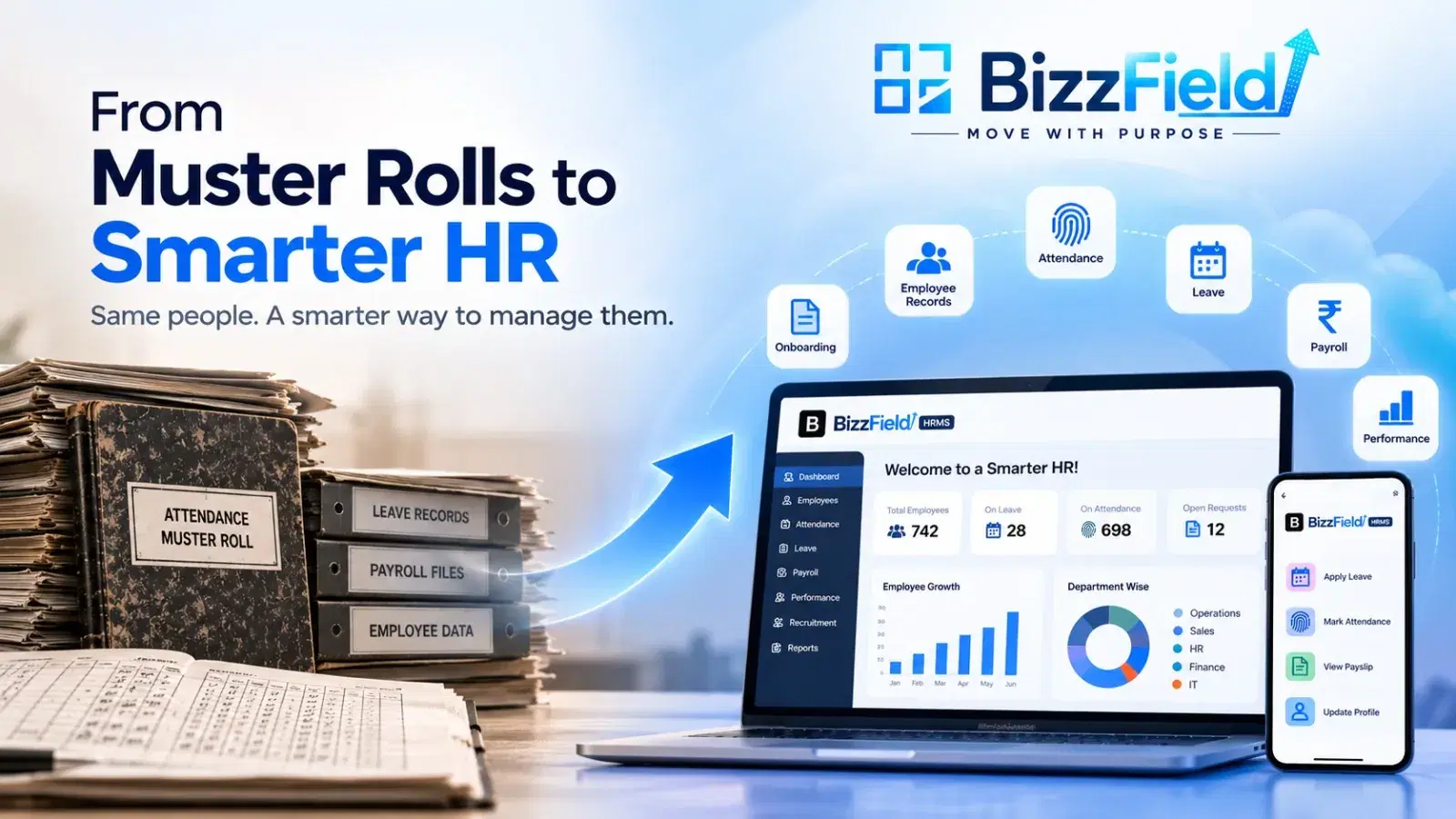
Indian HR administration ran on paper well into the 2000s: registers at the gate, paper leave applications, a salary sheet rebuilt in Excel each month. Biometric devices solved capture but not workflow — data sat in its own system and was re-entered into payroll. Desktop payroll software followed: reliable computation on one machine in accounts, where every statutory change meant waiting for a patch.
Cloud HRMS changed that: statutory updates ship centrally, employees reach the system from a phone, and attendance, leave and payroll read from one record instead of three that disagree. The buying question moved with it — not whether it calculates a salary, but whether, at 200 to 1,000 employees, it files your returns and covers every state you operate in.
HRMS Modules: What HRMS Software Actually Does
An HRMS holds one employee master record and runs every process off it:
- Core employee records — details, documents, designation, reporting line, salary structure, audit trail.
- Attendance and shifts — biometric, mobile and web capture, rosters, overtime, site-wise policies.
- Leave — types, accrual, carry-forward, approval routing, and the balance payroll draws on.
- Payroll and statutory filing — computation, deductions, statutory returns, payslips, year-end Form 16.
- Employee self-service (ESS) — leave applications, payslips and queries without going through HR.
- Onboarding and exit — offer-to-joining documentation, asset issue, full and final settlement.
- Performance — goals, review cycles, ratings and retained feedback history.
- Reporting and analytics — headcount, attrition, cost per employee, attendance exceptions, muster roll, statutory registers.
BizzField HRMS is built for Indian companies with 200 to 1,000 employees — large enough for multi-site attendance, multiple legal entities and real statutory exposure, small enough that a nine-month enterprise implementation is not an option.
- One employee master across attendance, leave and payroll — no reconciliation between modules.
- Multi-entity and multi-state handling across more than one registration.
- Statutory computation and return generation for EPF, ESI, PT, LWF and TDS.
- ESS on Android and web, built for plant and field staff.
HRMS vs HRIS vs HCM: What the Terms Actually Mean
The three acronyms have distinct origins and almost no distinct meaning left in Indian buying conversations. HRIS meant a system of record; HCM was the enterprise framing. HRMS sat between them and became the working term for the system most Indian companies buy. Vendors use whichever suits their positioning, so the acronym is not a useful filter. The module list is.
| HRIS | HRMS | HCM | |
|---|---|---|---|
| Original meaning | Employee records and data | Records plus HR operations | Full talent and workforce suite |
| Typically includes | Master data, documents, org chart | Attendance, leave, payroll, ESS, statutory | All of HRMS plus talent, planning, analytics |
| Payroll | Usually not | Usually yes, in India | Yes, often multi-country |
| Bought by | Smaller teams, or as a module | Indian mid-market — the common case | Large enterprise |
Who Builds HRMS Software in India
The market sorts by the company size a product was designed around, not by feature count — which removes most vendors before the first demo.
Under 200 employees. greytHR, Zoho People, Pocket HRMS and Kredily are configured for smaller headcounts: quick setup, limited multi-entity depth. Note that Zoho People has no payroll — Zoho Payroll is a separate subscription, so a Zoho evaluation is really two products.
Over 1,000 employees. Darwinbox, PeopleStrong, ZingHR and SAP SuccessFactors carry full suite scope, longer implementations and enterprise commercial models. Ranking well for mid-market queries is not the same as fitting a mid-market deal.
200 to 1,000 employees. HROne, Keka, factoHR, Zimyo and BizzField compete here — the least clearly served band, where few vendors segment by company size at all.
Which HRMS Modules Actually Matter at 200 to 1,000 Employees
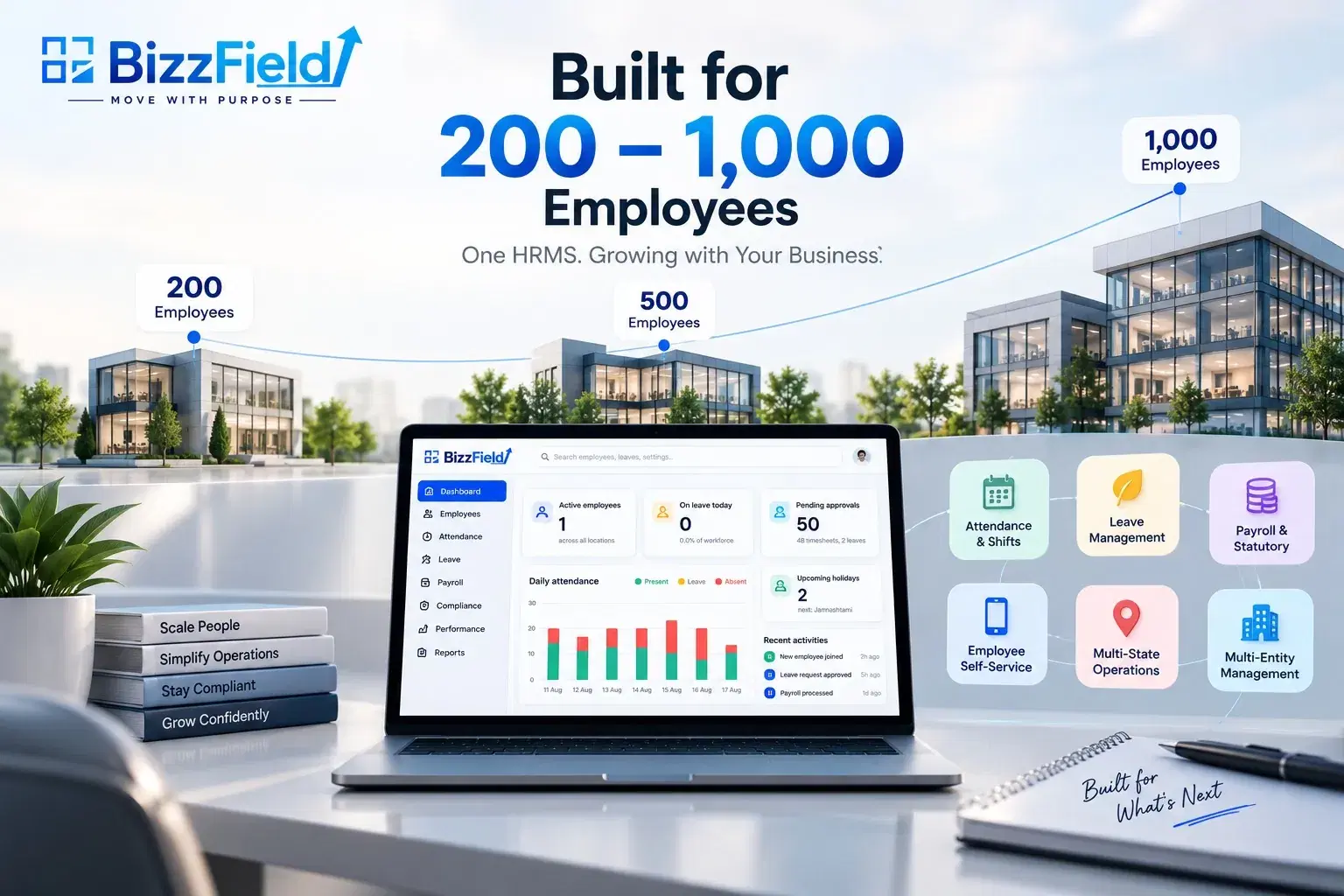
Company size decides which modules are load-bearing and which are expensive decoration.
Must have. Payroll with statutory filing — the monthly cycle is the largest operational risk at this size, and an HRMS that stops at computation leaves the hardest part manual. Attendance across multiple sites — head office, plant, warehouse and field teams rarely share one policy, and a single-policy system pushes spreadsheets back in. Leave, a direct payroll input. ESS, because HR here cannot absorb per-employee queries. Multi-entity, if you run more than one legal entity — retrofitting usually means re-implementing.
Worth having. Performance, onboarding and an HR helpdesk reduce HR load but will not stop a payroll cycle. Take them if included; do not let them decide the shortlist.
Enterprise-only — do not pay for it yet. OKR frameworks, workforce planning, global payroll and deep BI: frequently bought at this headcount, never configured, and carrying implementation weight a four-person HR team cannot staff.
What to Check in an Indian HRMS: The Statutory List
India-specific compliance is where software built for other markets stops being usable. Check coverage of each item:
- EPF — computation and ECR file preparation for monthly filing.
- ESI — eligibility tracking as wages change, contribution computation, return preparation.
- Professional Tax — state-wise slabs, with different rules and filing frequencies per state.
- Labour Welfare Fund — state-specific, and the most commonly missing module.
- TDS — Form 24Q quarterly and Form 16 at year end.
- Gratuity — accrual tracking and settlement computation.
- Shops and Establishments Act — registers and record-keeping varying by state.
- Multi-state shift and attendance rules — working hours, overtime and holiday lists differing by location.
Then ask what separates otherwise similar platforms: does the system file on your behalf, or generate a file someone still has to upload? Both are sold as "compliance"; only one removes a monthly task. Ask return by return — a vendor may file one and generate another.
Statutory information current as of 9 September 2026. Rates and slabs change; verify with the relevant authority. PF and ESI handling is covered in our guide to automating PF, ESI and TDS.
How to Evaluate HRMS Software in India: Eight Questions to Ask
- What is the realistic implementation timeline at our headcount? A single number with no dependencies is a bad answer.
- Who does the data migration?"We'll share a template" means you do.
- What is the support and escalation model?Ask for named response times, not "dedicated support".
- How do you handle multiple entities and states? Watch for "we can configure that" with no live example.
- What is ESS adoption among customers our size? A vendor with no number has not measured it.
- How are statutory changes shipped, and how fast? Expect a release process, not a promise.
- What is included and what is a paid add-on? Statutory filing, mobile app and integrations are the common three.
- What are the contract length and exit terms? Ask whether you can export full payroll history.
Conclusion: Buy for Your Headcount, Not for the Feature List
Indian HR software moved from registers to cloud systems that update themselves. What has not moved is how most vendors sell — as a fit for everyone. At 200 to 1,000 employees that is the trap: the platform sized for twenty will not hold multi-state payroll, and the one sized for twenty thousand will not be implemented by a four-person HR team. Judge on statutory filing, multi-state handling and real ESS adoption.
Book HRMS demo → — bring your own states, entities and shift patterns and test the fit.
BizzField also builds payroll software and sales force automation.
Frequently asked questions
HRMS software manages the employee lifecycle — records, attendance, leave, payroll, self-service and reporting — from one employee master. HR management software in India must also carry statutory scope: EPF, ESI, Professional Tax, LWF, TDS and state registers.
HRIS originally meant a system of record for employee data; HRMS added attendance, leave and payroll on top. That distinction has largely collapsed, and Indian vendors use both terms for the same product. Compare module lists, not labels.
Most Indian vendors price per employee per month, with the rate stepping down as headcount rises. Implementation is quoted separately and statutory filing is often a paid add-on. List prices are often unpublished, so a quote at your headcount is the only meaningful comparison.
Three criteria decide it at that size: whether payroll includes statutory filing, whether the system handles multi-state and multi-entity operations natively, and whether ESS is actually adopted. BizzField HRMS is built for the 200 to 1,000 band.
Some file the returns for you; many only compute the amounts and generate a file your team uploads. Both are marketed as compliance. Ask which model applies to each return — PF ECR, ESI and Form 24Q may be handled differently within one product.
WRITTEN BY
Shivam Gupta
Brand Manager
Brand Manager with 8+ years of experience in building brands, developing growth strategies, and creating impactful marketing campaigns that drive business success.
Connect on LinkedIn