
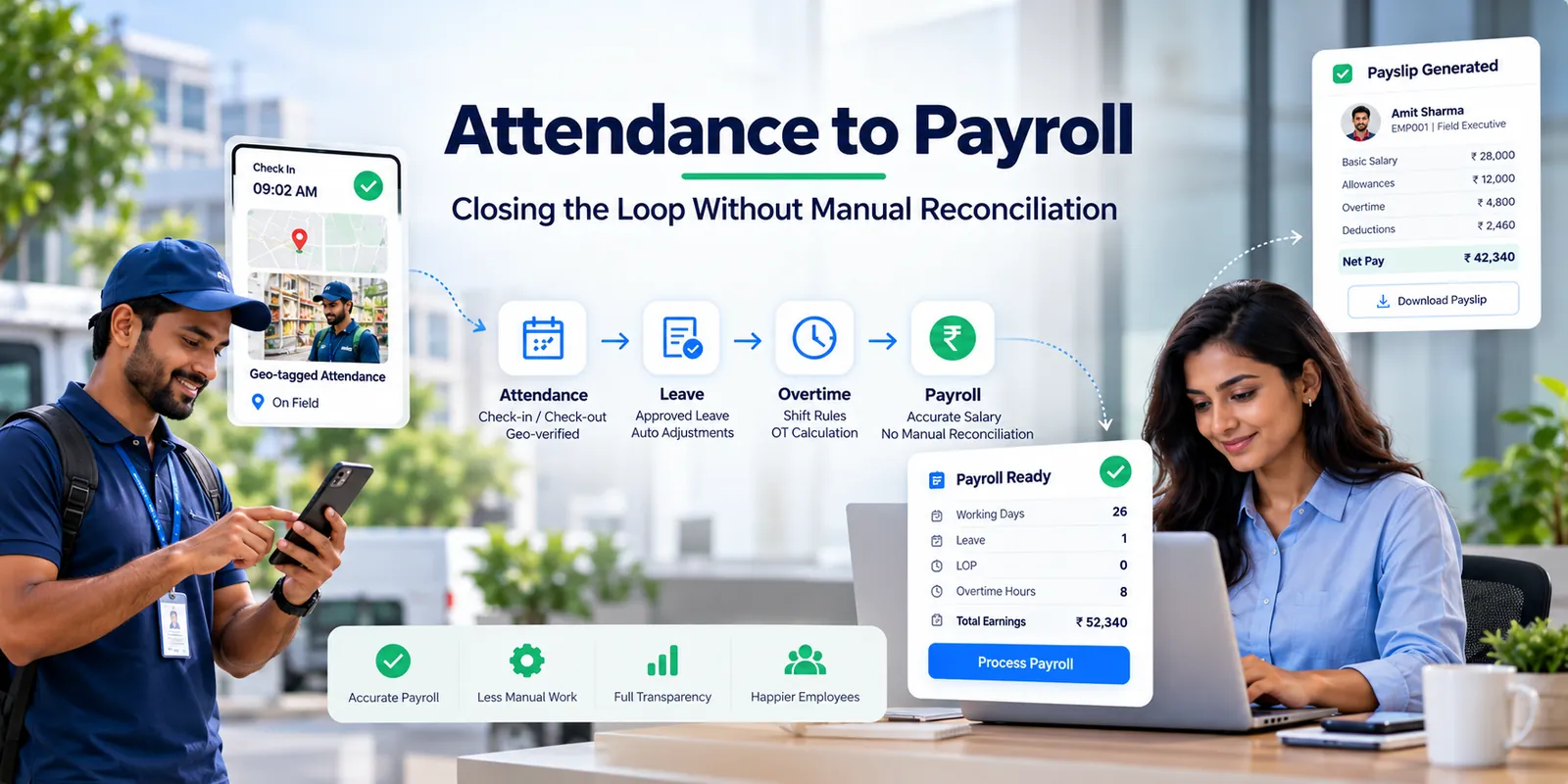
Attendance Should Not End at the Attendance Register
For many growing businesses, payroll day still starts with a familiar routine: attendance is closed in one place, someone exports a spreadsheet, HR checks exceptions, payroll imports the file, and Finance begins reconciling what changed. A late correction, an unapproved leave, a shift adjustment or an overtime entry can turn a straightforward pay run into a chain of manual checks.
The problem is not that attendance is being tracked. The problem is that the information created by attendance is not always carried forward as payroll-ready data.
That distinction matters. Attendance is one of the inputs that changes an employee's pay. If approved attendance, leave, shifts and overtime are disconnected from payroll, the payroll team has to recreate the connection every month.
BizzField approaches this differently. In BizzField HRMS, approved attendance and leave can feed payroll directly, while shifts and overtime become part of the same pay run. The objective is simple: the hours approved for the pay period should be the hours payroll uses — not a copied version sitting in another spreadsheet.
The Short Answer: What Is Attendance-to-Payroll Integration?
Attendance-to-payroll integration means approved attendance, leave, shift and overtime information is made available to the payroll process without requiring HR to manually export, clean, re-enter or reconcile the same data in another system. The payroll run uses the approved records as its source for pay-impacting attendance inputs such as loss of pay and overtime.
Why Attendance and Payroll Still Get Separated
Many organizations did not intentionally design a disconnected payroll process. They accumulated systems over time: a biometric device for attendance, an HR tool for leave, spreadsheets for overtime, email for approvals and accounting software for payroll. Each tool may work reasonably well on its own. The operational problem appears at the handoff.
| Typical handoff | What HR ends up doing |
|---|---|
| Attendance → Excel | Export, clean and verify records |
| Leave → Payroll | Check whether approved leave is reflected |
| Overtime → Payroll | Match overtime against attendance or shift records |
| Corrections → Payroll | Find late changes and recalculate affected values |
| Payroll → Finance | Reconcile totals and investigate exceptions |
The Hidden Cost of Manual Payroll Reconciliation
Manual reconciliation is not only an administrative inconvenience. It creates a control problem: the team must prove that the attendance record used for payroll is the same record that was approved, corrected and finally paid.
A payroll discrepancy can start with something small. An employee's shift changes. A half-day is corrected after the export. Overtime is approved separately. Leave without pay is updated after the payroll file has been prepared. Each change creates another reconciliation point.
This becomes more difficult as employee count, locations, shifts and business units increase. A process that feels manageable for 80 employees can become fragile when HR is handling several hundred or several thousand employees across offices, plants, warehouses, stores or field teams.
Common Failure Points
- Excel dependency: attendance data is exported, edited and imported instead of remaining connected to its source.
- Late corrections: attendance changes after the payroll cut-off may not reach the payroll calculation cleanly.
- Overtime mismatch: overtime is maintained in a separate register and has to be checked against shifts and attendance.
- LOP disputes: employees question deductions because HR has to trace the calculation across multiple records.
- No clear audit trail: it becomes difficult to see who changed a record, when it changed and whether the change was approved.
- Repeated data entry: the same information is typed or reformatted more than once.
What a Modern Attendance-to-Payroll Workflow Looks Like
The goal is not simply to remove an Excel file. The goal is to create a controlled chain from attendance capture to approved payroll inputs.
- Capture — Employee attendance is recorded through the configured attendance process.
- Validate — Attendance, shifts, leave and overtime are reviewed against applicable rules.
- Approve — Required corrections and approvals are completed before the pay run.
- Feed — Approved attendance and leave are read by payroll rather than re-keyed.
- Calculate — Pay-impacting items such as loss of pay and overtime are derived from the records.
- Review — The payroll draft is checked and exceptions are investigated before approval.
- Pay — The approved pay run produces payslips and downstream payroll outputs.
How BizzField Closes the Loop
BizzField HRMS is designed around the idea that payroll should not be a separate calculation exercise performed after HR has already closed attendance. Attendance, leave, shifts and payroll are connected parts of the employee record.
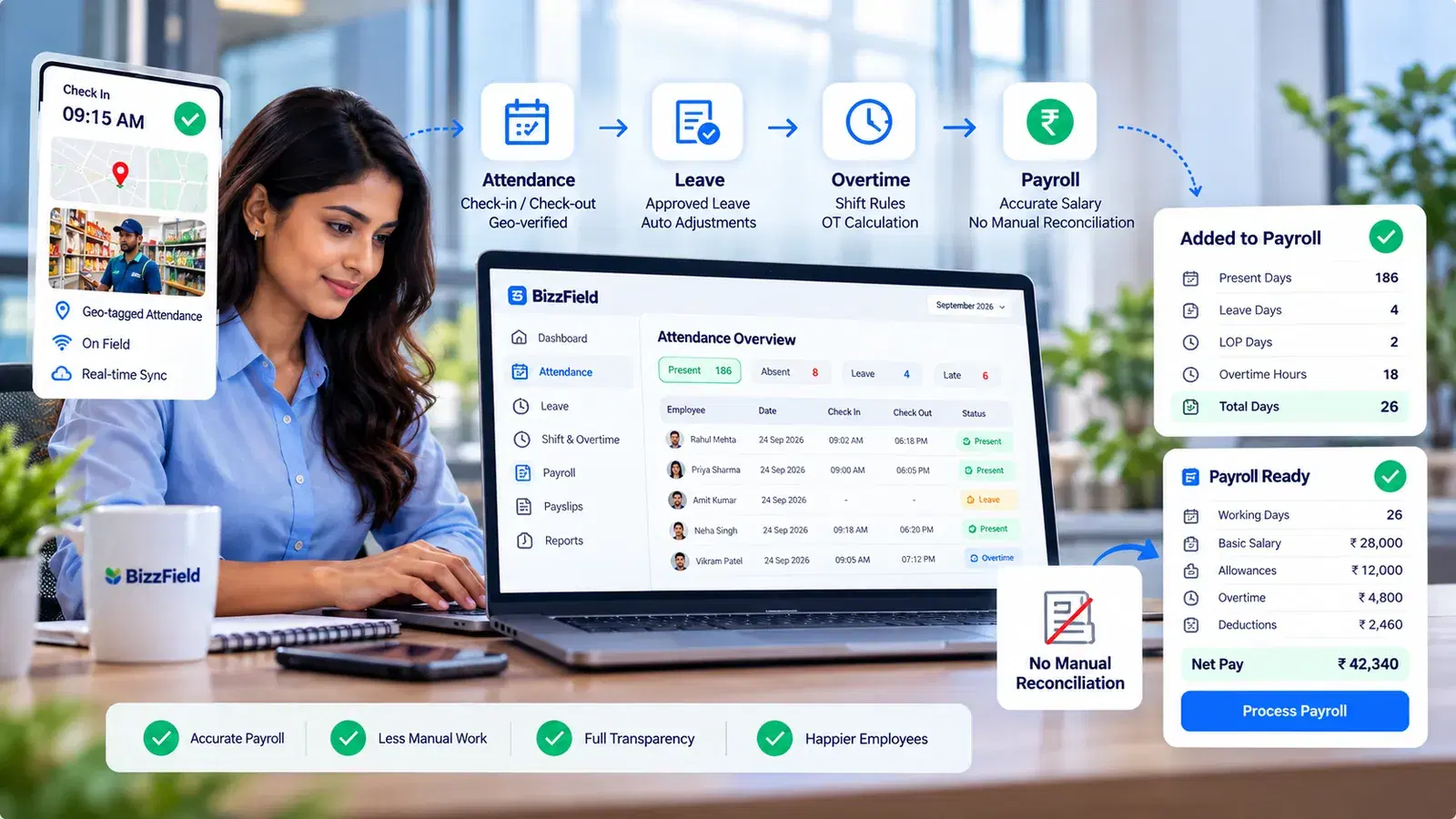
On the attendance side, BizzField can provide payroll with approved attendance and leave data. In the payroll flow, those records are used for pay-impacting calculations such as loss of pay and overtime. This removes the need to maintain a separate monthly attendance-to-payroll spreadsheet.
BizzField's Integrated Payroll also brings other monthly inputs into the same pay run, including overtime, incentives, reimbursements, loans and arrears. The result is a draft-to-paid process rather than a collection of disconnected files.
Inside the BizzField Pay Run
- Define Pay — Salary components, salary structures, revisions and retro pay establish the fixed-pay foundation.
- Capture Cycle Inputs — Shifts, overtime, incentives, reimbursements and employee loans provide the month-to-month inputs.
- Run & Verify — The payroll draft brings the inputs together, while variance checks help reviewers investigate unusual movements.
- Pay Out & Settle — Payslips, leave encashment and full-and-final settlement are produced from the same payroll record.
What Happens to Loss of Pay (LOP)?
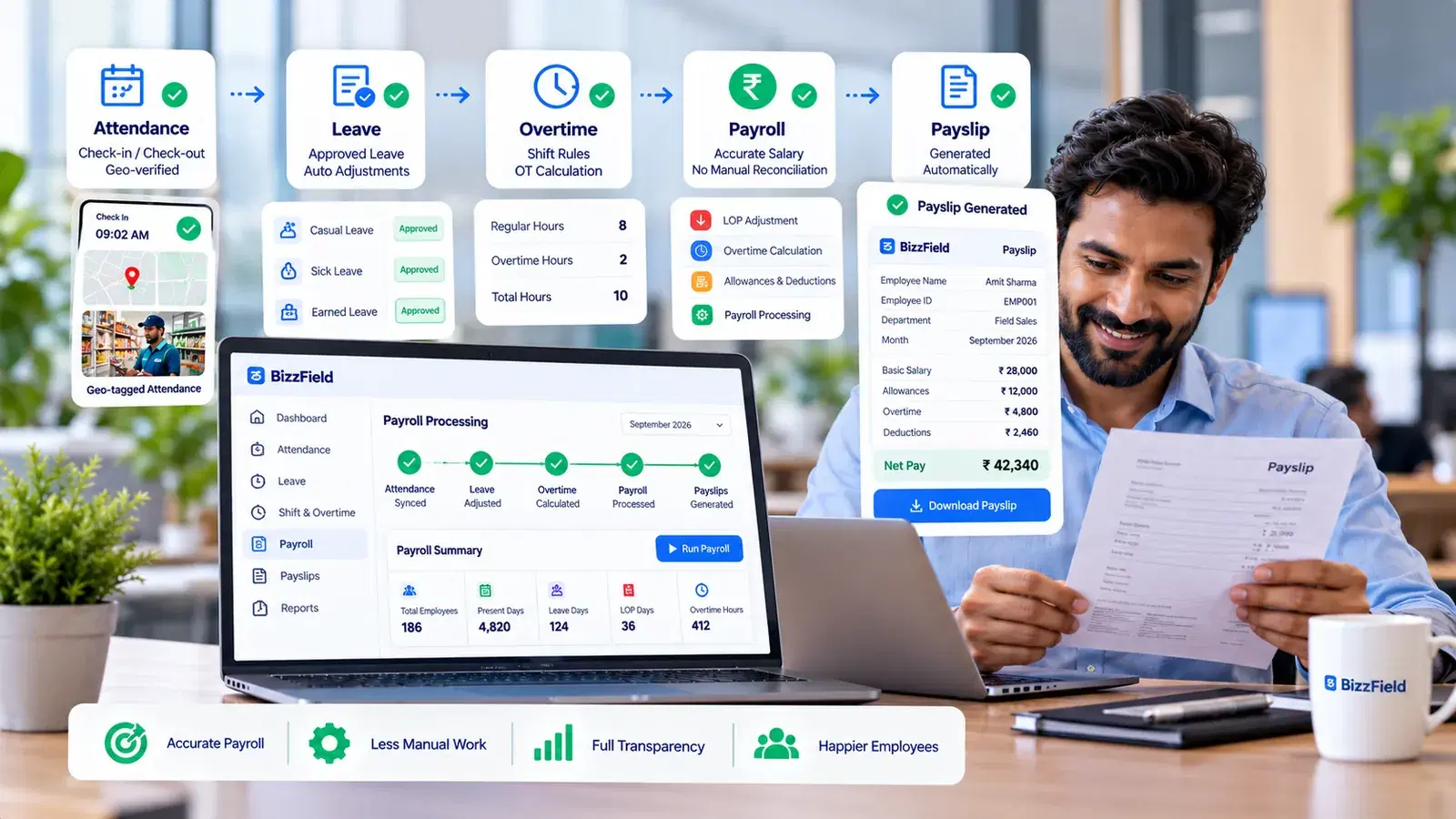
Loss of pay should not be a number someone manually types into payroll. It should be derived from the approved attendance and leave records according to the organization's configured rules.
With BizzField's attendance integration, attendance and leave can feed the payroll calculation directly. Unpaid days can be derived from the underlying records rather than recreated manually in a payroll spreadsheet. This gives HR a clearer path from the employee's attendance record to the pay calculation.
What About Overtime?
Overtime is another common reconciliation point because it often lives outside the attendance system. A payroll team may have one record for attendance, another for shift allocation and another for approved overtime.
BizzField connects shift and overtime inputs to the pay run. Approved hours can flow from Attendance & Shift Tracking into payroll, where overtime becomes part of the same cycle instead of a separate register that Finance has to reconcile manually.
Why a Single Source of Truth Matters
A single source of truth does not mean that every employee record is editable by everyone. It means the organization has one controlled record from which downstream calculations are made.
- One employee record: HR and payroll work from the same employee context.
- One attendance record: approved attendance does not need to be recreated for payroll.
- One pay run: attendance, leave, overtime and other approved inputs arrive in the same payroll process.
- One audit trail: approvals, edits and overrides can be traced.
- One employee experience: payslips and relevant information can be accessed through self-service.
The Difference Between Integrated Payroll and Payroll Automation
| Manual / disconnected process | Connected BizzField approach |
|---|---|
| Attendance exported to Excel | Approved attendance read by payroll |
| Overtime maintained separately | Shift and overtime inputs feed the pay run |
| LOP manually calculated | Unpaid days derived from attendance and leave records |
| Corrections patched in spreadsheets | Controlled cycle correction and recalculation |
| Payroll checked line by line | Variance checks surface unusual pay movements |
| Payslip generated as another step | Payslips generated when the pay run is paid |
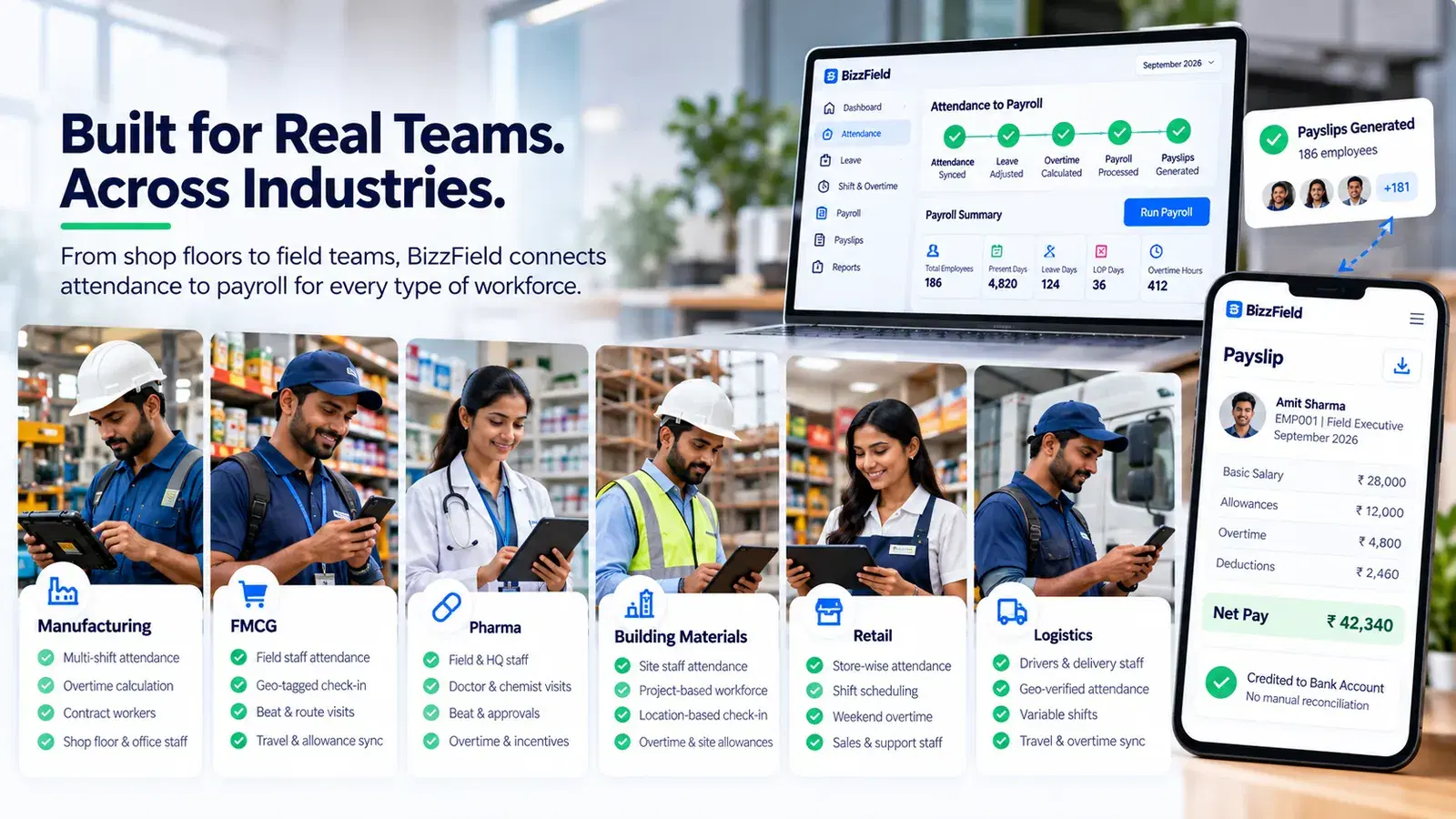
How This Applies Across Different Industries
Manufacturing
Multiple shifts, overtime, plant attendance and employee categories can make payroll inputs difficult to consolidate. A connected attendance and payroll process reduces the need to maintain separate shift and overtime trackers.
FMCG & Field Teams
Field employees may work across locations. When attendance is captured through a field-enabled process, approved attendance can become part of the same HRMS record that payroll consumes.
Pharma
Medical representatives and field teams may require attendance and location-aware processes. The important payroll principle remains the same: approved attendance inputs should reach payroll without manual reconstruction.
Building Materials & Paints
Employees may work across plants, offices, warehouses, dealerships or project locations. Centralized attendance and payroll records help HR manage different working patterns without maintaining disconnected payroll inputs.
Retail
Store-level teams often work with shifts, weekly offs and changing schedules. Connecting attendance and payroll makes it easier to carry approved attendance and overtime into the pay cycle.
Logistics
Drivers, warehouse teams and operations staff may work variable schedules. A connected process reduces the need to reconcile separate attendance, shift and overtime registers.
Where Businesses Actually Save HR Time
The value of integration is not simply that a spreadsheet disappears. The larger gain is that HR spends less time proving that two systems agree.
- Before payroll: fewer manual exports, imports and data clean-up steps.
- During payroll: fewer reconciliation checks between attendance, leave and payroll.
- During review: exceptions can be investigated instead of rechecking every employee manually.
- After payroll: employees can access payslips through self-service instead of asking HR for routine documents.
- During audits: the organization has a clearer record of approvals, changes and payroll inputs.
A Better Payroll Control Model
Automation should not mean removing human review. Payroll is too important for that. The better model is to automate repetitive data movement and calculations while keeping approvals and exception handling with the people responsible for payroll.
That is why BizzField's payroll flow moves through controlled stages — draft, submit, approve and pay. Attendance and leave can feed the draft, while Finance and HR retain the opportunity to review the result before money moves. Variance checks can also surface unusual pay movements for investigation.
What Changes for Employees?
The employee experience matters because payroll questions often return to HR. If an employee cannot understand why a deduction occurred or cannot access a payslip, HR becomes the support desk for routine payroll requests.
With BizzField, payslips are generated when a pay run is marked paid and employees can access current and previous payslips through self-service. This does not eliminate every payroll question, but it moves routine document access away from manual HR requests.
Questions HR Teams Should Ask Before Automating Attendance to Payroll
- Does approved attendance flow directly into payroll, or is it exported first?
- Where is overtime maintained, and how is it connected to the employee's shift?
- What happens when attendance is corrected after the payroll cycle is prepared?
- Can HR trace a payroll number back to the attendance or leave record that affected it?
- Who can approve changes to attendance and payroll inputs?
- Is there an audit trail for edits, approvals, reversals and overrides?
- Can employees access payslips without raising an HR ticket?
- Can the same payroll process handle fixed salary and variable inputs such as overtime, incentives, reimbursements and loans?
- How are statutory deductions and payroll outputs handled for the organization's operating model?
The Real Goal Is Not Just Automated Payroll. It Is a Connected Record.
Attendance automation by itself solves only one part of the payroll problem. The larger opportunity is to connect the records that influence pay so HR and Finance do not have to rebuild the same chain every month.
For a modern organization, the desired flow is straightforward: attendance is captured, exceptions are resolved, records are approved, payroll reads the approved data, Finance reviews the pay run, and employees receive their payslips. The fewer manual handoffs between those stages, the easier it becomes to control the process.
BizzField HRMS brings attendance, leave, shifts, overtime and payroll into a connected workflow designed around that principle. It keeps the human approvals where they matter while reducing the repetitive reconciliation work around them.
See How Attendance Flows Into Payroll with BizzField
If your payroll team is still exporting attendance to Excel, checking overtime in a separate register, manually calculating LOP or reconciling two systems every month, the first step is not to add another spreadsheet. It is to look at the workflow end to end.
Book a BizzField HRMS demo and walk through the attendance-to-payroll process using your organization's actual payroll structure and working model.
Frequently asked questions
It is the connection between approved attendance and the payroll calculation so that pay-impacting attendance data does not need to be manually exported, re-entered or reconciled in another spreadsheet.
Attendance can affect payroll through factors such as payable days, unpaid days, leave without pay, shifts and overtime. The exact treatment depends on the organization's configured payroll and attendance rules.
A connected system can derive unpaid days from approved attendance and leave records instead of requiring payroll teams to manually enter LOP values. BizzField's attendance integration is designed to feed attendance and leave into payroll for this purpose.
BizzField records shift and overtime inputs as part of the payroll cycle. Approved hours can flow from Attendance & Shift Tracking into the pay run, avoiding a separate overtime register that must be reconciled manually.
BizzField uses an explicit unlock process for a locked cycle. The attendance register can then be recalculated rather than silently patched, helping keep the payroll record consistent.
BizzField's payroll can consume attendance from BizzField HRMS or imported attendance data. Payroll is also available as a standalone product according to BizzField's current product documentation.
Approved attendance and leave can feed payroll directly, while overtime and other approved cycle inputs are brought into the same pay run. This reduces the need to compare separate spreadsheets and registers.
Yes. BizzField generates payslips when a pay run is marked paid and provides employee self-service access to current and previous payslips.
No. Attendance is one input. A complete payroll process also needs salary structures, revisions, overtime, incentives, reimbursements, loans, statutory deductions, approvals, variance checks, payslips and exit settlements.
WRITTEN BY
Shivam Gupta
Brand Manager
Brand Manager with 8+ years of experience in building brands, developing growth strategies, and creating impactful marketing campaigns that drive business success.
Connect on LinkedIn