
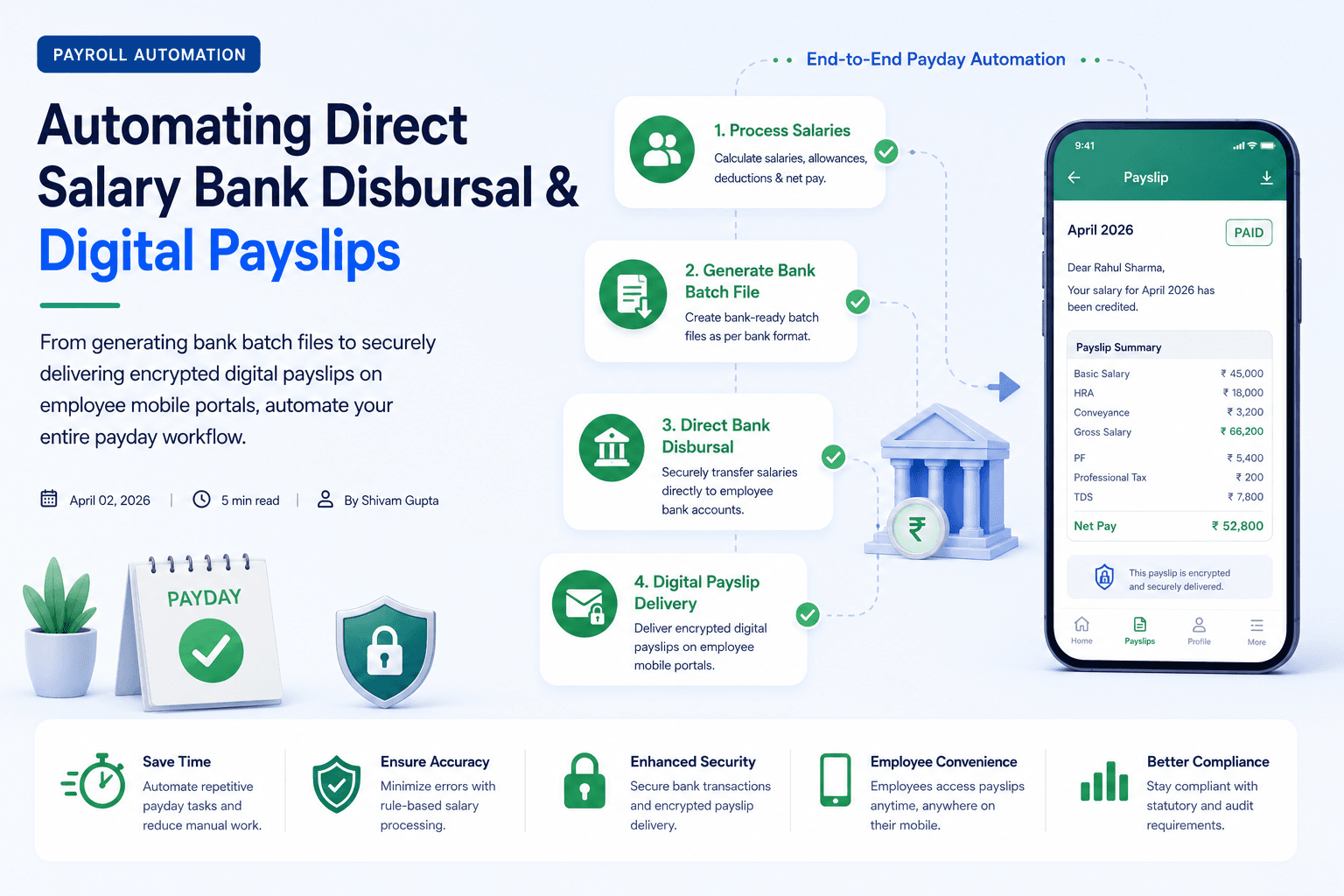
Managing Indian payroll compliance manually in Excel spreadsheets is one of the highest operational risks for growing organizations. Between Provident Fund (PF) ECR generation, Employee State Insurance (ESI) monthly salary threshold caps, State-wise Professional Tax (PT) slabs, and Tax Deducted at Source (TDS) calculations under dual tax regimes, a single manual formula error can trigger statutory notices, interest penalties, and delayed salary credits.
1. EPF ECR Challan File Generation & Statutory Capping
Under the Employees Provident Funds and Miscellaneous Provisions Act (1952), employees with a Basic Salary up to ₹15,000 per month must be enrolled in Provident Fund. The statutory contribution is 12% of Basic Pay + DA from the employee, matched by 12% from the employer (split as 3.67% to EPF and 8.33% to EPS capped at ₹1,250 per month).
When generating the monthly Electronic Challan cum Return (ECR) text file for direct upload to the EPFO Unified Portal, the payroll engine must correctly structure UAN numbers, gross wages, EPF wages, EPS wages, and tagged No Contribution Period (NCP) days. Manual CSV edits often fail portal validation rules, leading to late submission penalties under Section 14B and 7Q.
2. ESI Monthly Contribution Thresholds & Wage Rules
Employee State Insurance (ESI) applies to organizations with 10 or more employees where individual gross salary is up to ₹21,000 per month (₹25,000 for employees with disabilities). The statutory rates are fixed at:
- Employee Share: 0.75% of Gross Salary
- Employer Share: 3.25% of Gross Salary
A common compliance pitfall occurs when an employee's gross salary fluctuates across months due to overtime or variable incentives. Under ESIC guidelines, if an employee's gross pay is under ₹21,000 in the first month of a contribution period (April–September or October–March), they remain covered under ESI until the end of that 6-month contribution period regardless of mid-period pay raises. Automated engines track these contribution window rules seamlessly.
3. State-Wise Professional Tax (PT) & Labour Welfare Fund (LWF)
Professional Tax is governed by individual state governments with varying income slabs and deduction cycles:
- Maharashtra: ₹175/month for gross pay ₹7,500–₹10,000; ₹200/month above ₹10,000 (₹300 in February).
- Karnataka: ₹200/month for gross pay ₹25,000 and above.
- Tamil Nadu: Half-yearly slab-based deductions processed in September and March.
- West Bengal: Multi-tiered monthly slabs ranging from ₹110 to ₹200.
Automated payroll engines map employee primary work location branches to the correct state PT rules automatically, eliminating cross-state compliance discrepancies.
4. Monthly TDS Subtractions Under Dual Tax Regimes
Under Section 192 of the Income Tax Act, employers must compute and deduct income tax (TDS) monthly based on projected annual income under either the Old Tax Regime or New Tax Regime.
Automated systems process investment declarations (Section 80C, 80D, 24B home loan interest, HRA rent receipts) during the year, compute estimated annual tax liabilities, divide by remaining months in the financial year, and adjust monthly TDS dynamically as investment proofs are verified by HR in Q4.
Monthly & Quarterly Compliance Calendar
- 15th of Every Month: EPF & ESI monthly return filing and challan payment
- 7th of Every Month: Monthly TDS deposit into NSDL/ICEGATE government portal
- 21st of Every Month: ESIC monthly contribution filing
- 31st of April / July / Oct / Jan: Form 24Q Quarterly TDS Return Filing
- 15th of June: Form 16 Part A & B issuance to employees
Explore BizzField Payroll Automation
WRITTEN BY
Shivam Gupta
Brand Manager
Brand Manager with 8+ years of experience in building brands, developing growth strategies, and creating impactful marketing campaigns that drive business success.
Connect on LinkedIn