
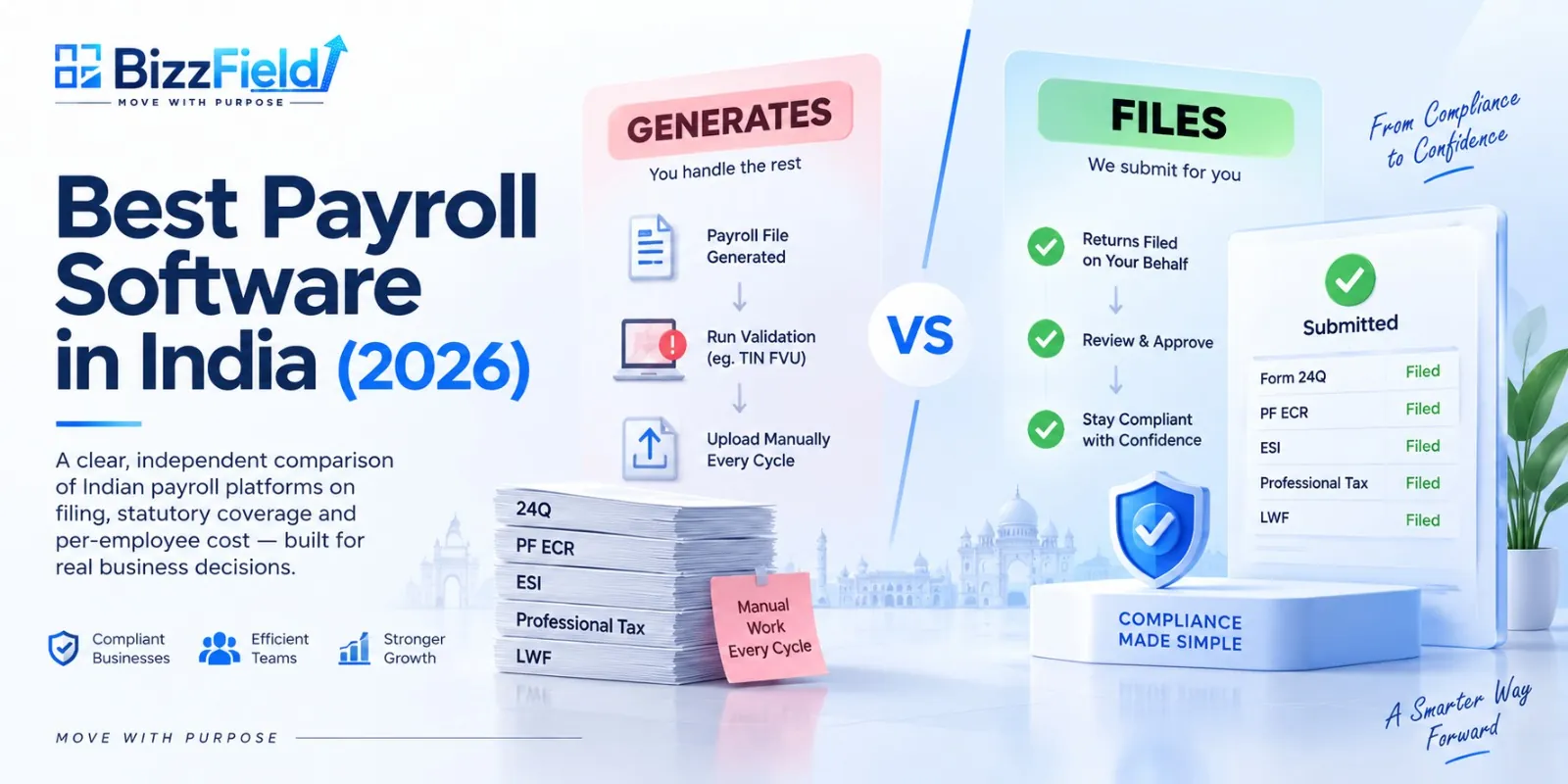
The best payroll software in India depends on one question most buyers do not ask: does the platform file your statutory returns, or only generate files someone on your team still has to upload? That single difference separates otherwise similar platforms more sharply than price or feature count.
Disclosure: BizzField makes payroll software and is included in this comparison. We have applied the same criteria to our own product as to every other platform listed, and we do not rank ourselves first.
How We Compared These Platforms
Four criteria, applied identically to every platform including our own.
Does it file, or only generate?Whether the platform submits your statutory returns or produces a file your team validates and uploads. Sourced from each vendor's own product documentation, not marketing pages.
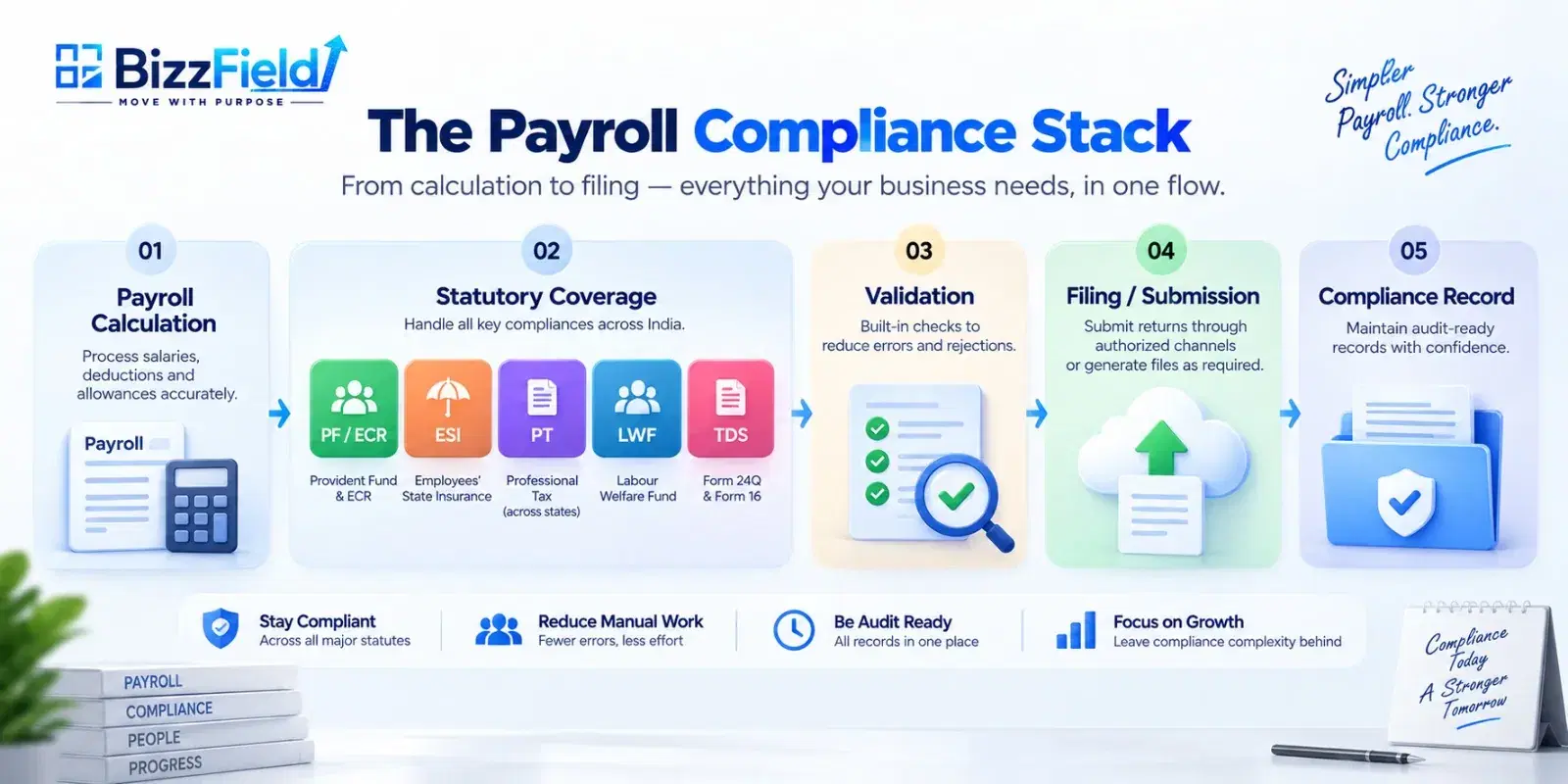
Statutory coverage. Provident Fund and ECR, ESI, Professional Tax across states, Labour Welfare Fund, and TDS via Form 24Q and Form 16.
Pricing model. Per employee per month, banded by headcount, or quote-only. Models, not figures — see the limits section below.
Fit by company size. Whether the product was designed around small teams, the 200 to 1,000 band, or enterprise.
Every claim on this page comes from the named vendor's own published documentation, recorded with the date it was accessed. Where a vendor's documentation is ambiguous or contradicts itself, this page says unclear from published documentation rather than guessing.
What we deliberately did not score: user-interface quality, support quality, implementation experience, and anything that requires a paid account to assess. These matter — they are simply not verifiable from outside, and a comparison that scores them is scoring an opinion while presenting it as a finding.
The Question That Separates Payroll Platforms: Does It File, or Only Generate?
Almost every Indian payroll vendor says it handles compliance. The word does no work. It is claimed by platforms that submit your returns and by platforms that hand you a file and stop, and a buyer cannot test the difference from a product page.
Use a specific verb instead. Files. Generates. Submits. Validates. Those are binary and checkable.
Form 24Q makes the distinction concrete. A platform that generates your quarterly TDS return produces a valid return file — but someone on your team still has to run the File Validation Utility from the TIN website, correct whatever it rejects, and submit the result. Every quarter. A platform that filesdoes that for you, and your team's job reduces to reviewing and approving.
The same split runs through PF ECR, ESI and Professional Tax. It is not a premium-versus-budget distinction either. Some inexpensive platforms file and some expensive ones do not, which is why it cannot be inferred from price.
| Approach | What you get | What your team still does |
|---|---|---|
| Files on your behalf | The return is submitted for you | Review and approve; provide inputs |
| Generates the file only | A valid return file — for example a 24Q FVU output | Run the validation utility and submit it yourself, every cycle |
| Services arm files it | A person at the provider submits on your behalf | Provide inputs; manage the relationship. Usually a different commercial model |
The practical consequence is a recurring workload with an owner and a name. On a generate-only platform, someone in finance blocks time every quarter for Form 24Q and every month for ECR, then absorbs whatever the validation utility rejects and resubmits. That work appears in nobody's pricing comparison. At three hundred employees across four states it is not a small line item, and it lands on the person least able to give it up.
Ask every vendor on your shortlist this one question — and ask them to answer it for each specific return, not in general. A platform may file your PF ECR and only generate your 24Q.
Payroll Software in India, Compared
Ten platforms, ordered by fit for a 200 to 1,000 employee company. That ordering is a judgement about company size, not a ranking of quality — a platform low on this list may be the right answer for a fifty-person business.
What "Not stated in public docs" means
Where a vendor does not publish a capability, this table says so rather than guessing. It is not a judgement that the capability is absent — only that it could not be confirmed from that vendor's own published documentation. Ask the vendor directly, and ask return by return.
| Platform | Files 24Q / TDS? | PF ECR | ESI | Professional Tax | LWF | Pricing model | Best fit by size |
|---|---|---|---|---|---|---|---|
| BizzField | Files | Files | Files | Supported | Supported | PEPM, banded | Mid-market |
| greytHR | Generates only | Not stated in public docs | Not stated in public docs | Not stated in public docs | Not stated in public docs | PEPM, banded | SMB to lower mid-market |
| RazorpayX Payroll | Files | Not stated in public docs | Not stated in public docs | Not stated in public docs | Not stated in public docs | Banded — bands contradict across sources | SMB to mid-market |
| Keka | Not stated in public docs | Not stated in public docs | Not stated in public docs | Not stated in public docs | Not stated in public docs | PEPM | Mid-market |
| HROne | Not stated in public docs | Not stated in public docs | Not stated in public docs | Not stated in public docs | Not stated in public docs | PEPM | Mid-market |
| factoHR | Not stated in public docs | Not stated in public docs | Not stated in public docs | Not stated in public docs | Not stated in public docs | PEPM | SMB to mid-market |
| ADP India | Via services arm | Via services arm | Via services arm | Not stated in public docs | Not stated in public docs | Quote only | Upper mid-market to enterprise |
| Zoho Payroll | Generates only | Not stated in public docs | Not stated in public docs | Not stated in public docs | Not stated in public docs | PEPM | SMB |
| Kredily | Generates only | Generates, paid tier | Generates, paid tier | Not stated in public docs | Not stated in public docs | Freemium, then paid | SMB |
| TankhaPay | Files | Not stated in public docs | Not stated in public docs | Not stated in public docs | Not stated in public docs | Not stated in public docs | SMB, informal workforce |
Vendor documentation changes without notice. Every verified cell in this table is backed by an entry in our evidence log recording the vendor, the claim, the source URL and the date accessed.
The Platforms, Briefly
Each entry follows the same structure — who it fits, one thing it does notably well, one real limitation — and every entry is the same length, BizzField included.
BizzField. Built for Indian companies in the 200 to 1,000 band. Computes payroll and files statutory returns rather than handing you a file to upload, which is the distinction this page is organised around. Multi-entity and multi-state handling for companies operating across more than one registration. The clear limitation: BizzField does not disburse salaries. Payroll is computed and filed; the actual bank transfer runs through your existing banking relationship. If you want computation, filing and disbursement from one vendor, that is a different shortlist. See BizzField payroll.
greytHR. One of the most established payroll names in India and the strongest organic presence in the category. Deep statutory feature set and a long track record with Indian compliance. The limitation for this comparison: it generates statutory files rather than filing them on your behalf, so the validation-and-upload cycle stays with your team every month. Strongest fit is small business through the lower end of mid-market; at several hundred employees across multiple states, the manual submission load becomes the thing you notice.
RazorpayX Payroll. The most significant payroll-native platform absent from most HRMS-derived shortlists, and one of the few that genuinely files on your behalf rather than generating files. Strong automation for a product at its price point. Two cautions. Its published employee bands differ between its pricing page and its documentation, so confirm which applies to you in writing before signing. And confirm current Professional Tax automation status for your specific states directly with the vendor rather than relying on any published summary.
Keka. An HR platform with payroll rather than a payroll platform with HR, which shapes the fit: strongest where you want one system for attendance, leave and payroll together, and where employee self-service adoption matters as much as the payroll engine itself. Well established in the Indian mid-market. Confirm its filing model return by return — HR-first platforms vary considerably on whether they submit or generate, and that behaviour is rarely stated plainly on the product page.
HROne. Another HRMS-led platform competing directly in the 200 to 1,000 band, and one of the few Indian vendors that segments its own material by company size rather than claiming to fit everyone. That is a useful signal — a vendor that has thought about which size it serves has usually built for it. As with any HR-first suite, establish whether payroll is a full module or a lighter component, and confirm the filing model for each statutory return separately.
factoHR. Mid-market HRMS and payroll with notably strong employer-facing statutory tooling — its calculators and computation utilities outrank far larger domains, which is usually a sign that the underlying statutory logic is well built rather than merely marketed. Fit runs from upper SMB into mid-market. Confirm multi-entity handling if you operate more than one legal entity, and confirm the filing model per return before shortlisting on compliance grounds.
ADP India. The one provider that credibly appears in both the payroll software and the payroll outsourcing conversation, through genuinely separate offerings. Filing happens through its managed services arm — a person submits on your behalf, which is a different model from software that files automatically, and it carries a different commercial structure. Best fit is the upper end of mid-market and enterprise, or any company that would rather buy a service than operate a system. Pricing is quote-only.
Zoho Payroll.Frequently confused with Zoho People, which is a separate product and subscription and does not include payroll — a Zoho evaluation is really an evaluation of two products. Zoho Payroll itself is capable, well documented and priced accessibly for small business. The limitation is squarely relevant here: Zoho's own Form 24Q documentation directs the customer to run the TIN validation utility and submit the return. It generates; it does not file.
How to Shortlist for 200 to 1,000 Employees
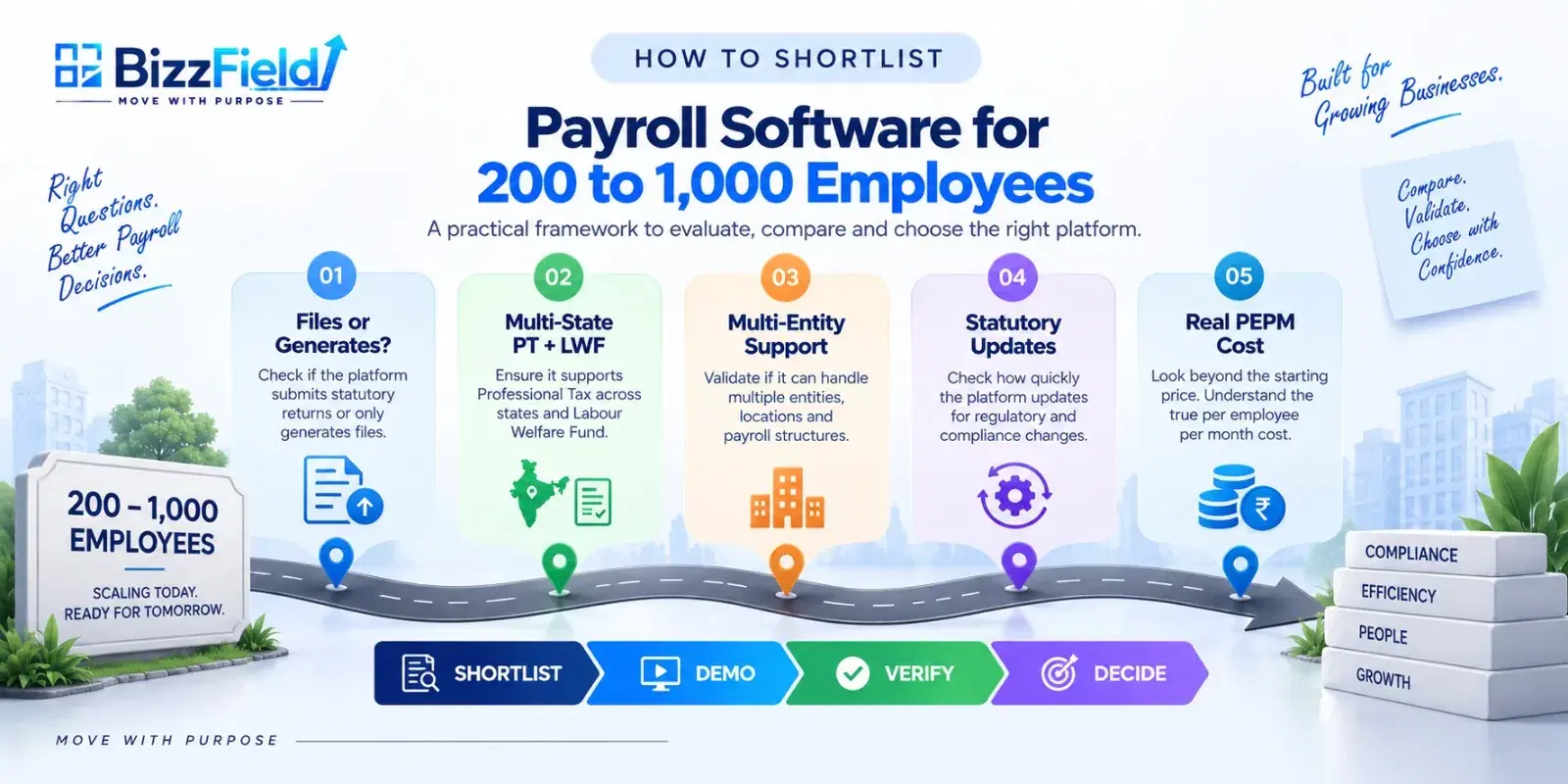
Five criteria change the answer at this headcount. Most published comparison criteria do not.
- Does it file, or generate?Ask per return, in writing. A bad answer sounds like "we're fully compliance-ready" — that is a claim about the vendor's intentions, not a description of what the software does.
- Multi-state Professional Tax and Labour Welfare Fund. If you operate across states, PT slabs, filing frequencies and LWF rules all differ, and LWF is the single most commonly missing component in Indian payroll products. A bad answer sounds like "PT is supported" with no list of states.
- Multi-entity support.More than one legal entity means separate registrations, separate filings and consolidated reporting across them. This is a foundation, not a feature — retrofitting it usually means re-implementing. A bad answer is "you can create separate accounts".
- How statutory changes ship, and how fast. Slabs, wage ceilings and filing formats change with limited notice. Ask for the release process and a recent example. A bad answer is a promise about responsiveness with no mechanism behind it.
- Real per-employee cost at your headcount. List price is not the number. Implementation, filing modules, the mobile app and integrations are commonly quoted separately. A bad answer is a per-employee rate with no statement of what falls outside it.
A Short Decision Tree
Four questions, in order. Each one removes platforms from consideration.
Do you need the platform to submit returns, or is generating files acceptable? If your finance team already runs the FVU utility comfortably and has capacity, generate-only platforms stay on the list and your options widen considerably. If not, this question alone eliminates roughly half the market.
Do you operate in more than one state? If yes, multi-state Professional Tax and Labour Welfare Fund coverage becomes a gating requirement rather than a nice-to-have, and you should ask for the specific list of states supported rather than accepting a yes.
Do you run more than one legal entity? If yes, confirm native multi-entity payroll with consolidated reporting. Separate logins per entity is not the same thing and will produce a reconciliation problem at year end.
Do you want software, or a service? If the honest answer is that you would rather someone else ran payroll entirely, you are looking at outsourcing rather than software, and the economics are closer than most buyers expect at mid-market scale.
What This Comparison Does Not Cover
Disbursement. BizzField computes and files but does not disburse salaries, and this comparison does not assess disbursement capability in any platform. If bank transfer from within the payroll product is a requirement, that is a separate evaluation.
Verified pricing figures. This page compares pricing models only. No competitor rupee figures appear anywhere on it, because none have been verified against a vendor page with a dated screenshot. Publishing modelled or second-hand pricing would be worse than publishing none.
Outsourcing providers. Payroll software and payroll outsourcing are close to separate markets with separate search behaviour.
Support quality, interface quality and implementation experience. Not assessable from outside a paid account. Ask existing customers of your size instead.
Nobody paid to be included in this comparison, and no placement on this page was purchased.
Where to Go From Here
If you take one thing from this page, make it the question. Ask every vendor on your shortlist whether the platform files your returns or generates a file your team uploads — and ask it return by return, in writing, before you compare a single price.
BizzField computes payroll and files statutory returns for Indian companies in the 200 to 1,000 band. We do not disburse, and this page has been built so you can tell where we fit and where we do not. If you also need an HRMS software layer above payroll, that runs on the same platform.
Frequently asked questions
There is no single answer, and any vendor page declaring one should be read accordingly. For small businesses, generate-only platforms with strong statutory logic usually suffice. At 200 to 1,000 employees the deciding criterion is whether the platform files or generates. At enterprise scale the question shifts toward managed services and multi-country capability.
Most Indian vendors price per employee per month, with the rate stepping down as headcount rises. Implementation is usually quoted separately, and statutory filing is sometimes a paid add-on rather than included. List prices are frequently unpublished, so the only meaningful comparison is a written quote at your actual headcount with inclusions stated.
Some do; many do not. A platform that generates your Form 24Q produces a valid return file, but your team still runs the TIN validation utility and submits it. Ask each vendor which model applies to each return separately — PF ECR, ESI and 24Q are often handled differently within the same product.
Yes, and rather more than most people assume. Tally generates Form 16, Form 24Q with Annexures I and II, PF ECR, and Forms 3A, 5, 6A, 10 and 12A. The real reasons growing companies move off it are patch cadence when statutes change, multi-entity handling, and the absence of employee self-service. The one precise documented gap is Labour Welfare Fund, which is not a built-in component.
WRITTEN BY
Shivam Gupta
Brand Manager
Brand Manager with 8+ years of experience in building brands, developing growth strategies, and creating impactful marketing campaigns that drive business success.
Connect on LinkedIn