
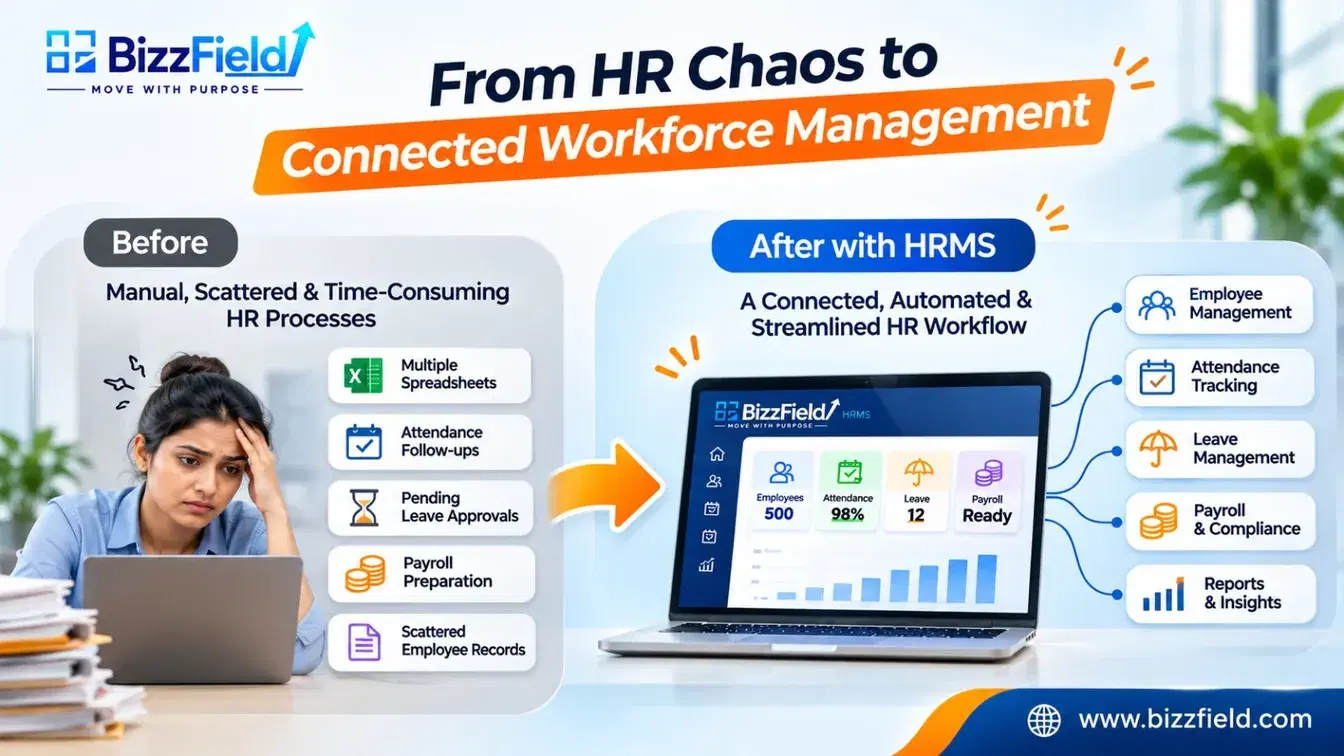
It is the 23rd of the month and the HR team at a 400-person company is still waiting. Pune has sent attendance in one format, the Delhi sales office in another, and field regularisations are buried in a manager's WhatsApp. Leave approvals are pending, payroll inputs trickle in from five departments, and one person stitches it all together in a spreadsheet.
That is usually the moment companies start looking for the best HRMS for a mid size company in India. At 100 employees the spreadsheet is an irritation. At 400 it is a monthly risk: a missed loss-of-pay deduction, a wrong shift allowance, a payroll close that swallows the last four days of the month.
A connected HRMS fixes the handoffs between attendance, leave and payroll, not just the forms. That is the idea behind BizzField HRMS, the platform at the centre of this guide: one employee record that carries attendance, leave, shifts and payroll inputs through to the pay run. The harder question is which HRMS fits your company. The right choice is seldom the one with the longest feature list. It is the one that matches your headcount band, your locations and your payroll complexity. This guide evaluates BizzField HRMS first and compares it fairly with seven other platforms through that lens.
Disclosure: this guide is published by BizzField. BizzField HRMS is included and presented first; the other seven platforms are described from their public information, with plan limits and pricing caveats stated plainly.
Why Companies With 200–1,000 Employees Need a Different HRMS
Headcount alone does not change what an HRMS must do. Structure does. A 150-person company usually has one office, a few managers who know everyone, and a payroll one person can eyeball. Somewhere between 200 and 1,000 employees, that comfort goes.
Reporting lines multiply. A sales executive in Lucknow reports to a regional manager, who reports to a national head, with a dotted line to a product team in Bengaluru. Leave requests must reach the right person without HR forwarding them. Attendance stops being one biometric machine and becomes a plant on rotating shifts, a field team punching in from client sites and a head office on flexible hours. Each pattern feeds payroll differently: overtime for one group, loss of pay for another, night-shift allowance for a third.
India's labour-compliance framework also needs careful attention. The four Labour Codes came into effect on 21 November 2025, and the Central Government notified the Central Rules on 8 May 2026. Sources: PIB announcement – 21 November 2025; Ministry of Labour and Employment – Labour Codes and Central Rules. The Central Rules apply to establishments for which the Central Government is the appropriate government. Other establishments must check the relevant State Rules and notifications. HR and finance teams should confirm which provisions apply to their locations and establishment type with their compliance adviser.
Add twenty joiners a month, exits that need clearances and Full & Final settlements, and a CFO asking for attrition by department, and a spreadsheet plus a basic attendance app starts costing more than it saves.
Which HRMS Is Right for Your Company Size?
Treat the bands below as practical buying guidelines, not industry standards. A 300-person manufacturer running three shifts can have needs closer to a 700-person services firm, so it is also worth reviewing industry-specific HRMS solutions.
200–300 employees. The goal is to get off spreadsheets cleanly: one employee record, attendance, leave, and a payroll run that reads from them. Several platforms in this guide offer these core capabilities. At this stage, subscription cost, implementation effort and how easily employees and managers adopt the system often become the deciding factors.
301–500 employees. Approvals start to break. Managers sit in different cities, shifts overlap, and HR spends its day answering payslip and leave-balance queries. Look for configurable approval chains, rosters and self-service, and test the attendance-to-payroll link hard.
501–700 employees. Multiple locations mean state-wise Professional Tax, branch-level reporting and permissions. A branch manager should see their own team and nothing else. Integrations with accounting software and attendance devices begin to matter.
701–1,000 employees. Separate legal entities, audit trails that finance and security can review, and approval hierarchies that follow the organisation chart. Plan tiers matter more here, because multi-entity features are often reserved for higher plans.
Best HRMS for a mid-size company in India: how to use this shortlist
There is no single winner across all four bands. Start with BizzField HRMS to see how a connected employee record, attendance and payroll workflow looks in practice, then use your band to decide which of the other seven platforms below deserve a demo, and use the questions later in this guide to separate them. For more on how needs change by size, see HRMS solutions by company size.
How We Evaluated HRMS Software for Mid-Sized Companies
We compared platforms on six criteria: core HR and employee lifecycle; Indian payroll capabilities; attendance and workforce management; employee and manager experience; reporting and integrations; and pricing and implementation. This comparison is based on publicly available product information, vendor documentation and pricing pages reviewed in November 2026. It is a desk-based comparison, not independent hands-on software testing. Where public information does not clearly specify feature availability, plan inclusion, integration status or pricing, buyers should confirm the details directly with the vendor.
8 HRMS Platforms Worth Comparing in India
The platforms below serve different business requirements and are not ranked from best to worst. Their suitability depends on employee strength, payroll complexity, required modules, implementation needs and budget.
| Employee Strength | Important HRMS Requirements |
|---|---|
| 200–300 | Core HR, payroll, attendance, leave and employee records |
| 301–500 | Approval workflows, shift management, self-service, payroll integration |
| 501–700 | Multi-location management, role-based access, reporting and integrations |
| 701–1,000 | Complex workflows, multi-entity support, audit trails and advanced workforce analytics |
1. BizzField HRMS – Connected Employee Management and Payroll Workflows
BizzField HRMS is built for growing companies that want employee information, attendance, leave and payroll activities managed through one connected HR workflow, and it is the platform we recommend evaluating first.
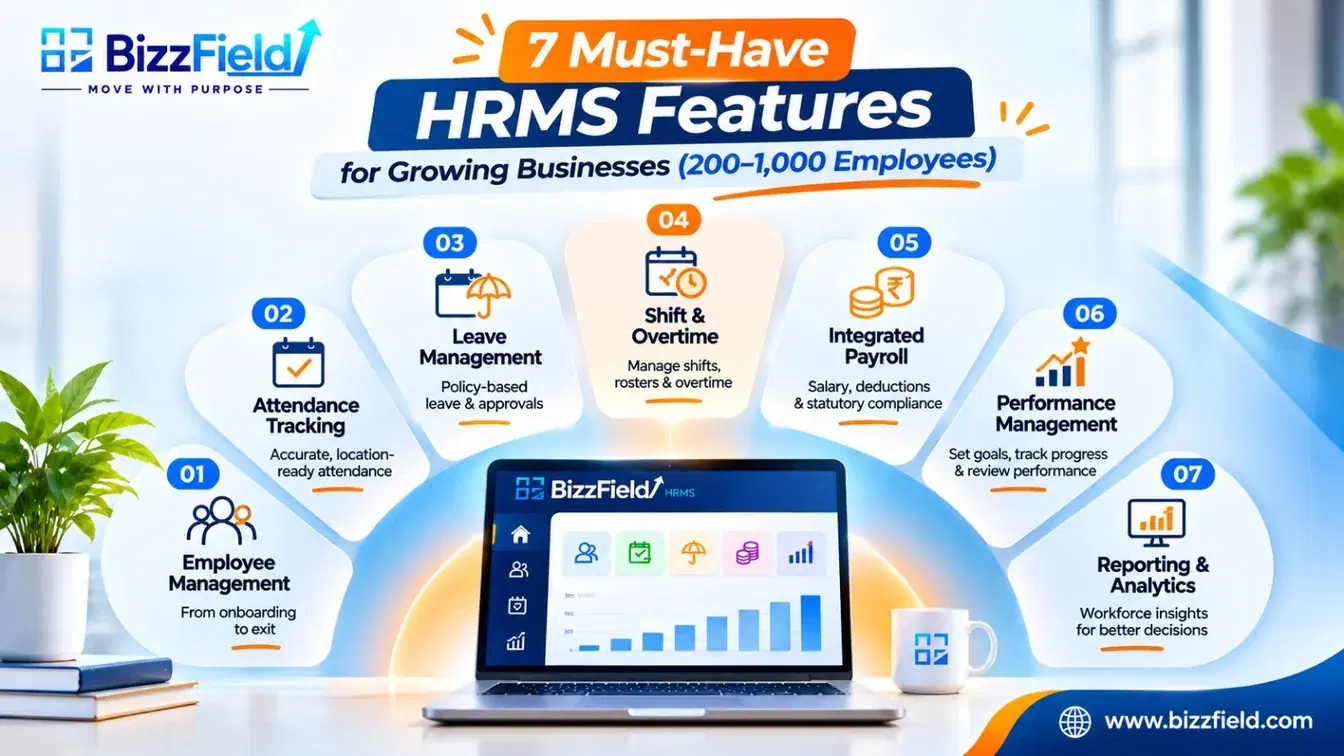
Its platform covers the employee lifecycle end to end, starting with employee profiles, recruitment and onboarding, and extending to attendance, leave management, shift management, timesheet tracking, performance management and employee exits.
A key strength for mid-sized businesses is its attendance and shift tracking. Employees can check in through the web or mobile application. The mobile attendance workflow includes GPS location validation, selfie verification and face-match checks, while managers can review attendance according to their reporting permissions. Shift rosters and approved overtime can feed into the payroll process.
It is important to distinguish mobile attendance from biometric device integration. BizzField supports web and mobile check-ins, while integration with external biometric devices such as ZKTeco and Essl is currently on its roadmap and is not live.
BizzField also provides integrated payroll management covering salary structures, pay runs and statutory calculations such as PF, ESI, Professional Tax, TDS and Labour Welfare Fund. Its product documentation describes the movement of approved attendance and leave information into draft payroll, along with a Form 24Q export generated from payroll data. You can read more about BizzField payroll management and its statutory compliance features.
For a company with several departments or reporting levels, this connected approach can reduce manual handoffs. Instead of treating employee records, leave approvals, attendance and payroll as unrelated administrative tasks, HR manages them through the same employee record.
Where it fits: Growing organisations looking for employee lifecycle management, attendance, shift and leave management, payroll and HR reporting in one platform.
Before choosing it: BizzField HRMS offers integrated payroll and statutory compliance through its Growth plan. For organisations requiring payroll across multiple legal entities, cross-entity adjustments or customised approval workflows, confirm the Enterprise requirements and scope in the commercial proposal.
Also check integrations carefully. BizzField's published integrations page separates available features from planned ones. Accounting connections such as Tally Prime and Zoho Books, banking integrations, external biometric device connections, single sign-on and REST APIs are currently listed on BizzField's integration roadmap. They should not be treated as live integrations. Businesses that depend on these connections should obtain written confirmation of availability before purchasing.
Official reference: BizzField HRMS integrations
Explore BizzField HRMS and book a product demonstration.
2. HROne – For Structured HR Workflows and Payroll Management
HROne is an option for organisations that want to bring core HR, attendance and payroll under a structured HR management system.
Its published Basic plan includes Core HR, Time Office, payroll, a mobile application, reports and dashboards. The attendance offering includes features such as geo-tagging, geo-fencing, selfie attendance and offline attendance.
Its Professional plan adds workforce-related processes such as employee confirmation, transfers and separation, along with digital acknowledgement of letters and policies. Recruitment, performance, engagement, expense, asset and helpdesk capabilities are listed under its Enterprise plan.
This module structure is worth examining when the organisation wants to introduce HRMS functionality in stages rather than purchase every available feature immediately.
Published pricing: Basic starts at ₹4,950 per month for 50 users, with an additional ₹99 per user per month. Professional starts at ₹6,500 per month for 50 users, with an additional ₹130 per user per month.
What to consider: Ask for a complete quotation showing which modules are included. A company that requires performance management, recruitment or advanced workforce processes should compare the cost of its final configuration, not just the Basic subscription.
Official reference: hrone.cloud/pricing
3. Keka – For Employee Experience and Connected HR Suites
Keka is worth evaluating for businesses that want to manage core HR, employee experience, workforce processes and talent-related activities through a broader HR technology platform.
Its current product offering is organised around separate suites, including HR, payroll, talent management and project services. The HR suite covers areas such as employee records, onboarding, workforce management, timekeeping and HR analytics. Its talent offering includes recruitment, performance reviews, OKRs and employee development.
For a mid-sized company, this breadth can be useful when HR responsibilities extend beyond salary processing and leave administration. For example, organisations running structured appraisal cycles may want to evaluate how employee goals, reviews and compensation processes fit into the same system.
Where it may fit: Companies that want to evaluate a broader HR and talent management platform, particularly where employee experience and performance processes are important.
What to consider: Keka's current product structure should be evaluated module by module. Ask the sales team for a quotation covering HR, payroll, workforce management and performance requirements together. Check the exact plan names, included modules, additional charges and implementation costs instead of relying on older online price references.
Official reference: keka.com/pricing
4. greytHR
greytHR has a payroll-led product offering, with additional workforce capabilities available in higher plans. On its India pricing page, Essential is ₹2,495 a month including 50 employees (₹45 per extra head) and covers payroll, leave and basic HR. Attendance, shifts, overtime and geo-fencing arrive in Growth at ₹4,495 (₹85 per extra head). Premium is quote-based. It suits payroll-first teams with fairly standard shift patterns.
Check before you buy: at 500 employees, Essential is not comparable with plans that include attendance. Ask where performance management, expenses (an add-on) and multi-entity needs sit.
5. Zoho People – For Businesses Using the Zoho Ecosystem
Zoho People is worth considering for organisations that already use Zoho applications and want to manage employee information, leave, attendance and other HR processes within the same software ecosystem.
Zoho People offers employee management, attendance, shift scheduling, timesheets and performance management, but access to these features depends on the selected edition. Zoho's current plan-comparison page displays more than one edition structure, including Professional, Premium and Enterprise, as well as Essential HR, Workforce, Talent and Enterprise. Buyers should verify the exact India edition and feature list in their quotation rather than relying on plan names from older comparisons. The attendance and workforce-focused editions include features such as attendance tracking, biometric integrations and shift scheduling, while performance-related capabilities such as goals, OKRs, 360-degree feedback and appraisals are available in higher-tier editions.
An important distinction is that Zoho People and Zoho Payroll are separate products with separate subscriptions. However, Zoho provides an integration between the two for Indian payroll users. Through this integration, employee profiles and work-location information can sync from Zoho People to Zoho Payroll. HR teams can also push Loss of Pay (LOP) information from People to Payroll for monthly salary processing.
There is one configuration detail worth checking before selecting both products: Zoho's official documentation states that the Leave and Attendance module in Zoho Payroll cannot be enabled alongside this integration. The integration also uses one-way synchronisation rather than automatically syncing every change in both directions.
Where it may fit: Businesses already using Zoho applications that want employee management and payroll capabilities through connected Zoho products.
What to consider: Evaluate the subscription costs of both products, confirm the correct plan combination and ask Zoho to demonstrate employee and LOP synchronisation. Pay particular attention to the Leave and Attendance module configuration before purchasing.
Official references: Zoho People plan comparison; Zoho Payroll India pricing; Zoho People and Zoho Payroll integration guide.
6. Darwinbox
Darwinbox is an enterprise HCM suite: core HR, time and attendance, performance, recruitment and analytics, with India payroll covering income tax, PF, ESI, professional tax and gratuity. It makes most sense at the top of this guide's range, when 700–1,000 employees, several entities and a heavy integration layer justify a configurable platform. There is no public rate card.
Check before you buy: implementation scope and timeline, which modules your quote covers, and whether you will actually use the configurability you are paying for.
7. ZingHR
ZingHR's pitch is breadth on a shared employee record. Its site describes 35+ modules working from the same data, with multi-entity and multi-country support, and its payroll content cites PF, ESIC, PT, TDS and LWF. It speaks to companies spread across states or legal entities that expect HR to grow into workforce analytics. Pricing is quote-based.
Check before you buy: compliance statements are vendor claims. Ask for a customer reference at your headcount and a statutory-calendar walkthrough for your states.
8. Pocket HRMS – For Businesses Comparing Payroll and Attendance Costs
Pocket HRMS is worth including in a mid-market comparison, particularly for organisations that want published subscription pricing and a combination of HR, attendance and payroll capabilities.
Its Standard plan includes leave management, geo-tagging, attendance management, payroll processing and employee self-service. The Professional plan adds geo-fencing, custom payslip design, employee confirmation, transfers, asset management and employee exit functionality.
For a company with several locations or a workforce that relies on different attendance processes, the distinction between geo-tagging and geo-fencing is worth checking during a demonstration.
Published pricing: Standard starts at ₹2,995 per month for 50 employees, with ₹60 per additional employee. Professional starts at ₹4,495 per month for 50 employees, with ₹90 per additional employee. Both are listed as annual-billing plans.
What to consider: Check the implementation fee, performance management add-ons, analytics, advanced integrations and the minimum headcount for the plan you are considering. Larger organisations should also examine Premium, which has customised pricing.
Official reference: pockethrms.com/pricing
HRMS Comparison: Features, Plan Structure and Pricing
The table below provides a high-level comparison based on publicly available product information. Feature availability depends on the selected subscription and, in some cases, separately purchased modules.
| HRMS Platform | Core HR | Payroll | Attendance | Performance Management | Pricing |
|---|---|---|---|---|---|
| BizzField HRMS | Available | Plan-dependent | Web/mobile and location-based attendance; biometric integration planned | Module available; confirm plan | Contact vendor |
| HROne | Available | Basic plan onwards | Time Office included in Basic | Enterprise plan | Published |
| Keka | Available | Payroll suite | Plan/module dependent | Talent/Performance suite | Request quotation |
| greytHR | Available | Essential onwards | Growth and above | Confirm selected plan | Published |
| Zoho People | Available | Separate Zoho Payroll product | Edition-dependent; verify the current India plan matrix | Edition-dependent; verify the current India plan matrix | Separate subscriptions |
| Darwinbox | Available | India payroll offering | Available; confirm package | Available; confirm package | Custom quotation |
| ZingHR | Available | Available; confirm package | Available; confirm package | Available; confirm package | Custom quotation |
| Pocket HRMS | Available | Standard onwards | Standard onwards | Separate feature/add-on; confirm price | Published |
Important: This is not a feature-by-feature hands-on test or a claim that every vendor's plans are directly equivalent. Ask each provider to demonstrate the specific workflow you need and confirm what is included in the final commercial proposal.
Zoho People and Zoho Payroll are separate subscriptions. Their integration supports employee details, work-location information and Loss of Pay synchronisation from People to Payroll. It is a one-way integration and has a specific Leave and Attendance module restriction. Confirm the configuration with Zoho before purchasing.
How Much Does HRMS Cost for 200–1,000 Employees in India?
HRMS pricing can look straightforward on a vendor's website, but comparing subscriptions requires a little more attention.
Some providers charge a fixed monthly amount for a specified employee range and then add a fee for every additional employee. Others use per-employee pricing, annual contracts or customised enterprise quotations.
The selected plan also matters. A subscription covering employee records and leave management may not include payroll, advanced attendance, performance management or integrations.
For a clearer comparison, consider a company with 500 active employees.
Indicative HRMS Subscription Cost for 500 Employees
The following estimates use published pricing structures available in November 2026. They are indicative subscription calculations, not final vendor quotations.
| Platform and Plan | Calculation Basis | Monthly Equivalent | Annualised Amount |
|---|---|---|---|
| BizzField HRMS | Custom quotation based on headcount and selected modules | Contact vendor | Contact vendor |
| greytHR Essential | ₹2,495 + 450 × ₹45 | ₹22,745 | ₹2.73 lakh |
| Pocket HRMS Standard | ₹2,995 + 450 × ₹60 | ₹29,995 | ₹3.60 lakh |
| greytHR Growth | ₹4,495 + 450 × ₹85 | ₹42,745 | ₹5.13 lakh |
| Pocket HRMS Professional | ₹4,495 + 450 × ₹90 | ₹44,995 | ₹5.40 lakh |
| HROne Basic | ₹4,950 + 450 × ₹99 | ₹49,500 | ₹5.94 lakh |
| HROne Professional | ₹6,500 + 450 × ₹130 | ₹65,000 | ₹7.80 lakh |
| Zoho Payroll Professional (payroll component only; Zoho People subscription additional) | ₹3,000 + 450 × ₹60 | ₹30,000 | ₹3.60 lakh |
| Keka | Plan and module-based quotation | Contact vendor | Contact vendor |
| Zoho People + Zoho Payroll | Confirm India-specific combined pricing | Contact vendor | Contact vendor |
| Darwinbox / ZingHR | Custom enterprise quotation | Contact vendor | Contact vendor |
The Pocket HRMS figures are based on its annual-billing plans. Annualised amounts for the other published monthly rates are simple monthly calculations, not confirmation of contract terms.
The estimates do not include applicable taxes, implementation, migration, customisation or any separately priced modules unless stated in the vendor's final quotation.
HROne's published pricing is based on users. The estimate above assumes that all 500 employees require billable user seats. The actual cost may differ depending on the number of licensed users included in the organisation's configuration.
Zoho Payroll Professional is listed at ₹3,000 per month on annual billing, including 50 employees, with an additional charge of ₹60 per employee. For 500 employees, the indicative payroll subscription works out to ₹30,000 per month or ₹3.60 lakh annually, excluding GST. Zoho People is a separate subscription, so its applicable plan cost must be added to calculate the combined HR and payroll expense.
These plans do not all offer identical functionality. For example, greytHR Essential is a payroll-oriented entry plan, while Growth adds attendance. A lower subscription should not automatically be compared with a higher plan that includes additional modules.
For BizzField HRMS, obtain a written quote that identifies the selected plan, payroll scope, statutory features and any Enterprise requirements. Do not assume that integrations listed on a roadmap are included as live services.
What should your HRMS budget actually include?
Apart from the recurring licence, ask about data migration, employee onboarding support, administrator training, biometric hardware, integration charges, premium support, contract renewal terms and the cost of adding employees. The three-year cost is a more useful comparison than the first month's subscription alone.
What Should a Company With 500 Employees Actually Look For?
Picture 500 employees across three offices and five departments, a mix of field and office staff, several reporting managers and a monthly payroll. A good HRMS should make the month run like this.
Joiners and exits are updated on the employee record as they happen, so payroll never works from last month's list. Field staff check in through the mobile application within configured location restrictions. Office employees use web check-in or supported attendance methods. Where biometric device integration is required, confirm that the selected HRMS provider supports the specific device and that the integration is live.
Managers clear regularisations weekly instead of on the 28th. Leave balances update automatically, and sandwich rules or loss-of-pay conditions follow your policy rather than someone's memory.
Around the 20th, attendance is frozen. Overtime, night-shift allowances and loss-of-pay days move into payroll without an export. The payroll team runs a variance check against last month, Professional Tax applies by each employee's work location, and finance approves. Payslips publish, and statutory files are prepared for filing. When someone resigns, clearances, leave encashment and loan recovery roll into Full & Final settlement.
For companies evaluating integrations, there is one more point to check. A software provider may support mobile attendance directly while offering biometric device integration separately or as a planned connection. The same distinction applies to accounting exports, banking files and single sign-on. Ask the vendor to demonstrate the connections that are live today, rather than assuming that every integration shown on a product roadmap is already available.
The test is simple: at every step, ask whether data moves on its own or whether someone exports and re-imports it. Every manual handoff is where errors return.
Questions to Ask Before Finalising Your HRMS
- Show me one month of attendance, from punch to payslip, in a single system. Where do I export or re-key anything?
- Which statutory components (PF, ESI, PT, LWF, TDS) does payroll calculate, which files or returns does it prepare, and what remains our responsibility?
- How does the system handle the Labour Codes' wage definition for PF and gratuity, and how are rule changes rolled out?
- How do state-wise Professional Tax and LWF follow employees across our locations?
- Can a branch manager see only their own reporting tree? Show me role-based permissions.
- What can employees do on mobile (attendance, leave, payslips, claims) without involving HR?
- Which integrations are live today (biometric devices, accounting, bank files) and which are roadmap items? Can you commit to dates in writing?
- How will you migrate our employee master, leave balances and year-to-date payroll, who does the work, and what does it cost?
- Walk me through an exit: notice period, clearances, leave encashment, loan recovery and Full & Final settlement.
- What does the quote include: plan tier, add-ons, setup, training, support hours, annual increases, GST, and our right to export data if we leave? What is the implementation plan, and will we run a parallel payroll first?
- For Zoho People and Zoho Payroll, demonstrate exactly which employee and attendance-related details sync between the applications. Is the integration one-way or two-way, and what happens to Leave and Attendance functionality after integration?
Quick answers to common buying questions are at the end of this guide. For product-specific questions, see the BizzField HRMS FAQs.
Final Thoughts
Choosing an HRMS for 200–1,000 employees is ultimately a decision about how your HR department works.
A company managing 250 employees may primarily need reliable employee records, leave management and payroll processing. At 500 employees, attendance coordination, approval workflows and reporting become more important. As the organisation approaches 1,000 employees, access controls, multiple locations, legal entities and integration requirements may need closer attention.
That is why comparing HRMS software only by its feature count or starting price can lead to the wrong decision. Look at the processes your team handles every month, identify where manual work still happens and ask shortlisted vendors to demonstrate how those tasks would work in their software.
BizzField HRMS brings employee management, attendance, leave, shift tracking and payroll-related processes into a connected HR workflow. For growing organisations evaluating HRMS software for 200–1,000 employees, BizzField HRMS is a strong starting point for exploring how these processes can work together. Review the features, discuss your organisation's requirements with our team and book a personalised product demonstration.
Official Vendor References
- BizzField HRMS: bizzfield.com/hrms
- HROne: hrone.cloud/pricing
- Keka: keka.com/pricing
- greytHR: greythr.com/pricing
- Zoho People: zoho.com/people/pricing-comparison
- Zoho Payroll: zoho.com/in/payroll/pricing
- Darwinbox: darwinbox.com
- ZingHR: zinghr.com
- Pocket HRMS: pockethrms.com/pricing
Product features, plan inclusions and pricing are subject to change. Readers should confirm current details with the respective software provider before making a purchasing decision.
Frequently asked questions
There is no single HRMS that suits every mid-sized company. For businesses with 200–500 employees, BizzField HRMS is a strong first platform to evaluate if you want employee records, attendance, leave and payroll running through one connected workflow. Alongside it, HROne, Keka, greytHR, Zoho People and Pocket HRMS are worth comparing on your payroll, attendance and employee management requirements. Companies approaching 1,000 employees may also consider Darwinbox or ZingHR when their reporting structures, integrations or enterprise HR requirements become more complex.
At 500 employees, look for approval workflows, shift management, self-service and an attendance-to-payroll link that needs no re-keying. BizzField HRMS is a good first demo for that connected workflow; request a quotation against your exact requirements. HROne, greytHR, Zoho People and Pocket HRMS publish rates you can model, while Keka, ZingHR and Darwinbox also need a quotation.
Prioritise a single employee record, configurable leave and approvals, attendance with shift and overtime handling, payroll that reads attendance directly, and employee self-service. After that come role-based access, reporting and integrations. Performance modules matter, but only if your appraisal cycle will actually run on them.
HRMS payroll software can calculate components such as PF, ESI, Professional Tax, TDS and Labour Welfare Fund using the rules and salary structures configured in the system. Some platforms, including BizzField HRMS, also prepare statutory data or exports for filing. However, employers remain responsible for reviewing applicable requirements, validating calculations, making payments and completing statutory filings. Always confirm the scope of the vendor's compliance functionality.
An HRMS manages core HR administration: employee records, attendance, leave and payroll. HCM (human capital management) is the broader term, adding talent acquisition, performance, learning, succession and workforce planning, typically for larger organisations. Vendors use both labels loosely, so compare actual modules rather than the name.
There is no reliable vendor-neutral figure. Timelines depend on data migration, the number of leave and pay policies, states, legal entities and integrations. Ask for a written plan with milestones, and run at least one parallel payroll cycle before go-live.
WRITTEN BY
Urvashi Srivastav
VP, Business Management & Client Relationships
VP at BizzField, working across business management and client relationships — building strong partnerships, streamlining operations and driving business growth.
Connect on LinkedIn