
Consider a typical month-end situation at an FMCG company. A regional sales manager is looking at claims from forty distributors. Some arrived as Excel files, some as PDFs, a few as photos of handwritten statements on WhatsApp. Finance is matching each one against invoices. The same invoice appears twice in the claim files. A third claimed a slab benefit that wasn't available to its distributor tier.
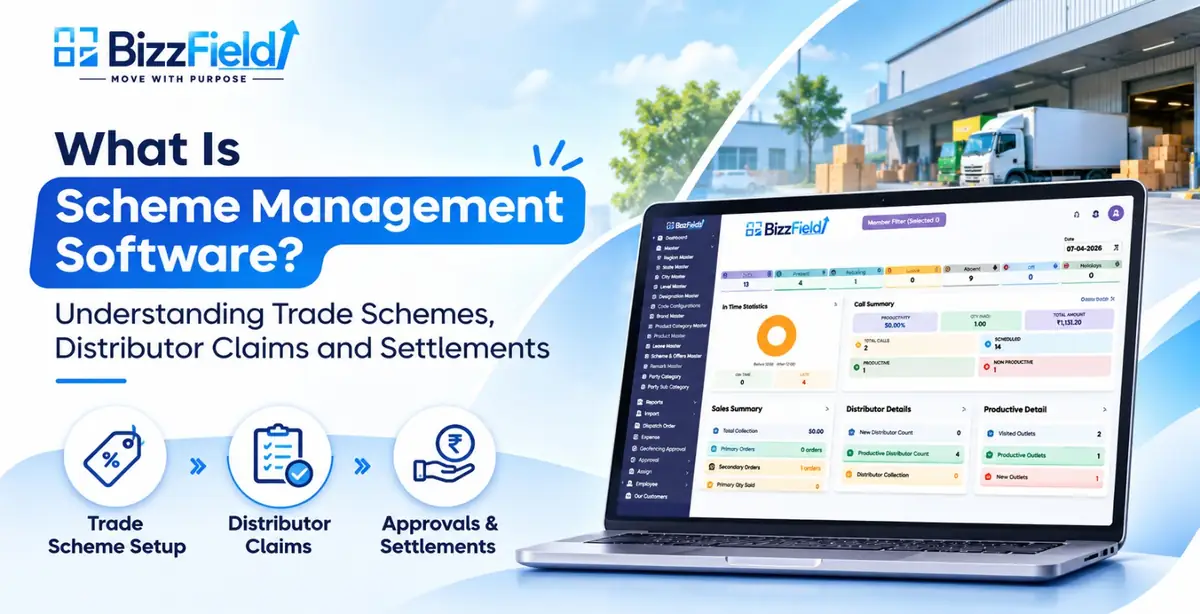
Most of this is not bad faith. The scheme terms simply lived in too many places. Scheme management software is a system for configuring trade schemes, calculating eligible benefits, and validating, approving and settling distributor claims in one place. This guide covers how it works, what to look for, and where BizzField fits.
Why Managing Trade Schemes Gets Harder as Distribution Networks Grow
Managing a few distributor schemes over calls may seem straightforward. The same approach becomes difficult when schemes extend across multiple states, distributor tiers and product categories. Four things tend to break first.
Scheme structures multiply. A metro distributor may get a volume slab, a rural stockist a combo offer, and modern trade its own terms, with retailer incentive schemes layered on top. Each carries its own conditions: minimum quantity, SKU list, validity window, retailer type.
Calculations drift. Worked out by hand, benefits go wrong in small ways. An expired scheme gets applied, the wrong slab is picked, free goods are rounded incorrectly.
Claims arrive in every format. Finance reconciles each one against invoices manually. Duplicates and mismatches are easy to miss, approvals wait in inboxes, and disputes strain distributor relationships.
Teams work from different versions of the truth. Sales, finance and trade marketing often work with different versions of the same scheme data. Sales sees uptake, finance sees payouts, and trade marketing wants to know whether volume moved. By the time anyone checks whether a scheme worked, the next one has already started.

What Is Scheme Management Software?
Scheme management software is a system that lets a company configure trade schemes, calculate eligible benefits, and validate, approve and settle distributor claims against actual purchases. It is sometimes grouped under trade promotion management, though the focus here is narrower: the day-to-day mechanics of schemes running through a distribution network.
It works alongside other systems. Sales force automation (SFA) captures field activities and sales orders. A distributor management system (DMS) typically manages distributor-side stock, orders and sales data, and may also include claim management. Scheme management applies the scheme rules to those transactions. Some vendors bundle all three; others sell them separately.
How Does Distributor Scheme Management Software Work?
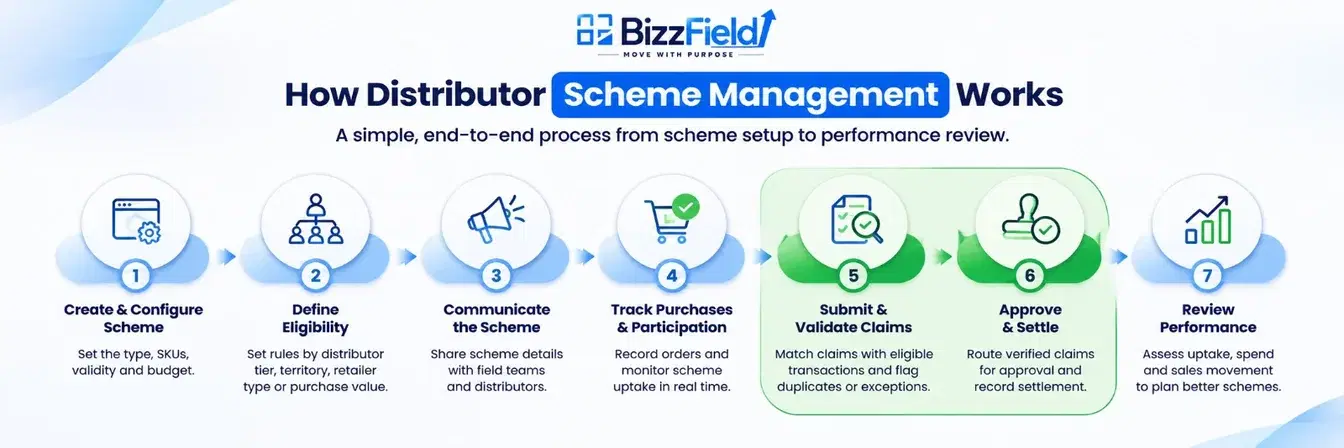
Exact workflows differ by software and by company, but most follow this sequence.
- Create and configure the scheme. Set the type (slab, volume, value, combo, free goods), the SKUs, validity dates and budget.
- Define eligibility. Specify who qualifies by distributor tier, territory, retailer type or minimum purchase.
- Communicate the scheme. Share the scheme details with field teams and distributors so everyone works from the same terms.
- Track purchases and participation. Record orders against the scheme as they happen.
- Submit and validate claims. Match each claim to eligible transactions and flag duplicates or unmet conditions.
- Approve and settle. Route verified claims through your organisation's approval chain, then record settlement.
- Review performance. Compare uptake, spend and sales movement to decide whether the scheme is worth repeating.
Approval depth, settlement method (credit note, payment or adjustment) and claim cutoff rules vary widely. A good tool adapts to your process rather than forcing one on you.
Key Features to Look for in Scheme Management Software
Treat this as a checklist for any vendor, BizzField included.
- Scheme configuration. Handles your real structures (slabs, combos, free goods, tiered terms) without custom development.
- Eligibility rules. Conditions are enforced by the system instead of remembered by people.
- Automated scheme calculation. Benefits are computed from the rules, which removes the most common manual errors.
- Claim tracking. One record per claim, with status visible to both sides.
- Claim validation. Claims are checked against actual purchases and scheme terms before they reach approval.
- Approval workflows. Configurable levels, with a record of who approved what.
- Duplicate claim identification. Catches the same invoice claimed twice.
- Settlement tracking. Shows what is pending, paid or disputed.
- Scheme performance reporting. Uptake, budget use and sales movement by scheme, territory and distributor.
Benefits of Automating Trade Scheme Management
Automation will not fix a badly designed scheme, but it removes much of the friction around good ones. The gains most businesses look for are fewer calculation errors and tighter control over scheme spend, since budget use is visible while a scheme is still running. Disputes can become easier to resolve when scheme terms and supporting evidence are maintained in one record. Settlement status becomes easy to answer, and sales, finance and distribution teams work from the same data instead of reconciling separate files.
How to Choose the Right Scheme Management Software for Your Business
Start with your own schemes, not a vendor's feature list. Bring three real examples, including your messiest, and ask:
- Flexibility: Can it model your scheme structures without custom work?
- Network fit: Will distributors, many of them not tech-savvy, use it? Is there a distributor-facing interface?
- Claim validation: What is checked automatically, and what stays manual?
- Reporting: Can finance and trade marketing get what they need without exports?
- Integration: How does data move to and from your ERP or accounting system?
- Ease of use: Will field reps and distributors actually adopt it?
- Scalability and support: What happens at 200 distributors, and who helps when scheme rules change?
How BizzField Supports Scheme Management Across Distribution Networks
Schemes do not run in isolation. They apply to field orders, distributor stock and billing, and the secondary sales that show whether a scheme moved volume.
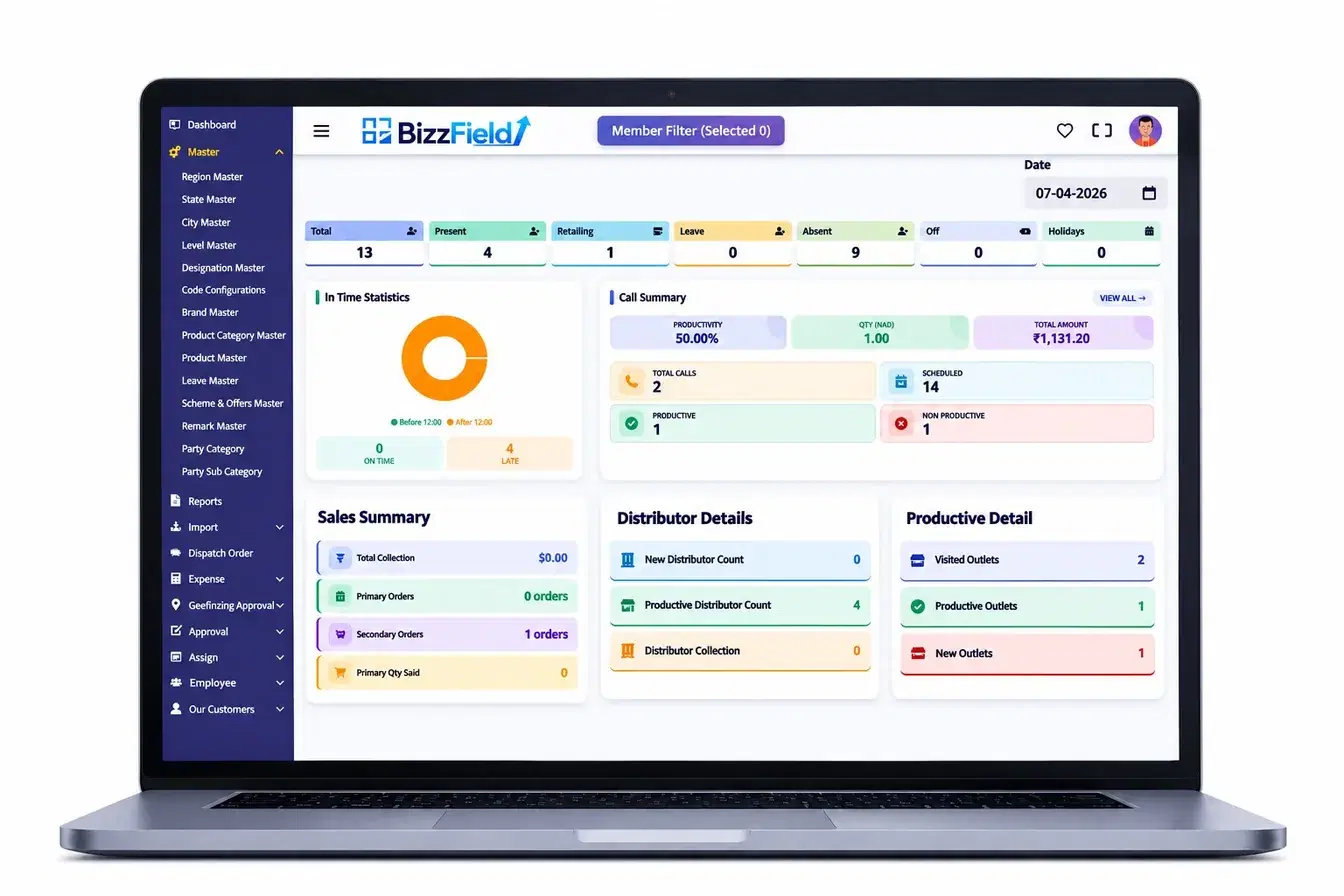
BizzField is a sales force automation platform with a distribution management system module. Its SFA platform covers field activity and order booking, with orders syncing to the distributor. Its DMS tracks distributor stock, secondary sales, scheme claims and settlement. In practice, this links four areas: field sales execution, distributor order booking, secondary sales visibility and day-to-day distribution operations.
According to its published product pages, BizzField's scheme and offer management module lets teams configure volume, value, combo and slab schemes, route them by territory, push them to field reps and apply eligible offers during order booking. A distributor portal supports scheme acknowledgment and claim submission. Claim handling includes multi-level approval, verification against eligibility rules and duplicate claim detection, with budget-versus-spend and scheme performance reporting. Integrations with SAP, Oracle and Tally are listed.
It is most relevant to FMCG, pharma, electronics and agri companies that run schemes through distributor networks. Before making a decision, test the software against your actual scheme structures and claim approval requirements. To see the dedicated module, visit the Scheme & Offer Management Software page, or Book a BizzField Demo.
Conclusion
As distributor networks grow, schemes stop being a pricing decision and become an operational process. Accurate calculations, clear eligibility, claim validation and visible settlement are what keep that process under control. When you shortlist scheme management software, test it on your hardest scheme. To see how BizzField handles yours, book a demo.
Related reading:
- How AI Is Changing Field Sales & Distribution in India in 2026
- BizzField customer stories
- Industries we serve
Frequently asked questions
Software that helps companies set up trade schemes, calculate eligible benefits, and validate, approve and settle distributor claims. It replaces spreadsheets and email threads with a single record of each scheme and claim.
Distributors get clear scheme terms, a consistent way to submit claims, and visibility into claim status. That tends to shorten disputes and make settlement more predictable, provided the software offers a distributor-facing interface.
Disputes usually come from unclear terms, calculation differences or claims nobody can verify. Automation applies the same rules to every claim, checks it against actual purchases and keeps an audit trail, so there is less to argue about.
Yes, if it is built for it. Look for different structures by distributor tier or territory running at the same time, with clear handling when schemes overlap.
Scheme flexibility, depth of claim validation, distributor adoption, ERP integration, reporting and vendor support.
A DMS manages distributor operations such as stock, orders, billing and sales data. Scheme management focuses on the rules and claims around promotions. Some DMS products include scheme handling, so check whether it covers configuration, validation and settlement or only records them.
WRITTEN BY
Urvashi Srivastav
VP, Business Management & Client Relationships
VP at BizzField, working across business management and client relationships — building strong partnerships, streamlining operations and driving business growth.
Connect on LinkedIn