
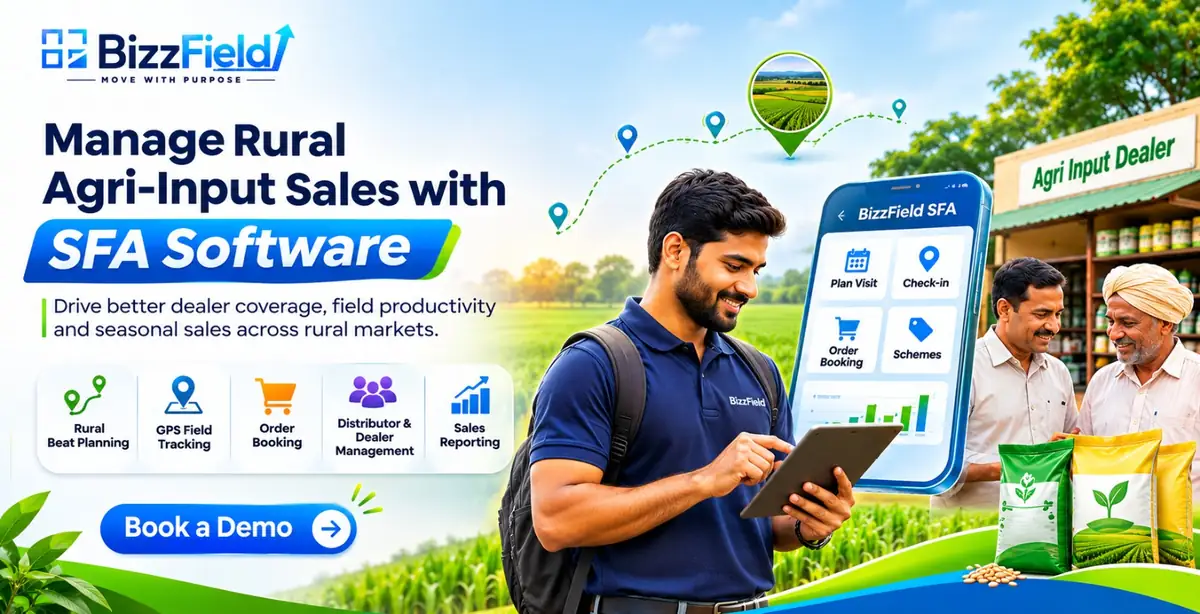
Consider a territory officer managing dealer visits across four rural blocks. He leaves his base town at 7 a.m. with a list of dealers. By noon he has met three of them. One was closed for a family function, one wanted to talk about a pending credit note, and one needs a fresh stock of a crop protection product before the next spray cycle. By evening, his manager gets a WhatsApp message that says "6 visits done." Nobody can say which six, how long he spent at each, or whether the dealer who ran out of stock was among them.
Situations like this can create serious visibility gaps in agri-input field sales, particularly during the Kharif and Rabi seasons. Agriculture sales force automation software replaces that kind of scattered reporting with a single system for planning visits, recording field activity, booking orders and tracking performance across rural territories. This guide explains how it works, what to look for, and how to choose a solution without overbuying.
What Is Agriculture Sales Force Automation Software?
Agriculture sales force automation (SFA) software is a mobile and web platform that helps agri-input companies plan, track and manage field sales activity. It covers dealer visits, order booking, territory coverage, attendance, targets and reporting, all in one place.
Field representatives use a mobile app to check in at dealers, record visit outcomes and book orders. Managers use a dashboard to see what actually happened in the market: which territories were covered, which dealers were missed, and how sales compare with targets. Distributors and dealers sit within the same structure, so the company can see its network instead of guessing at it.
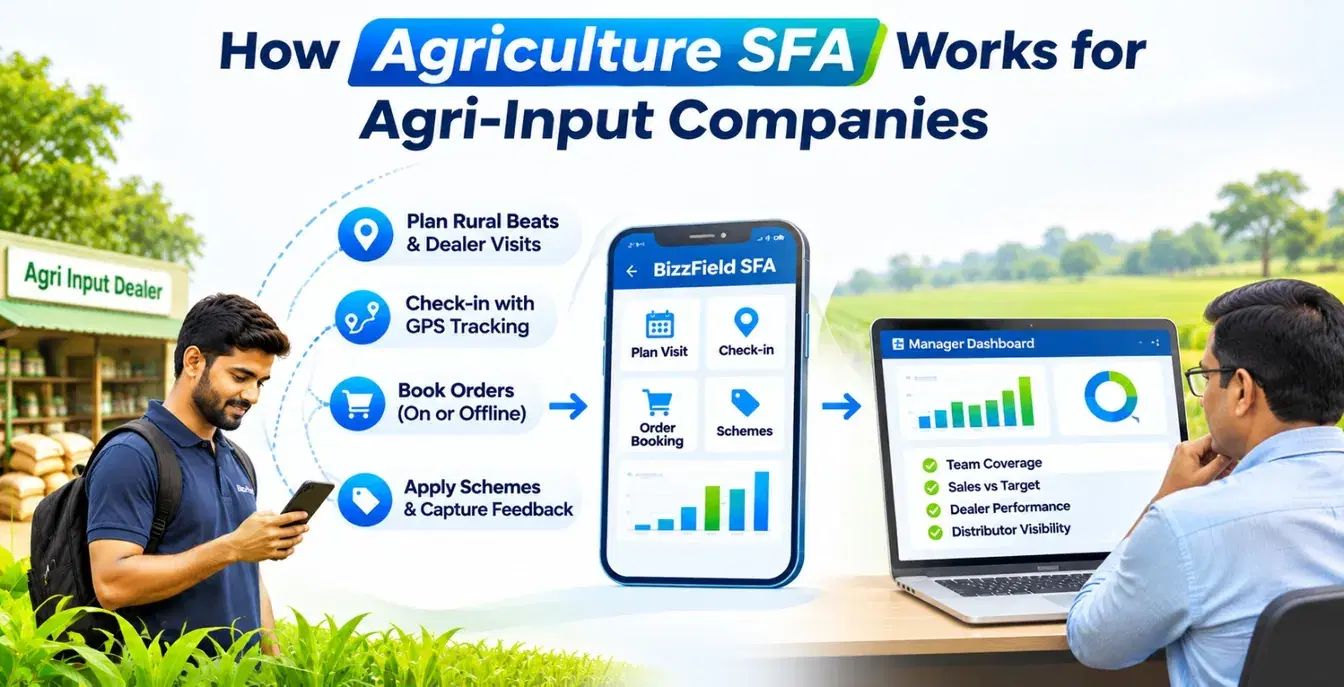
The category is sometimes called agri input SFA or agriculture field sales software. A general-purpose CRM, by contrast, is built around leads and customer accounts. SFA is built around the field team's day: routes, visits, orders and coverage.
Why Do Agriculture and Agri-Input Companies Need SFA Software?
Agricultural input sales do not behave like urban retail. A few differences explain why generic tools often fall short:
- Geography. A representative may cover dealers in different villages and blocks, with long travel between each. Visit planning matters far more when every kilometre costs time.
- Seasonality. Demand for fertilizers, seeds and pesticides is tied to sowing windows, crop stages and pest pressure. A missed dealer visit in a critical fortnight is hard to recover later.
- Layered networks. Many companies sell through distributors to dealers and retailers, so the company often has only a partial view of what happens after the first sale. Distribution models differ between businesses, and good software should adapt to yours rather than force a standard one.
- Stock and availability. A dealer who runs out of a product during peak demand loses sales, and a competitor's representative may fill the gap.
- Relationship-driven selling. Follow-ups on credit, schemes and product queries decide whether a dealer pushes your brand.
Consider a regional manager overseeing twelve representatives in one state. Without a system, he learns about coverage gaps at the monthly review, long after the sowing window has passed. With one, he can see mid-season that a cluster of high-potential dealers has not been visited in three weeks, and act on it.
Common Challenges in Managing Agriculture Field Sales Operations
Most agri-input companies recognise these problems, even if they have stopped noticing them.
Manual attendance and location checks. When attendance is reported by phone call or message, managers cannot verify where the team actually is. This makes it difficult to plan coverage or judge a representative's day fairly.
Unplanned market visits. Without a defined beat plan, representatives gravitate to nearby or familiar dealers. Remote villages and smaller retailers get visited less, even when their potential is significant.
Incomplete visit records. Notes in diaries or text messages are inconsistent. Information about dealer complaints, competitor activity or stock position rarely reaches the people who need it.
Delayed sales reporting. If reports are compiled weekly or monthly, the company reacts to last month's market. In a seasonal business, that delay is expensive.
Limited distributor visibility. The company knows what it sold to the distributor but often not what moved from distributor to dealer. Secondary sales and stock position remain approximate.
Missed follow-ups. A promised sample, a pending scheme clarification or a payment discussion gets lost between visits. Dealers notice, and trust erodes.
Weak target monitoring. When achievement data arrives late, a territory that is falling behind goes unnoticed until the quarter is nearly over.
Dependence on spreadsheets and WhatsApp. Spreadsheets work until the team grows. WhatsApp orders and updates are fast but unstructured, hard to audit, and easy to misread, especially when product names and quantities are typed hurriedly.
How Does Agriculture Sales Force Automation Software Help?
The value is not in individual features but in which operational problem each one removes. Here is how the main capabilities map to real field situations.
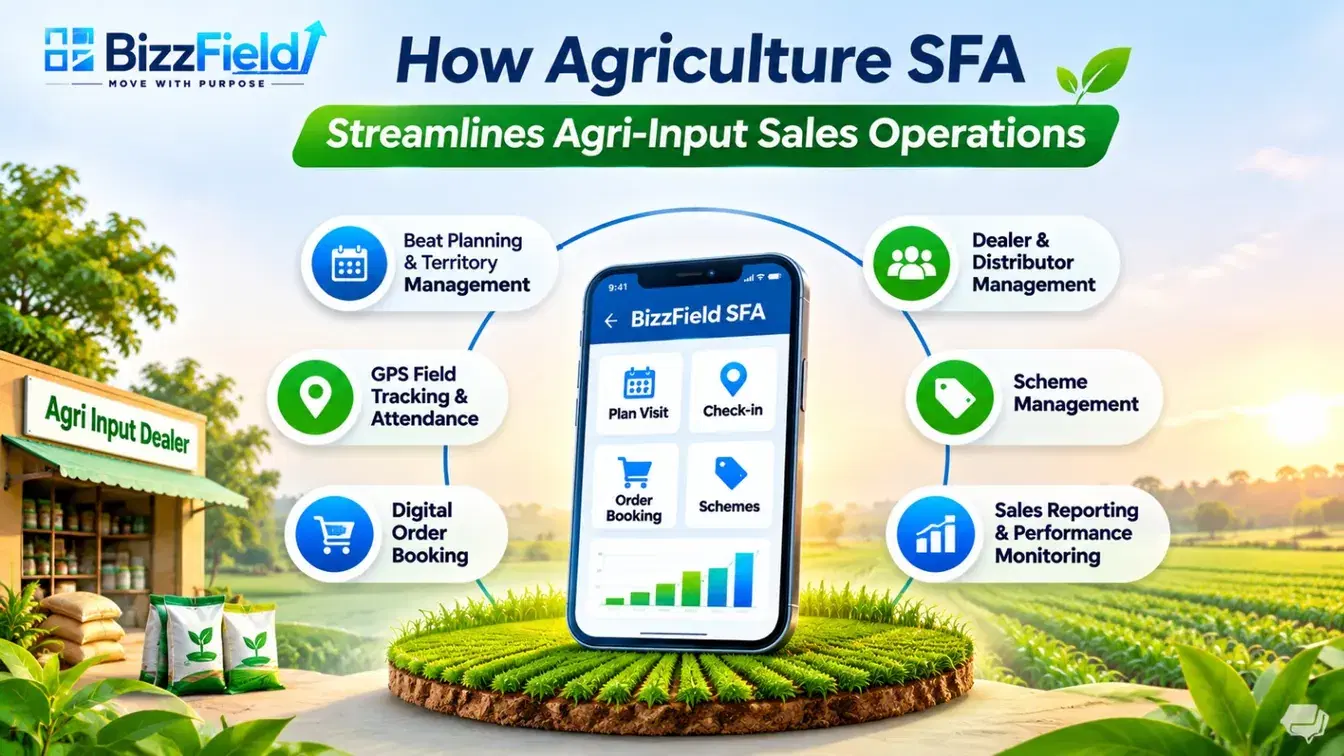
Rural Beat Planning and Territory Management
A beat is a planned route of dealers and retailers that a representative visits on a set schedule. Beat planning software lets managers build these routes around dealer clusters, villages and visit priority, and assign them to representatives. The problem it addresses is uneven coverage. The benefit is that every important dealer has a visit schedule, and managers can see where plans were not followed.
GPS-Based Field Tracking and Attendance
GPS-based attendance records where and when a representative starts work, and location-stamped check-ins show where visits took place. This solves the verification problem in widely dispersed territories. Managers get a factual view of field activity instead of relying on self-reported summaries.
Dealer and Distributor Management
A central database holds dealer and distributor profiles, territories, visit history and linked orders. It addresses the scattered records that sit in individual representatives' phones and notebooks.
Digital Order Booking
Orders are booked in the app at the dealer's counter, with products and quantities selected from a catalogue instead of typed into a message. This reduces transcription errors and gives managers a clear record of what was ordered.
Field Visit and Retailer Management
Representatives log visit outcomes, discussions and follow-up actions at the time of the visit. The problem solved is information loss between the field and the office.
Sales Target and Performance Monitoring
Targets can be assigned by representative, territory or product, with achievement tracked as orders come in. Managers see shortfalls while there is still time to respond.
Expense Management
Field travel is a major cost in rural sales. Digital expense claims, tied to field activity, replace paper claims and reduce back-and-forth in approvals.
Real-Time Sales Reporting and Analytics
Dashboards consolidate visits, orders, coverage and target data. Instead of compiling reports from spreadsheets, sales heads can review the same numbers each morning and compare territories. The benefit is faster decisions.
Offline Field Data Capture
Network coverage in rural areas is unreliable. An offline-capable app lets representatives record visits and orders without connectivity, then sync when the network returns.
What Should You Look for in Agriculture Sales Management Software?
Use this checklist when comparing solutions:
- Rural territory coverage: Can you structure territories by state, district, block or cluster as your company defines them?
- Flexible beat planning: Can beats be changed during the season without rebuilding the plan?
- Dealer database management: Can you segment dealers by region, potential or product focus?
- Mobile accessibility: Is the app simple enough for representatives with varied technical comfort?
- GPS and attendance: Are check-ins and attendance location-verified?
- Offline support: Can core tasks be completed without a network?
- Order management: Can orders be booked, reviewed and tracked?
- Sales reporting: Are reports available the same day, and can they be filtered by territory and team?
- Role-based visibility: Do representatives, area managers and sales heads see the data relevant to them?
- Scalability and integration: Will it handle more users and territories, and can it connect with your existing ERP or accounting systems?
How to Choose the Right Agriculture SFA Software in India
A structured evaluation protects you from buying features you will not use.
- Map your sales and distribution workflows. Write down how a visit, an order and a follow-up currently happen, from representative to distributor.
- Identify field reporting gaps. Note where information is late, missing or unverifiable.
- Define dealer and territory needs. Decide how you want to segment dealers and structure beats, then check whether the software supports it.
- Test mobile and offline behaviour. Try the app in a low-connectivity area, not just in the office.
- Review reporting and visibility. Ask to see the dashboards your sales head and regional managers would actually use.
- Assess implementation and adoption. Ask how onboarding works, what training the field team receives, and what support is available during the season.
- Request a demonstration using your own scenario.
Plan the rollout outside peak season if you can. A field team learns a new app more easily when it is not also chasing its most important sales fortnight.
How BizzField SFA Supports Agriculture Sales Teams
BizzField is a Sales Force Automation Software platform from Code Aspire, built for field-led sales teams. Its general capabilities map well to the operational needs described above:
- GPS-based field tracking and geo-fenced attendance give managers a verified view of where the team is working.
- Smart beat planning helps structure rural routes and territories.
- Retailer and dealer visit management records visit activity and follow-ups.
- Digital order booking replaces messaged or handwritten orders.
- Through its integrated Distributor Management System (DMS), BizzField provides visibility into distributor stock and secondary sales from distributors to dealers. Its SFA platform also supports field sales execution, including dealer visits and order booking. See also distribution management.
- Expense management and territory performance monitoring support cost control and target tracking.
- A sales analytics dashboard with real-time reporting consolidates this activity for managers.
- An offline mobile app supports data capture in low-connectivity areas.
Managing Dealer Orders, Schemes and Distribution Visibility
During the season, a representative can book an order at the dealer counter with scheme details in view, and managers can follow those orders as they come in. BizzField's agriculture page also describes scheme eligibility checks at order entry and distributor stock visibility through its distribution management module. How far each workflow is automated depends on how your schemes and distributor data are set up, so confirm the specifics against your own processes during a demo.
Example: Adapting SFA to Agriculture Business Requirements
Hyderabad Crops, an agriculture company using BizzField SFA, shows how the platform can be adapted to a company's own process. According to BizzField's published case study, the implementation included customised collection target tracking and a quantity-wise sales target feature. The case study does not report quantified results, so none are claimed here.
BizzField has a dedicated agriculture SFA page that outlines how these capabilities apply to agri-input and fertilizer businesses.
Final Thoughts: Bringing Better Visibility to Agriculture Sales Operations
Agriculture sales run on relationships, timing and presence in the market. Companies that grow in this space tend to be the ones that know what their field teams are doing and where their dealers stand, not just what the month-end sales figure says.
Agriculture sales force automation does not replace the judgment of a good territory manager or the trust a representative builds with a dealer. It gives both of them a structure: planned visits, recorded activity, and reports that arrive while there is still time to act. Start by mapping your current workflow and finding where information goes missing. That will tell you what you need from any platform.
Managing a growing agriculture sales team across rural territories? Explore BizzField SFA and see how digital beat planning, field tracking, dealer management and sales reporting can support your sales operations.
Frequently asked questions
It is a mobile and web platform that helps agri-input companies plan and track dealer visits, book orders, monitor territories and review field performance in one system.
It gives managers verified, same-day visibility into field activity, so coverage gaps and missed follow-ups can be corrected during the season instead of after it.
Yes. Representatives can check in at dealers, log visit outcomes and set follow-ups, while managers compare planned visits with actual coverage.
A beat plan defines which dealers to visit, and when. It helps ensure that remote villages and smaller dealers are covered on a schedule, not left to chance.
With an offline-capable app, yes. Visits and orders are saved on the device and sync when connectivity returns. Confirm exactly which functions work offline during your evaluation.
Flexible beat planning, a dealer database, GPS attendance, offline support, order booking, role-based reporting, and the ability to scale with your territories.
A CRM is organised around customer accounts and leads. SFA is organised around the field team's daily work: routes, visits, orders, attendance and coverage.
WRITTEN BY
Urvashi Srivastav
VP, Business Management & Client Relationships
VP at BizzField, working across business management and client relationships — building strong partnerships, streamlining operations and driving business growth.
Connect on LinkedIn