
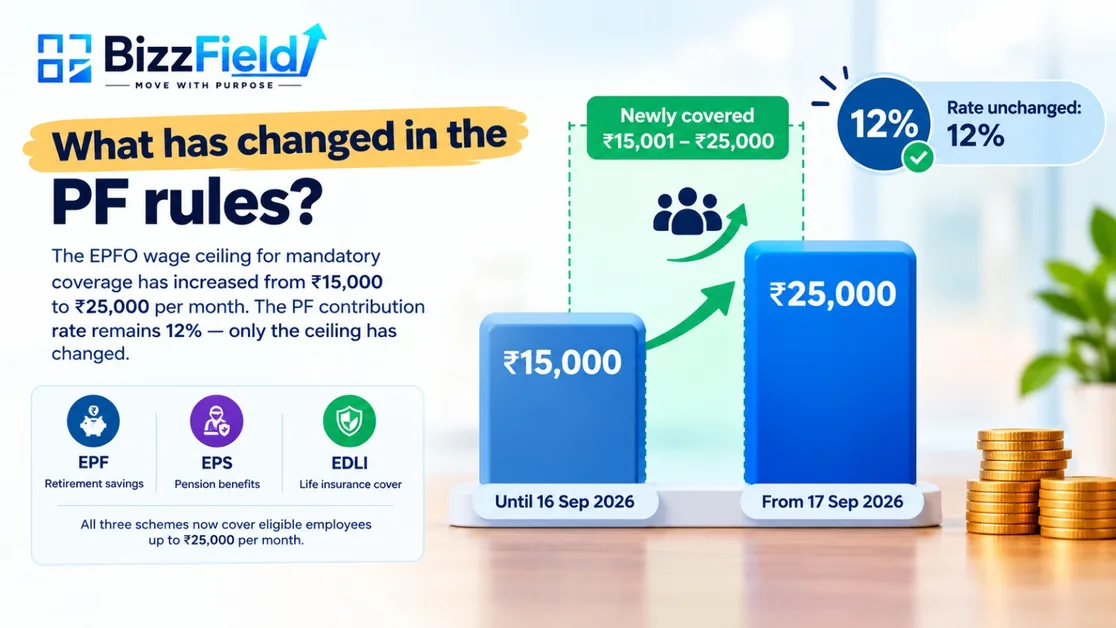
The PF contribution rate has not changed. It is still 12%.
What has changed is the statutory wage ceiling on which mandatory contributions are calculated. The ceiling for EPF, EPS and EDLI coverage has moved from ₹15,000 to ₹25,000 per month, under Notification S.O. 5109(E) dated 17 September 2026. Around 51 lakh more employees are expected to come under EPFO's social security cover.
For twelve years, ₹15,000 has been the number that decided who had to be covered by the Provident Fund. Many employers also used it as a cap, calculating PF on ₹15,000 even when an employee's PF wages were higher.
The Ministry of Labour and Employment has now changed that, through Notification S.O. 5109(E) dated 17 September 2026. The change is effective from 17 September 2026, and it supersedes the earlier notification S.O. 2702(E) of 29 May 2026.
That distinction affects who must be enrolled, how much is deducted each month, what the employer pays, and how the September 2026 return is filed. This guide covers each of those.

What has changed in the PF rules?
The ceiling for EPF, EPS and EDLI coverage has moved from ₹15,000 to ₹25,000 per month. It was last revised in September 2014, when it went from ₹6,500 to ₹15,000.
| Particulars | Up to 16 September 2026 | From 17 September 2026 |
|---|---|---|
| EPFO statutory wage ceiling | ₹15,000 | ₹25,000 |
| Employee PF contribution | 12% | 12% |
| Employer contribution | 12% | 12% |
| Employer share to EPS | 8.33% | 8.33% |
| Employer share to EPF | 3.67% | 3.67% |
| ESIC wage limit (employees generally) | ₹21,000 | ₹21,000 (unchanged) |
The ceiling covers three schemes:
- EPF (Employees' Provident Fund): retirement savings built from employee and employer contributions.
- EPS (Employees' Pension Scheme): pension for eligible members, subject to scheme conditions.
- EDLI (Employees' Deposit Linked Insurance): life insurance cover for eligible EPF members.
ESIC wage limit: ₹21,000 per month for employees generally. Separate provisions apply to employees with disabilities. The EPFO wage ceiling revision does not itself change ESI coverage limits.
Is PF now deducted at a higher rate?
No. The employee still contributes 12% of PF wages, and the employer still contributes 12%.
What can change is the amount of wages the 12% applies to. Take an employee whose PF wages are ₹20,000 a month. If their contribution was being calculated on ₹15,000, it can now be calculated on ₹20,000. The percentage is the same, but the rupee amount goes up.
How the 12% employer share is split
| Contribution | Rate |
|---|---|
| Employee's EPF contribution | 12% |
| Employer's total contribution | 12% |
| of which, to EPS | 8.33% |
| of which, to EPF | 3.67% |
The 8.33% EPS and 3.67% EPF allocation shown above applies to employees eligible for EPS membership. The allocation may differ for employees who are not eligible for EPS. Employers also pay EDLI contribution and EPF administrative charges, generally 0.50% each of PF wages, subject to the applicable scheme provisions and minimum charges. Some notified establishments contribute at 10% instead of 12%.
PF calculation examples under the ₹25,000 ceiling
The examples below assume a full month and the standard 12% structure. Amounts are rounded to the nearest rupee.
| Monthly PF wages | Employee PF (12%) | Employer EPS (8.33%) | Employer EPF (3.67%) |
|---|---|---|---|
| ₹15,000 | ₹1,800 | ₹1,250 | ₹550 |
| ₹20,000 | ₹2,400 | ₹1,666 | ₹734 |
| ₹25,000 | ₹3,000 | ₹2,083 | ₹917 |
- PF wages of ₹15,000.Nothing changes. Both employee and employer contribute ₹1,800.
- PF wages of ₹20,000.Both contribute ₹2,400, which is ₹600 more each than on the old ₹15,000 base. The employer's ₹2,400 splits into ₹1,666 to EPS and ₹734 to EPF.
- PF wages of ₹25,000.Both contribute ₹3,000, the maximum under the new ceiling. The employer's share splits into ₹2,083 to EPS and ₹917 to EPF.
What it means for employer cost
At the full ceiling, the employer's monthly outgo per employee goes up by roughly ₹1,300:
| At ₹15,000 | At ₹25,000 | |
|---|---|---|
| Employer PF (12%) | ₹1,800 | ₹3,000 |
| EDLI (0.50%) | ₹75 | ₹125 |
| EPF admin charges (0.50%) | ₹75 | ₹125 |
| Total | ₹1,950 | ₹3,250 |
The above calculation is illustrative and assumes a 0.50% EDLI contribution and a 0.50% EPF administrative charge on the respective wage bases. Actual establishment-level administrative charges may vary, including applicable minimum charges.
Consider an organisation with 50 eligible employees whose PF wage contribution base increases from ₹15,000 to ₹25,000. The additional employer PF contribution would be ₹1,200 per employee per month. For 50 employees, that is an additional ₹60,000 a month, or ₹7.2 lakh a year, excluding EDLI and administrative charges. This is why reviewing employee-wise PF eligibility and updating payroll budgets should be a priority.
Who comes under the revised coverage?
- New joiners from 17 September 2026.Employees whose PF wages are within ₹25,000 come under mandatory coverage, subject to the usual membership provisions.
- Existing employees who were left out because of the old ceiling. If their PF wages were up to ₹25,000 on 17 September 2026, EPFO's FAQs say they are to be enrolled from that date.
- Existing members who were contributing on ₹15,000. Their contribution base can rise, depending on their actual PF wages. Someone with PF wages of ₹20,000 moves from a ₹15,000 base to a ₹20,000 base.
- Existing members who were not in EPS. Eligible members with wages between ₹15,000 and ₹25,000 who were not previously in EPS are to be enrolled in EPS from 17 September 2026. This changes how the employer's 12% is split between EPF and EPS.
- Employees earning above ₹25,000.The new ceiling does not end anyone's membership. Once an employee is a member, they stay a member even if their wages later cross ₹25,000. Their contributions continue under the applicable scheme rules.
Does the ₹25,000 limit apply to gross salary?
No, and this is where payroll errors most often start.
The ceiling applies to PF wages, not to gross salary, take-home pay or CTC. Under Section 2(88) of the Code on Social Security, 2020, wages include basic pay, dearness allowance and retaining allowance. Certain payments, such as HRA and conveyance allowance, are excluded, subject to conditions.
There is also the 50% rule. If the excluded payments come to more than half of total remuneration, the excess is added back when working out wages.
Salary components should be assessed collectively under the applicable statutory definition of wages. Simply renaming or restructuring an allowance does not automatically make it exempt from PF wage calculations. A salary structure that records the PF treatment of each component once, and applies it consistently, is far safer than adjusting formulas by hand each month.
So an employee with a gross salary of ₹50,000 can still have PF wages of ₹25,000 or less. The right answer depends on the salary structure and the statutory definition, not on how components are labelled.
What happens to take-home pay?
For employees whose contribution base rises, take-home pay can fall. If an employee's PF wages are ₹20,000 and they were contributing on ₹15,000:
- Earlier employee contribution: 12% of ₹15,000 = ₹1,800
- Revised employee contribution: 12% of ₹20,000 = ₹2,400
- Difference: ₹600 a month
All else equal, take-home is ₹600 lower. The additional amount is not lost — it goes into the employee's retirement savings, and the employer's matching contribution rises too. Eligible members also build more pension under EPS.
It is worth telling employees this before the first payslip with the new deduction, not after. Employers should also note that the employer's statutory contribution and the employee's contribution are legally separate. Describing the employer share as part of CTC does not let you recover it from the employee's pay.
What happens to EPS and EDLI?
EPS.The pensionable wage ceiling rises with the wage ceiling, so the employer's maximum EPS contribution under 8.33% goes from ₹1,250 to ₹2,083 a month. The pension an employee finally receives still depends on pensionable service, pensionable salary and EPS rules. EPFO's FAQs also state that the Government's own 1.16% EPS contribution continues to be calculated on wages up to ₹15,000, at most ₹174 a month.
EDLI.The wage ceiling feeds into EDLI calculations, but the maximum assurance benefit has been stated as ₹7 lakh. Do not read the higher ceiling as an automatic increase in insurance cover.
September 2026: the transition month
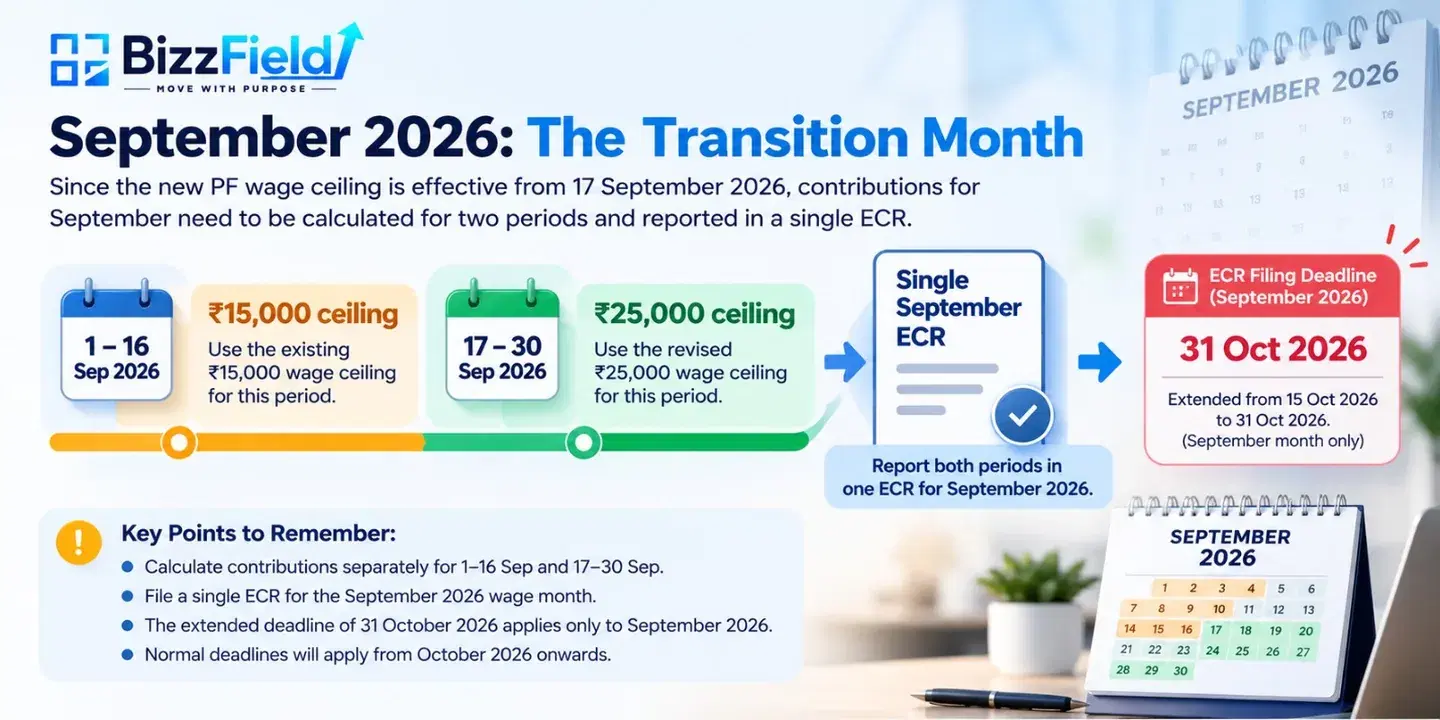
Because the change took effect on 17 September, September is a split month. EPFO's FAQs set out two periods:
| Period | Ceiling that applies |
|---|---|
| 1 to 16 September 2026 | ₹15,000 |
| 17 to 30 September 2026 | ₹25,000 |
Contributions are calculated separately for each period, but they are reported through one September 2026 ECR. You do not file two.
Recovering the extra employee deduction
Where the additional employee contribution could not be deducted in September payroll, employers may recover it from the next payroll cycle. That flexibility applies only to recovering the amount from salary. The full contribution — both employee and employer shares — still has to be reported and paid through the September ECR.
Deadline
The normal due date for the September ECR was 15 October 2026. By its circular of 13 October 2026, EPFO extended the deadline for filing the September 2026 ECR and paying the contributions to 31 October 2026. The extension is for the September wage month only. From the October 2026 wage month, the revised rules apply to the full month.
The extended deadline for filing the September 2026 ECR and remitting the corresponding contributions is 31 October 2026. This extension applies specifically to the September 2026 wage month and should not be treated as a general extension for subsequent months.
A payroll checklist
The ceiling change is a data and configuration exercise as much as a policy one. Here is a sensible order of work:
- Pull the list of employees whose PF wages fall between ₹15,000 and ₹25,000.
- Check who was excluded earlier because of the old ceiling, and enrol those who now qualify.
- Check EPS membership for existing members who were not enrolled in EPS.
- Update the PF ceiling in your payroll configuration, including the contribution split and admin charges.
- Verify how PF wages are derived from your salary components, rather than relying on gross or CTC.
- Reconcile the September ECR against the two-period calculation before filing.
- Brief employees on why their deduction is changing and what they gain from it.
- Keep a calculation trail. If EPFO queries a figure, you should be able to show how it was reached.
How BizzField Payroll helps
A ceiling change is the kind of event that exposes how fragile spreadsheet payroll is. A single hardcoded ₹15,000 in a formula can produce wrong deductions for every employee in the new band.
BizzField Payroll is a standalone payroll product for Indian businesses, built around a controlled monthly cycle:
- Salary component master.Define each component's PF, ESI and tax treatment once, so PF wages are derived consistently. See salary structure.
- Statutory calculations by work location.PF, ESI, professional tax, LWF and TDS are applied by each employee's work state. See PF, ESI, PT and LWF.
- Variance review before release. Each draft register is compared with the previous cycle, so an employee whose deduction jumped because of the new ceiling is flagged before payslips go out.
- Maker-checker approval. The person who prepares the cycle is not the person who approves it, and every approval is logged.
- ECR file from the same pay run. The ECR is produced from the figures payroll actually deducted. Submission to the EPFO portal stays with your finance or compliance team.
- Audit trail. Revisions, approvals and reversals are recorded and open to review.
You can also try the payroll calculators to see how deductions work out for different salary structures.
See it on your own data. Book a 15-minute demo with our payroll team.
Conclusion
The 12% rate has not moved, but the ₹25,000 ceiling touches enrolment, deductions, employer cost, pension membership and the September return all at once.
For employees, it means more retirement savings and wider social security cover. For employers, it means checking who is newly eligible, confirming how PF wages are calculated, and getting the September split-month return right.
The businesses that handle this smoothly will be the ones whose payroll rules live in one controlled system rather than in scattered formulas. Want your next pay cycle to run on the revised PF rules without the month-end scramble? Talk to a BizzField payroll expert or book a demo.
Sources and references
- Gazette Notification S.O. 5109(E), 17 September 2026 (supersedes S.O. 2702(E) of 29 May 2026)
- Code on Social Security, 2020, Sections 2(88) and 2(89)
- EPFO FAQs on the revised statutory wage ceiling, September 2026
- EPFO circular dated 13 October 2026 extending the September 2026 ECR due date
- Ministry of Labour & Employment / PIB announcement, 16 September 2026
This article is for general information and is not legal advice. Please confirm treatment for your establishment against the official notification and EPFO's FAQs, or with your compliance advisor.
Frequently asked questions
No. Employee and employer rates are both still 12%. The statutory wage ceiling has gone from ₹15,000 to ₹25,000 per month, under Notification S.O. 5109(E) dated 17 September 2026.
From 17 September 2026, under Notification S.O. 5109(E). For the September 2026 wage month, contributions are split: the ₹15,000 ceiling applies from 1 to 16 September, and the ₹25,000 ceiling applies from 17 to 30 September.
If they are covered under EPFO, yes. At 12% the employee contribution for a full month is ₹2,400, and the employer contributes the same. The employer’s ₹2,400 splits into ₹1,666 to EPS and ₹734 to EPF.
No. PF wages follow the definition in the Code on Social Security, 2020, not gross salary or CTC. Basic pay, dearness allowance and retaining allowance are included. Certain payments such as HRA and conveyance allowance may be excluded, subject to conditions and the 50% rule.
Yes, wherever the contribution base rises. The employer’s 12% is split between EPS (8.33%) and EPF (3.67%) for eligible employees. EDLI and administrative charges also move with PF wages. At the full ₹25,000 ceiling, the employer’s total monthly outgo rises from roughly ₹1,950 to ₹3,250 per employee.
Eligible members with wages between ₹15,000 and ₹25,000 who were not previously in EPS are to be enrolled in EPS from 17 September 2026. This changes how the employer’s 12% is split between EPF and EPS.
No. Contributions are on actual PF wages, up to the ceiling. Someone with PF wages of ₹18,000 contributes on ₹18,000. The ₹25,000 ceiling is the maximum base, not a fixed amount.
No. The ESIC wage limit remains ₹21,000 a month for employees generally. Separate provisions apply to employees with disabilities. The EPFO wage ceiling revision does not change ESI coverage limits.
31 October 2026, extended by EPFO circular of 13 October 2026, for the September 2026 wage month only. Normal due dates apply from the October 2026 wage month onwards.
No. Once enrolled, an employee remains a member even if their wages exceed the ceiling. Their contributions continue under the applicable scheme rules.
WRITTEN BY
Shivam Gupta
Brand Manager
Brand Manager with 8+ years of experience in building brands, developing growth strategies, and creating impactful marketing campaigns that drive business success.
Connect on LinkedIn