

It is the last week of October, and an HR manager is preparing the annual bonus sheet. Finance wants a number for the upcoming budget, but the spreadsheet has employees who joined at different times, different wage structures and several salary components. Applying 8⅓% to everyone's gross salary might seem like the easiest way to finish the calculation. It can also produce the wrong result.
A statutory bonus calculator helps HR and finance teams estimate bonus liability once eligibility, the applicable wage basis and statutory limits have been checked. You can use the BizzField bonus calculator for a quick estimate. For the wider payroll cycle, BizzField Payroll helps manage calculations, approvals and related records.
What Is a Statutory Bonus Calculator?
A statutory bonus calculator estimates the bonus payable to eligible employees using the relevant wage figures, the period worked and the applicable bonus rate.
For an HR manager handling payroll for 50 or 500 employees, the value is practical: calculations become easier to review, finance can estimate liability, and unusual figures can be flagged before payments are processed.
Statutory bonus is different from a performance incentive or discretionary bonus. Those payments may follow separate contractual or company-policy arrangements.
Who Is Eligible for Statutory Bonus in India in 2026?
The Code on Wages, 2019 came into force on 21 November 2025, and Section 26 governs statutory bonus.
On 25 August 2026, the Ministry of Labour and Employment issued two notifications under Section 26, both deemed effective from 21 November 2025:
- S.O. 4711(E) (Section 26(1)): every employee drawing wages not exceeding ₹21,000 per month shall be paid bonus.
- S.O. 4710(E) (Section 26(2)): sets the wage used to calculate bonus (see below).
Important: which notification applies?
These notifications are issued by the Central Government. They apply to establishments for which the Central Government is the appropriate government. If your establishment falls under a State Government, check whether your State has issued its own notification before applying these figures.
Before calculating an employee's bonus, check four things:
- Establishment coverage:Confirm whether your establishment is covered by the Code's bonus provisions, whether it falls under an exclusion (see Section 41), and whether the Central or State Government is the appropriate government. Do not carry over coverage rules from the old Payment of Bonus Act without checking the current Code and Rules.
- Wage eligibility:Wages must not exceed the notified limit (₹21,000 per month under S.O. 4711(E) for Central-sphere establishments).
- Working days: The employee must generally have worked at least 30 days in the accounting year.
- Wage definition: Check wages as defined under the Code, not just gross salary.
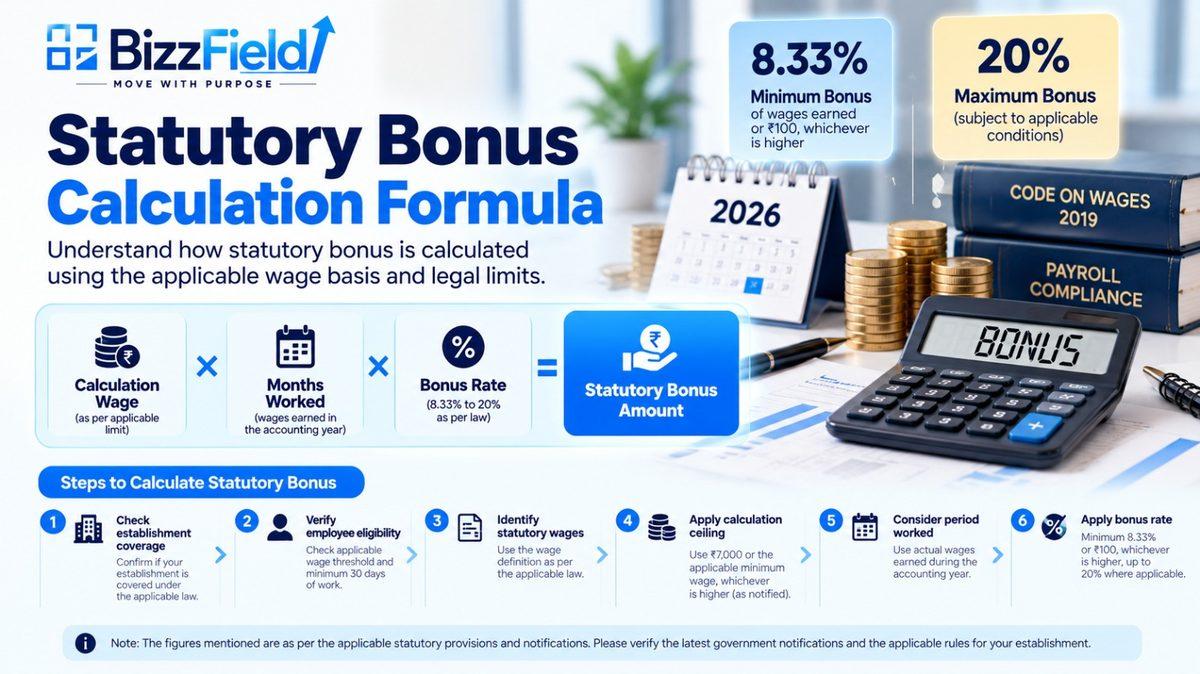
How Is Statutory Bonus Calculated?
- Confirm establishment coverage and employee eligibility.
- Identify the wages recognised under the Code.
- Where wages exceed ₹7,000 per month, apply S.O. 4710(E): calculate as if wages were ₹7,000 or the applicable minimum wage fixed by the Central Government, whichever is higher.
- Account for wages earned and the period worked in the accounting year.
- Apply the statutory rate and any required adjustments.
Section 26 provides a minimum bonus of 8⅓%(about 8.33%) of wages earned or ₹100, whichever is higher. The maximum may reach 20%, subject to the statutory conditions and allocable surplus.
Key distinction
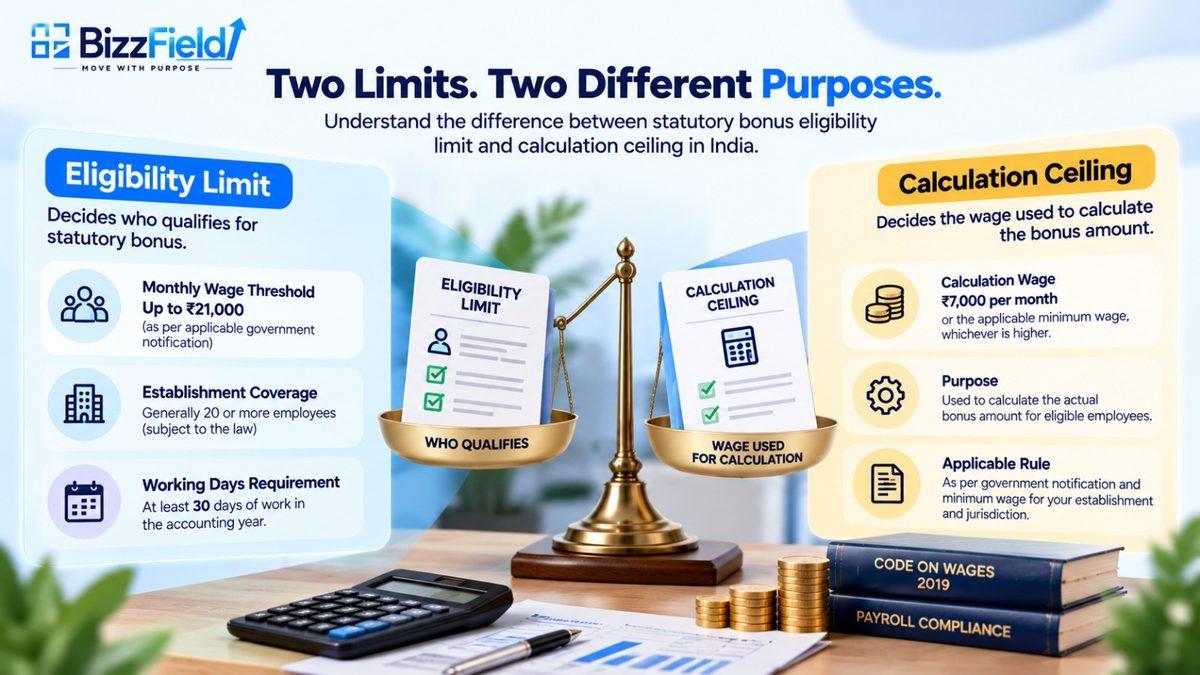
The eligibility limit (₹21,000) and the calculation wage (₹7,000 or minimum wage, whichever is higher) are different things. One decides whether an employee qualifies; the other decides the wage on which bonus is computed.
A Simple Bonus Calculation Example
Suppose an employee is eligible, has worked throughout a 12-month accounting year, and the applicable monthly calculation wage is ₹7,000.
| Calculation | Amount |
|---|---|
| Monthly calculation wage | ₹7,000 |
| Annual calculation base | ₹84,000 |
| Bonus at 8⅓% | ₹7,000 |
This is an illustration. Under S.O. 4710(E), the calculation wage is ₹7,000 or the applicable minimum wage, whichever is higher — so check the minimum wage applicable to your employee before using ₹7,000. For an employee with a shorter period of service, the base reduces accordingly.
Where Payroll Teams Can Go Wrong
Manufacturing: A factory spreadsheet assumes every employee worked all 12 months. Someone who joined in December gets the same estimate as an employee who joined in April. Each entitlement must reflect the period worked and wages earned.
Retail: An employee transferred between branches appears in two payroll sheets. Reconciling employee records and confirming the applicable jurisdiction helps prevent duplicate entries.
FMCG and distribution: Finance estimates the bonus budget using gross payroll, while HR uses a different wage basis. The two totals never match. Working from consistent employee data and an agreed statutory method reduces reconciliation work.
These are illustrative situations, but they reflect the discrepancies payroll teams should look for before processing payments.
Common Statutory Bonus Calculation Mistakes
- Using gross salary automatically: This distorts both eligibility checks and the calculation base.
- Confusing the ₹21,000 eligibility limit with the ₹7,000 calculation wage: They serve different purposes.
- Ignoring the period worked: Joining dates and wages earned affect the amount.
- Using outdated thresholds: Old spreadsheets may still carry limits from the earlier Payment of Bonus Act.
- Applying Central notifications to State-sphere establishments: Verify which government's notification applies.
- Skipping reconciliation: Differences between HR and finance records tend to surface just before payment.
How a Statutory Bonus Calculator Simplifies Payroll Planning
A calculator helps payroll teams estimate liabilities, compare scenarios and prepare budgets. It also makes unusual figures easier to spot.
However, the result is only as reliable as the data and rules behind it. A calculator cannot confirm legal coverage or replace verification of the notifications that apply to your establishment.
Once calculations are ready, you need a dependable way to review and approve them. BizzField Payroll supports controlled pay runs, variance reviews, maker-checker approvals and bonus and incentive processing, so teams are not relying entirely on disconnected spreadsheets.
Frequently Asked Questions
How is statutory bonus calculated in India?
Statutory bonus is calculated on the applicable wage basis, wages earned in the accounting year and the bonus rate. Where an eligible employee's wages exceed ₹7,000 per month, S.O. 4710(E) provides for calculation as if wages were ₹7,000 or the applicable minimum wage, whichever is higher.
What is the minimum statutory bonus rate?
Section 26 of the Code on Wages provides a minimum bonus of 8⅓% of wages earned or ₹100, whichever is higher. The maximum may reach 20%, subject to statutory conditions.
What is the statutory bonus eligibility limit in 2026?
For establishments covered by the Central Government's notification, S.O. 4711(E) sets the limit at wages not exceeding ₹21,000 per month. State-sphere establishments should check for State notifications.
Is an employee eligible for bonus after working for 30 days?
Working at least 30 days in the accounting year is a statutory condition, but it does not guarantee eligibility. Establishment coverage and the wage limit must also be satisfied.
What is the difference between bonus eligibility and the calculation wage?
The eligibility limit decides whether an employee qualifies for bonus. The calculation wage decides the wage on which the bonus is computed when actual wages exceed ₹7,000.
Conclusion
A correct bonus calculation starts before anyone opens a spreadsheet. HR and finance need verified employee records, the correct wage definition, and the notifications that apply to their establishment.
A statutory bonus calculator makes the numbers easier to work through, but the rules behind them matter just as much. Try the BizzField bonus calculator, or explore BizzField Payroll to bring calculations, approvals and employee records into one workflow.
Frequently asked questions
Statutory bonus is calculated on the applicable wage basis, wages earned in the accounting year and the bonus rate. Where an eligible employee's wages exceed ₹7,000 per month, S.O. 4710(E) under the Code on Wages, 2019 provides for calculation as if wages were ₹7,000 or the applicable minimum wage, whichever is higher. The minimum bonus rate is 8⅓% (about 8.33%) of wages earned, or ₹100, whichever is higher.
Section 26 of the Code on Wages, 2019 provides a minimum bonus of 8⅓% of wages earned or ₹100, whichever is higher. The maximum may reach 20%, subject to the statutory conditions regarding allocable surplus.
For establishments covered by the Central Government's notification, S.O. 4711(E) dated 25 August 2026 sets the eligibility limit at wages not exceeding ₹21,000 per month. Establishments that fall under a State Government should check whether their State has issued its own notification before applying these figures.
Working at least 30 days in the accounting year is a statutory condition under the Code on Wages, but it does not on its own guarantee eligibility. Establishment coverage and the wage limit must also be satisfied before bonus entitlement arises.
The eligibility limit (₹21,000 per month under S.O. 4711(E) for Central-sphere establishments) decides whether an employee qualifies for statutory bonus. The calculation wage decides the wage figure on which bonus is actually computed — where actual wages exceed ₹7,000, the calculation is done as if wages were ₹7,000 or the applicable minimum wage, whichever is higher. The two figures serve different purposes.
WRITTEN BY
Urvashi Srivastav
VP, Business Management & Client Relationships
VP at BizzField, working across business management and client relationships — building strong partnerships, streamlining operations and driving business growth.
Connect on LinkedIn