
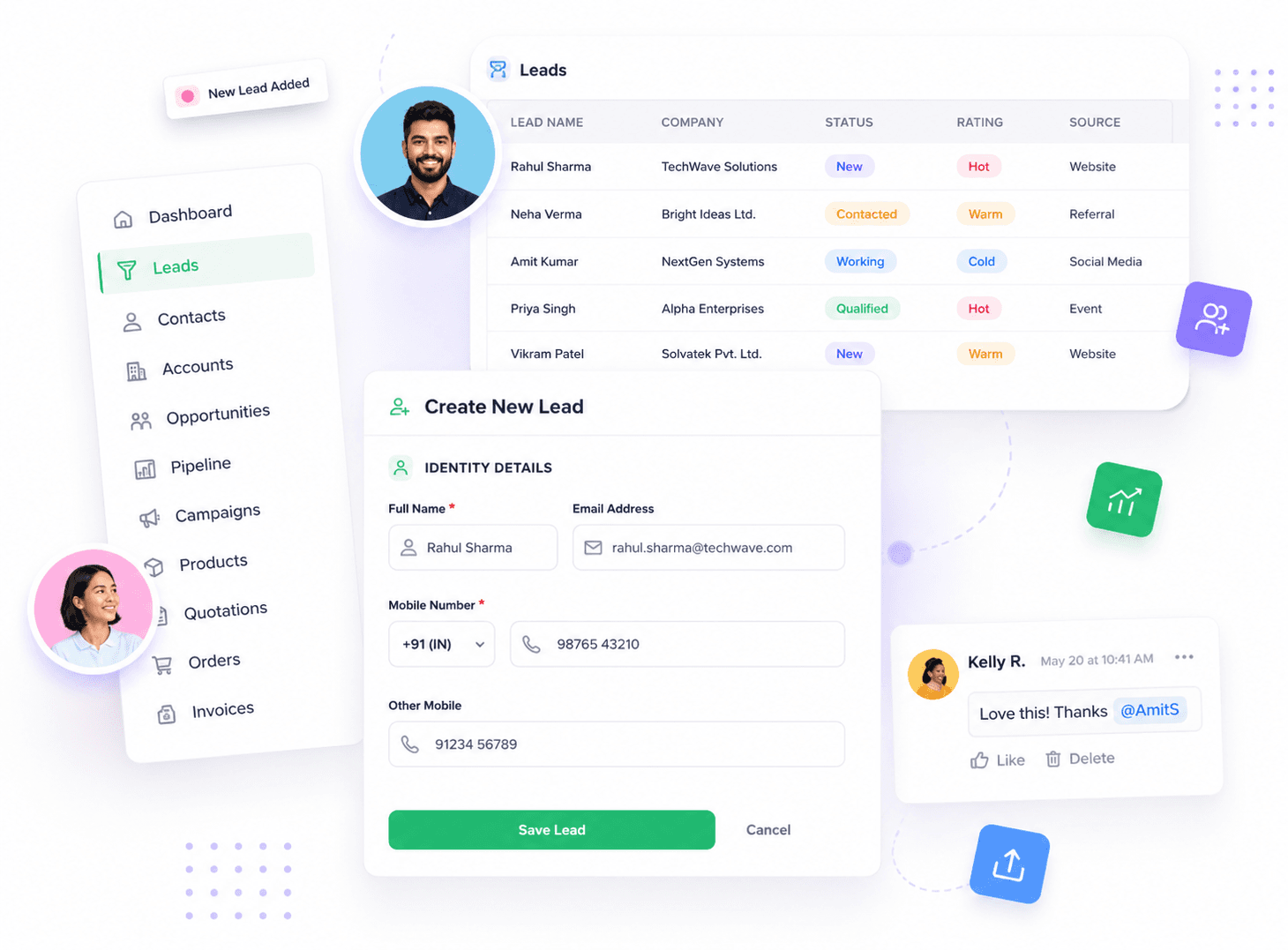
Most sales organizations do not suffer from a lead generation shortage; they suffer from a lead management decay problem. Up to 70% of inbound sales inquiries are lost, forgotten, or mishandled in the crucial hours after submission.
This 2026 playbook details proven lead management best practices for high-velocity sales teams. We cover SLA response benchmarks, lead scoring frameworks, automated routing rules, lead-to-opportunity conversion hygiene, and source attribution reporting.
Direct Answer (AEO): What Is Lead Management?
Lead Management is the structured process of capturing inbound and outbound sales leads, qualifying them based on buying intent and fit, assigning ownership via SLA rules, nurturing them through communication touchpoints, and converting qualified prospects into active commercial opportunities.
1. The 5-Minute Lead Response Rule & Decay Curve
Research across thousands of B2B sales cycles proves that lead conversion probability drops exponentially with response latency. Reaching an inbound lead within 5 minutes increases conversion rates by up to 9x compared to waiting 30 minutes:
| Response Time Window | Qualification Probability | Operational Impact |
|---|---|---|
| Under 5 Minutes | Highest (100% Benchmark) | Prospect is actively researching and available |
| 5 to 30 Minutes | Drops by 21x | Prospect attention shifts to competing vendors |
| 1 to 4 Hours | Drops by 60x | High risk of unreturned calls and cold outreach |
| > 24 Hours | Severe Lead Leakage | Prospect has likely engaged another solution |
2. BANT & MEDDPICC Qualification Frameworks
Before a lead is passed to account executives, sales reps must evaluate them against standardized qualification criteria:
- Budget: Does the prospect have financial resources allocated for a solution?
- Authority: Are you engaging with the primary decision-maker or an influencer?
- Need: Has the prospect articulated an urgent operational problem your solution solves?
- Timeline: Is there a defined target implementation date within the current quarter?
In BizzField Lead Management, leads are categorized by Lead Rating (Hot, Warm, Cold) and Lead Status (New → Contacted → Working → Qualified / Unqualified), giving reps instant clarity on priority follow-ups.
3. Automated Routing & Territory Distribution
Manual lead distribution by sales managers creates delays. Modern CRMs use automated routing logic:
- Round-Robin Routing: Equitably distributes incoming leads among available reps to maintain balanced workloads.
- Territory-Based Routing: Routes leads automatically to regional specialists based on geography, state, or postal code.
- Deal-Size Threshold Routing: Automatically assigns high-value enterprise leads to senior account executives.
4. 1-Click Conversion: Preserving Context & History
The moment a lead meets qualification criteria, it must convert cleanly into three linked entities without manual data re-entry:
- Contact Record: Stores personal contact details, email logs, and direct phone lines.
- Account Record: Stores company profile, GSTIN, billing address, and corporate history.
- Opportunity Record: Enters the Kanban CRM pipeline with an assigned deal value and target closing date.
5. Lead Attribution & Source ROI Analysis
To optimize marketing spend, revenue leaders must track lead performance by channel. BizzField's analytics reporting suite includes Lead Source Analysis and Lead Conversion Rate reports, allowing executives to see exactly which marketing campaigns (Google Ads, LinkedIn, Trade Shows, Referrals) yield the highest commercial return.
Eliminate Lead Leakage Today
Frequently asked questions
Letting a new lead sit unassigned. Every hour a qualified lead goes untouched, the odds of a response drop. Assign ownership the moment a lead is captured, using a clear hierarchy so there is never a question of whose job it is to follow up.
Record a Lead Source and a Rating on every lead. BizzField tracks Lead Source (Website, Referral, Event, Advertisement, and more) and a Rating (Hot, Warm, Cold) on each record, so managers can see which channels produce quality leads, not just volume.
BizzField uses a Lead Status workflow of New, Contacted, Working, and then Qualified or Unqualified. Tracking status this way makes a stalled lead visible instantly instead of requiring someone to open every record to check.
When a lead is qualified, BizzField's one-click conversion turns it into a Contact, an Account, and an Opportunity with none of its history lost, so later follow-ups still show everything that happened while it was a lead.
WRITTEN BY
BizzField Sales Desk
Sales Strategy
The BizzField Sales Desk shares practical playbooks on pipeline management, lead handling and closing more deals.
Connect on LinkedIn