
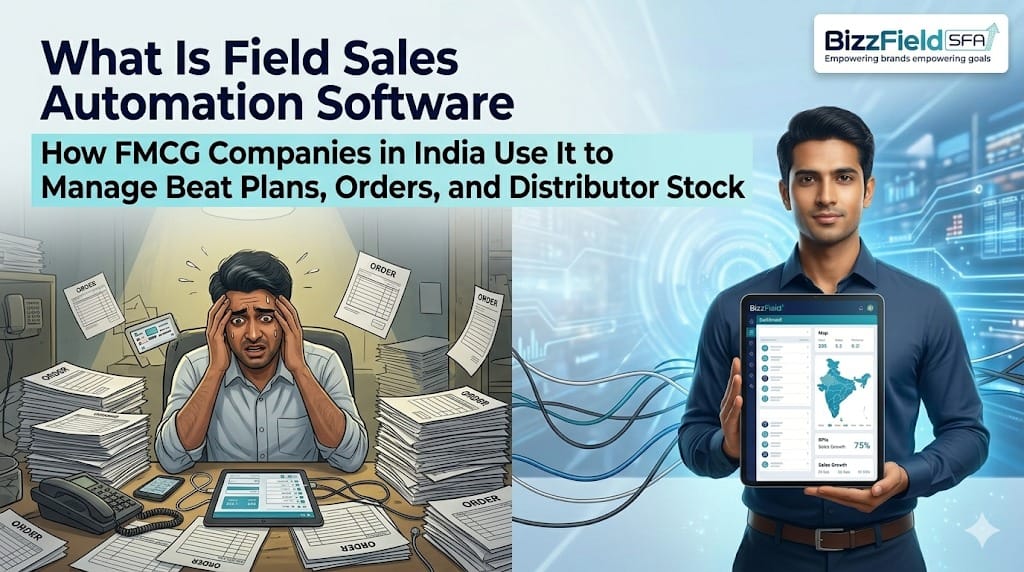
If you manage a field sales team for an FMCG company in India, you are likely handling one of the most operationally complex sales structures in any industry — multiple distributor tiers, hundreds of stockist outlets, daily beat routes across territories, and a reporting chain that runs from the rep on the ground to the NSM at the top.
Field sales automation software is the technology that makes this entire structure visible, measurable, and manageable — from a single dashboard, in real time, without Friday Excel reports.
This guide explains what field sales automation software does, how FMCG companies in India use it, and what to look for before choosing a platform for your team.
1. What Is Field Sales Automation Software?
Field sales automation software is a mobile-first platform that digitises the daily activities of field sales representatives — replacing manual processes like paper beat sheets, WhatsApp order messages, and hand-filled DCR forms with a structured, real-time system.
In practice, it means a field rep opens an app on their phone at the start of the day, checks their assigned beat, visits outlets in sequence, logs each visit with GPS verification, books orders directly through the app, and files their daily activity report automatically — all before returning home.
For managers and NSMs, it means a live dashboard that shows, throughout the day, which reps are on route, which outlets have been covered, what orders have been placed, and where the gaps are — without waiting for any report.
📌 Key Distinction
Field sales automation software is not a CRM. CRM manages customer relationships and sales pipelines. Field sales automation manages what happens on the ground — physical visits, outlet coverage, order booking, beat adherence, and distributor stock. In FMCG, the revenue is made in the field. That is where the software needs to operate.
2. The 5 Core Functions — What It Actually Does on the Ground
The simplest way to understand field sales management software is not through features — it is through the problems each function eliminates.
Beat Planning and Route Management
A beat plan is a structured schedule of outlets a field rep must visit — which stockists, in what sequence, on which days. Without software, beat plans live on WhatsApp groups or printed sheets. With field sales management software, each rep receives their daily beat on the app, with outlet addresses, visit history, and order targets built in. Managers see the planned route before the day starts.
GPS-Verified Outlet Check-ins
Every visit is geo-stamped at the point of check-in — the rep taps 'check in' at the outlet and the system records their GPS coordinates and timestamp. This creates a verifiable record of every visit without requiring manual reporting or manager supervision.
Digital Order Booking
Reps book stockist orders directly from the app — selecting SKUs from a live catalogue, applying active schemes, and submitting the order to the distributor system in real time. The order arrives instantly and accurately, without passing through WhatsApp or a phone call.
Daily Activity Reporting (DCR)
Call reports, visit notes, and activity summaries are captured at the outlet — not reconstructed at home. This improves accuracy, saves time, and gives NSMs real-time activity data rather than a delayed summary.
Manager and NSM Dashboard
The NSM sees a live sales monitoring view — visits completed, orders booked, beat adherence, fill rate, and secondary sales — updated throughout the day. Territory-level and rep-level comparisons are available without pulling any manual report.
3. Why FMCG Companies in India Need SFA Specifically
FMCG distribution in India operates through multiple tiers — C&F agents, super stockists, distributors, stockists, and retailers — with field reps touching the lowest two layers daily. This creates a data gap that does not exist in most other industries: the most important sales activity (stockist-level sell-out) happens at the furthest point from the company.
Field sales automation software bridges this gap by connecting the field rep's daily activity directly to the distributor's inventory system — creating a continuous data flow from the outlet floor to the NSM dashboard.
For FMCG companies managing 20 to 200 field reps across multiple territories, this connection is not optional — it is the operational foundation that makes the difference between reactive management (responding to problems after they occur) and proactive management (preventing problems before they affect revenue).
✅ What Changes When FMCG Companies Deploy Field Sales Software
Before: Beat plan on WhatsApp. Order on WhatsApp. DCR in Excel. NSM reviews Friday summary. After: Beat on app. Order on app. DCR auto-filed. NSM dashboard live by 8am. The entire reporting cycle compresses from 5 days to 5 hours.
4. Beat Planning: The Feature FMCG Teams Use Most
Of all the features in a FMCG SFA app, beat planning is typically the one that delivers the fastest visible improvement. Here is why.
A field rep's beat plan defines their entire working week — which outlets to visit, in what frequency, and in what sequence. When beat plans are managed manually, two things happen consistently: reps visit familiar, easy-to-reach outlets more often than difficult ones, and managers have no way to know when the plan is not being followed until it shows up in a coverage gap.
With automated beat planning, every deviation is visible the same day. An ASM can see, at 11am on Tuesday, that a rep skipped three high-priority stockists and reallocate the visits before the day ends. The correction happens in real time, not at the monthly review.
5. Order Booking and Secondary Sales — Two Problems Solved Together
One of the most significant advantages of field sales automation software for FMCG companies is that order booking and secondary sales visibility are solved simultaneously.
When a field rep books a stockist order through the app, that order feeds directly into the distributor's inventory system. Stock levels update in real time. The NSM can see, at any point during the day, which distributors are running low on which SKUs — before a stock-out occurs, not after a complaint arrives.
This is the transition from reactive supply chain management to proactive supply chain management — and it happens as a natural by-product of digital order booking, not as a separate system or integration.
The key requirement is that the SFA platform includes a Distributor Management System (DMS) natively — not as a third-party add-on. When SFA and DMS are separate tools, the data connection is always imperfect. When they are built together, field rep activity and distributor stock are part of the same real-time data flow.
See how Bizzfield's distribution management system for FMCG works →
6. What to Look for When Choosing FMCG Field Sales Software
Not every field sales automation platform is built for FMCG in India. Five criteria that matter specifically for the Indian FMCG context:
| Criteria | What to Look For |
|---|---|
| Beat plan configuration | Stockist tiers, C&F agent integration, and distributor hierarchy that match your actual operation — not a generic template. |
| Offline functionality | Must work fully offline for Tier 2 and Tier 3 territories (UP, MP, Rajasthan, Gujarat) and sync when connectivity returns. |
| SFA + DMS in one platform | If the SFA has no distributor module, secondary sales remain invisible. Both need to be natively integrated. |
| Intuitive interface | An app that requires a week of training will not be adopted. Field reps need to be productive from day one. |
| Pricing for your team size | Look for per-user pricing structured for 20–200 rep teams, not enterprise platforms priced for companies 10x your size. |
💡 The Right Question to Ask Before Choosing
"Does this platform understand what a beat plan is? Does it have a DMS module? Has it been deployed for FMCG field teams in India?" If the answer to any of these is no — keep looking.
Book a Free 15-Min Demo — See FMCG Field Sales Automation Live
· No commitment. Live product in 15 minutes.
Shivam Gupta
Brand Manager with 8+ years of experience in building brands, developing growth strategies, and creating impactful marketing campaigns that drive business success.
Frequently asked questions
Field sales automation software for FMCG companies is a mobile platform that manages and digitises field rep activity — beat planning, GPS-verified outlet visits, digital order booking, scheme execution, and real-time reporting — giving NSMs live visibility into what is happening on the ground without manual Excel reports.
By replacing WhatsApp and verbal order booking with a digital catalogue-based order entry system that validates SKUs, quantities, and scheme eligibility at the point of booking. Orders reach the distributor system instantly and accurately — eliminating the transcription errors and delays that manual relay creates.
The best platforms are built offline-first — field reps complete visits, book orders, and file activity reports without a data connection. All data syncs automatically when connectivity is restored. This is essential for FMCG field teams operating in Tier 2 and Tier 3 markets across India.
No. A CRM manages customer relationships and sales pipelines, while field sales automation manages what happens physically on the ground — outlet visits, beat coverage, order booking, and distributor stock — which is where FMCG revenue is actually made.
WRITTEN BY
Shivam Gupta
Brand Manager
Brand Manager with 8+ years of experience in building brands, developing growth strategies, and creating impactful marketing campaigns that drive business success.
Connect on LinkedIn