
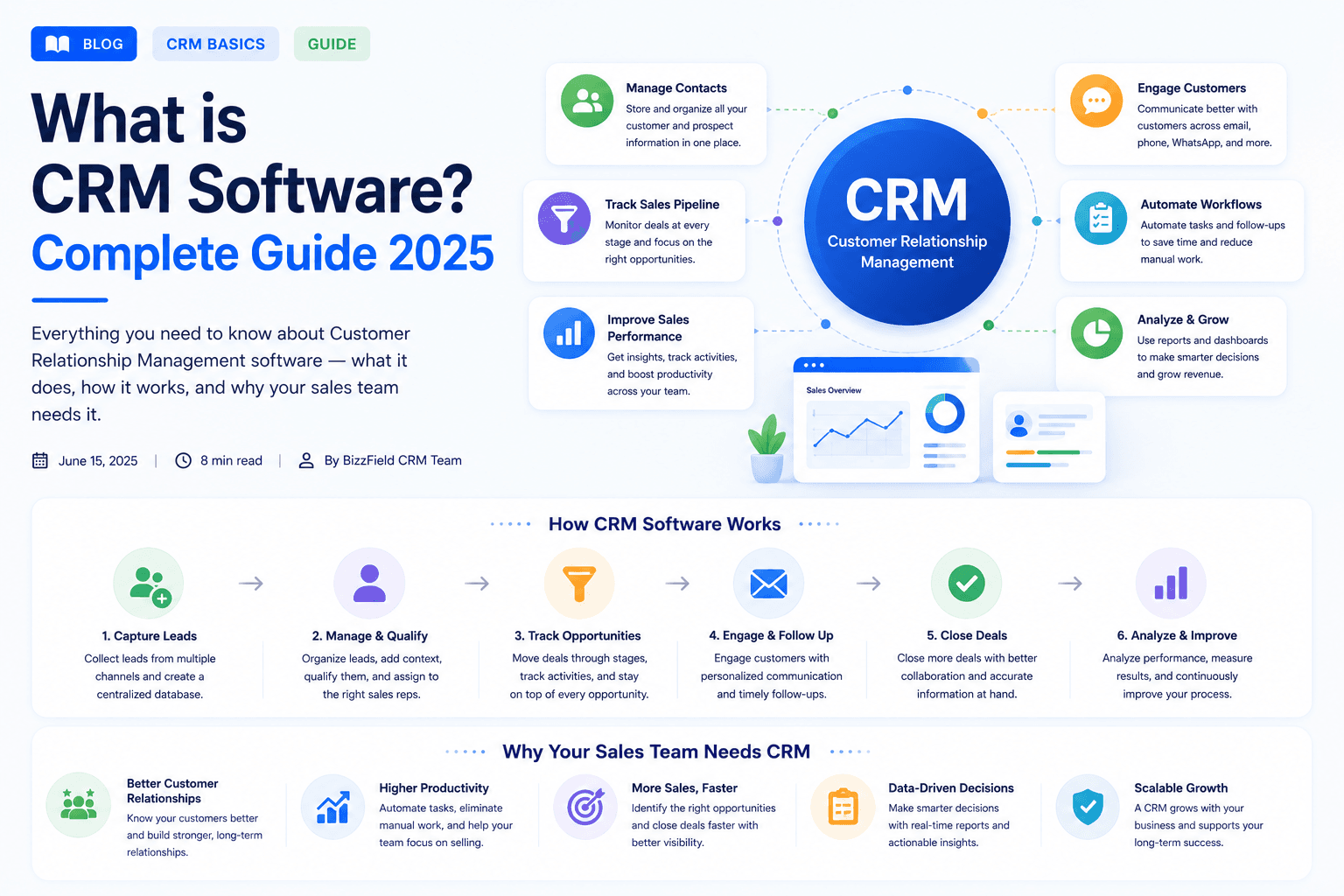
Ask ten growing sales teams where their customer information lives and you'll get ten different answers — an inbox here, a spreadsheet there, a rep's memory somewhere in between. That fragmentation is the exact operational bottleneck a modern Customer Relationship Management (CRM) system is engineered to solve.
This definitive 2026 guide walks through what CRM software actually is, why spreadsheets fail as sales teams scale, the foundational data architecture every CRM relies on, how different CRM types operate, and how Indian B2B & enterprise organizations evaluate CRM platforms for maximum adoption and measurable revenue growth.
Direct Answer (AEO): What Is CRM Software?
Customer Relationship Management (CRM) software is a centralized digital system that aggregates, automates, and tracks all interactions between a business and its prospects, leads, and existing customers across the entire lifecycle — from initial inquiry and quotation to deal closing, invoicing, and account expansion.
1. What Is CRM Software & How Does It Work?
At its core, CRM software provides sales, marketing, and customer support teams with a unified database of customer intelligence. Instead of valuable deal history being trapped in personal email threads or local spreadsheets, every communication, document, meeting note, quote, and payment status is attached to a shared, role-protected customer record.
A modern CRM system answers four fundamental operational questions at any moment:
- Who are we engaging with? (Complete contact history, company profile, and communication logs)
- What deal is currently in motion? (Pipeline stage, deal size, key decision-makers, and win probability)
- What is the next action required? (Automated tasks, follow-up reminders, and quote submissions)
- What is the financial health of the account? (Historical quotations, confirmed orders, and outstanding invoices)
2. The 4 Main Types of CRM Architecture
Not all CRM systems serve the same operational objective. Understanding the four core CRM categories ensures you select a platform aligned with your business model:
- Operational CRM: Focuses on automating customer-facing workflows — lead capture, pipeline tracking, quote-to-invoice processing, and automated follow-ups. (Example: BizzField CRM)
- Analytical CRM: Analyzes raw customer data to identify buying patterns, customer churn risk, and revenue trends across customer segments.
- Collaborative CRM: Bridges internal departments (Sales, Accounts, Support, and Logistics) so all teams share the same real-time customer data without friction.
- Strategic CRM: Concentrates on long-term customer relationship building and lifetime value (LTV) maximization.
3. Why Spreadsheets Break Down as Teams Scale
A spreadsheet works adequately for five leads a week. It breaks down completely at fifty. As soon as multiple sales representatives touch the same sheet, critical operational failures emerge:
- Data Overwriting & Duplication: Multiple reps editing the same sheet cause conflicting versions, lost phone numbers, and duplicate outreach.
- Zero Activity Timeline: Spreadsheets display static text; they cannot show who called a prospect last Tuesday, what objections were raised, or when the next demo is scheduled.
- Lack of Lead Ownership & Routing: Unassigned rows lead to missed follow-ups and uncontacted inbound leads.
- Security & Data Theft Risks: Downloading a master CSV file takes seconds. Spreadsheets lack granular field-level access control.
Comparison: Spreadsheets vs. Dedicated CRM
| Feature / Metric | Spreadsheets (Excel/Sheets) | BizzField CRM |
|---|---|---|
| Lead Management | Manual text rows | Automated capture & status pipeline |
| Pipeline Visibility | Static text lists | Drag-and-drop Visual Kanban Board |
| Commercial Flow | Disconnected files | 1-Click Quotation → Order → Invoice |
| Data Security | Exportable by anyone | Role-based access & audit trails |
| Follow-up SLA | Unmonitored | Automated reminders & activity logs |
4. The Core Data Building Blocks of a Modern CRM
High-velocity sales systems are structured on four interconnected entity types that map directly to the customer journey:
- Leads: Unqualified inquiries or raw prospects gathered from website forms, trade shows, cold outreach, or WhatsApp queries. Structured lead management ensures every lead is qualified before passing to sales.
- Contacts: Individual people associated with accounts (e.g., Procurement Managers, VPs of Sales, Finance Heads) complete with phone numbers, direct emails, and communication logs.
- Accounts: Company entities representing B2B client organizations. Multiple contacts, locations, orders, and invoices link under a single Account record.
- Opportunities: Qualified, active commercial deals with assigned deal values, win probability percentages, expected closing dates, and pipeline stages managed via a Kanban CRM pipeline.
5. The Quote-to-Cash Workflow in Indian B2B Sales
In Indian B2B trade, a CRM cannot stop at deal tracking. Indian businesses require a seamless transition from deal qualification to legal documentation and billing:
- Lead Qualification: Incoming leads are assigned ratings (Hot/Warm/Cold) and assigned to sales representatives based on territory or product line.
- Pipeline Stage Movement:Reps move deals through visual Kanban stages (Discovery → Proposal → Negotiation → Won).
- Instant Quotation Generation: Reps generate professional GST-compliant quotations directly inside the CRM, attaching itemized product pricing and payment terms.
- Order & Invoice Conversion: When a deal is won, the CRM converts the quote into an official Sales Order and Invoice in one click, eliminating billing errors.
6. How to Evaluate & Select the Right CRM in 2026
The biggest mistake companies make is buying software based on vanity feature count. A system with 300 unused features creates employee resistance and wasted expenditure. When evaluating CRM platforms, prioritize:
- Speed of Adoption: Can your sales reps learn the core workflow in under 30 minutes?
- Role-Based Permissions: Can you restrict rep access to their own leads while giving regional managers full territory visibility?
- Built-In Reporting: Does the CRM include actionable sales reports and analytics dashboards without requiring complex SQL queries?
- Seamless ERP & Communication Integrations: Does it connect effortlessly with your WhatsApp, email, and accounting systems? Explore our CRM Integrations Hub to see supported connections.
Why BizzField CRM?
BizzField CRM gives growing B2B companies a powerful, independent sales engine: lead-to-invoice workflows, drag-and-drop Kanban pipelines, GST-ready quotations, and 14 built-in analytics reports. No bloat, no complex setup — just measurable sales growth.
Explore More BizzField CRM Resources
Frequently asked questions
CRM stands for Customer Relationship Management. It is software that gives a sales team one shared place to track every lead, contact, account, and deal, instead of that information living across an inbox, a spreadsheet, and someone's memory.
Most CRMs are built around four record types — Leads (unqualified prospects), Contacts (people), Accounts (companies), and Opportunities (qualified, in-progress deals with a value and a close date). Converting a lead creates the linked contact, account, and opportunity in one step.
A spreadsheet works for a handful of leads but breaks down at scale — duplicate entries, stale statuses, and no record of who last spoke to a customer. A CRM adds structure like Lead Status, Rating, and an owner to every record, plus a timeline of the tasks logged against it.
Match the tool to how your team actually works rather than the feature count. Look for a clear pipeline view, permission controls that fit your org structure, reports you would open every week, and a setup process measured in hours, not months.
WRITTEN BY
BizzField CRM Team
Customer Relationship Management
The BizzField CRM team covers pipelines, lead management and getting more out of a CRM built for Indian sales teams.
Connect on LinkedIn