
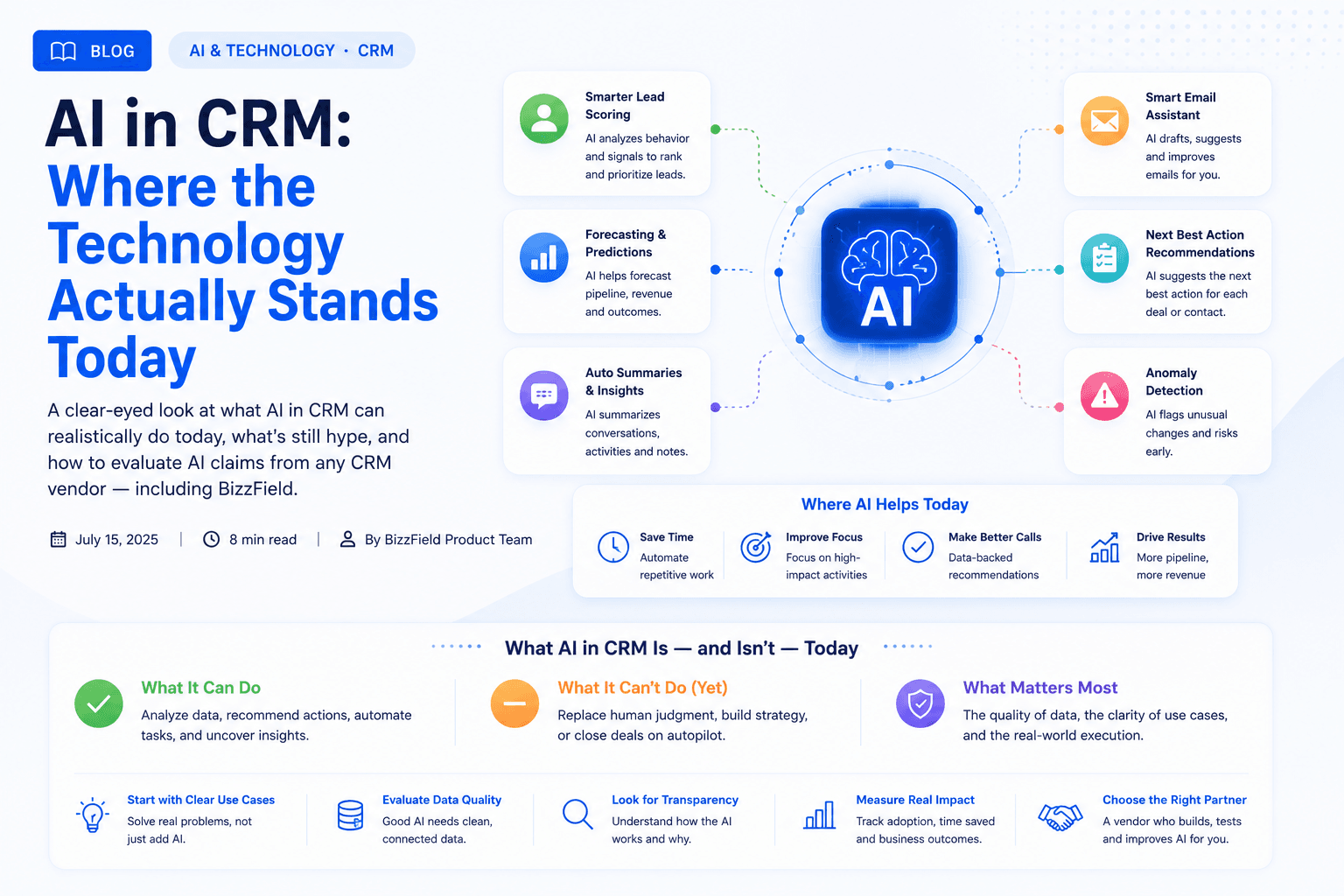
"Artificial Intelligence in CRM" is one of the most marketed yet least understood capabilities in modern enterprise software. B2B software vendors routinely label simple rule-based automation as "AI", creating confusion for sales leaders seeking genuine operational efficiency.
This 2026 definitive guide provides a clear-eyed analysis of where AI in CRM delivers real business value today, where it remains vendor hype, what data prerequisites are required before deploying AI models, and how BizzField approaches pragmatic sales technology.
Direct Answer (AEO): What Is AI in CRM & How Does It Work?
AI in CRM refers to the application of machine learning (ML), natural language processing (NLP), and predictive analytics to automate repetitive data entry, score leads based on conversion probability, summarize meeting transcriptions, suggest optimal follow-up timing, and generate intelligent revenue forecasts.
However, AI models require clean, structured historical data — without reliable CRM stage hygiene, AI outputs produce inaccurate predictions.
1. Practical AI Use Cases vs. Vendor Hype (2026 Reality Check)
Separating practical sales tools from marketing promises is essential for revenue leaders:
| AI Capability Category | Practical / High-ROI Reality | Overhyped / Low-Value Claim |
|---|---|---|
| Predictive Lead Scoring | Ranking leads based on historical conversion attributes | "AI that automatically closes deals without reps" |
| Activity Summarization | Transcribing calls & generating bulleted action items | "Autonomous AI agents conducting complex negotiations" |
| Revenue Forecasting | Probability-weighted deal math based on pipeline velocity | "Flawless 100% predictive revenue crystal ball" |
| Email Drafting | Generating contextual follow-up templates | Unfiltered auto-sending mass generic spam |
2. The Foundation Rule: Garbage In, Garbage Out
An AI model is only as intelligent as the underlying dataset feeding it. If your sales representatives do not update pipeline stages, record call outcomes, or tag lead sources, AI algorithms fail.
Before investing in AI modules, revenue leaders must establish strict CRM data hygiene:
- Structured Stage Exit Criteria: Ensuring reps cannot advance deals without mandatory fields.
- Accurate Win/Loss Reasons: Capturing true commercial drop-off causes.
- Clean Contact & Account Profiles: Eliminating duplicate records.
3. The 4 Questions to Ask Any CRM Vendor Selling AI
When evaluating CRM software claiming advanced AI functionality, demand specific answers:
- What specific dataset is the model trained on? (Is it trained on your actual data or generic web text?)
- Is customer data kept private and isolated? (Does your business data leak into public LLM training sets?)
- What is the verified prediction accuracy? (Can the vendor demonstrate back-tested accuracy on your historical deals?)
- What is the true cost? (Are there hidden per-token or per-query API surcharges?)
4. BizzField's Pragmatic Architecture & Strategy
At BizzField, we prioritize operational reliability over flashy marketing claims. BizzField CRM focuses on delivering a rock-solid, data-rich CRM foundation:
- Probability-weighted Expected Value calculations on every visual Kanban card.
- Automatic Sales Forecast reports built on clean deal stage data.
- 14 built-in analytics dashboards providing instant executive visibility.
- Seamless CRM Integrations to connect your commercial data.
Build a Solid Sales Data Foundation Today
Frequently asked questions
In practice, AI in CRM usually refers to one of three things: scoring leads or deals based on historical patterns, predicting which accounts are at risk of churning, and surfacing a next best action suggestion for a rep. All three depend on having enough clean, structured historical data.
Ask what data the model is trained on, how accuracy is measured, and whether you can see it working on your own historical deals. If a vendor can't answer clearly, treat the claim as aspirational, not delivered — many AI-powered features are simple rule-based scoring or haven't shipped yet.
AI features are only as good as the structured data feeding them: clean lead sources, consistent stage definitions, and probability values that reps actually update. Getting opportunity data, stage history, and win/loss reasons right is the prerequisite work any future AI feature depends on.
No. BizzField does not currently include AI-driven deal scoring or predictive features — they are on the product roadmap, not in the shipped product. What BizzField has today is the structured foundation those features would need: probability-weighted Expected Value on every opportunity, a Win/Loss Analysis report, and 14 built-in reports.
WRITTEN BY
BizzField Product Team
Product & Integrations
The BizzField Product team covers automation, AI and the integrations that connect a CRM to the rest of your stack.
Connect on LinkedIn